
Essays · Contemporary Art
Danh Vo. We The People.
A great symbol made of a very thin skin.
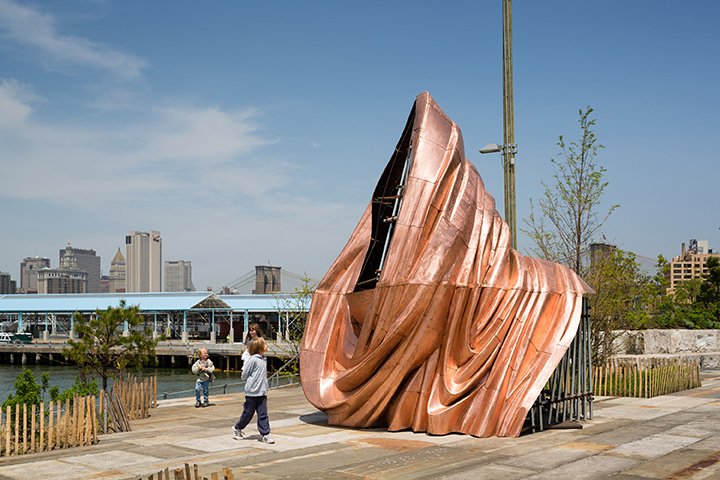
Photo: James Ewing; courtesy Public Art Fund · Public Art Fund
A monument taken apart
The Statue of Liberty in New York Harbour is one of the most familiar images in the world. People tend to think of it as massive and solid. In fact, outside its steel frame, it is only a skin of hammered copper, surprisingly thin.
In 2010, Danh Vo began remaking that skin at one to one scale. He hired a workshop in Shanghai and used the same repoussé technique as the original: hammering the metal from behind to raise a relief. The copper is about as thick as two coins stacked, roughly two millimetres.
The result is about 250 separate pieces. A fold of drapery. Part of an arm. Other pieces, seen alone, give no clue where on the statue they belong. They are simply curved surfaces of copper. The work is called We The People, the first three words of the preamble to the United States Constitution.
Never assembled
The most important thing about We The People is that it is not meant to become a complete statue. The pieces are shown separately, in different places, held by different collections around the world. They scatter, like people who share one name but live in different countries.
According to Public Art Fund, the project was conceived in Germany, fabricated in Shanghai, supported by a French gallery, then dispersed to museums and collectors in many places. That route is part of the work. An American symbol, remade by an artist living in Europe, by the hands of Chinese workers, then spread across the globe.
Public Art Fund describes it as a metaphor for the circulation of cultural values. No one owns the whole. No one sees the whole at once.
In New York, 2014
From 17 May to 5 December 2014, Public Art Fund brought nearly a fifth of the project to New York itself, the city of the original statue. The pieces stood at two sites: City Hall Park in Manhattan and Brooklyn Bridge Park in Brooklyn.
At Brooklyn Bridge Park, three large sculptures were assembled from 13 pieces, parts of the draped sleeve and the raised right arm. Passers by could walk around them, look inside, and see the rough back of the copper.
From inside, the symbol is no longer a symbol. It is metal, hammer marks, seams. It is at human scale. It can be touched. That is something the real statue, far off and high on its island, does not allow.
An artist who crossed the sea
Danh Vo was born in 1975 in Bà Rịa, Vietnam. In 1979, when he was four, his family left Vietnam in a homemade boat and was rescued at sea by a Danish freighter. They settled in Denmark. He studied at the Royal Danish Academy of Fine Arts in Copenhagen and the Städelschule in Frankfurt.
That story is not written on the work, but it is hard not to think of it. A former refugee remakes the symbol that generations of migrants saw first on arriving in America. And he makes it as loose fragments with no fixed place to stand.
Other artists of Vietnamese origin have also looked at America through the images it makes of itself, such as Dinh Q. Lê in From Vietnam to Hollywood. For Danh Vo, the question lies in the material itself: is freedom a solid mass, or a thin skin that we must look after together?
Contemporary Art