
Essays · Olfactory Art
Elaine Cameron-Weir. Who you are what looks out from behind you are is the thing that names what transforms…now, look what calms the captive by letting him sniff the perfume, like smell what smells like your masters crotch.
A warm smell is the trace of an absent body.
A title as long as a line of dialogue
The work has an unusually long title, almost a monologue: Who you are what looks out from behind you are is the thing that names what transforms…now, look what calms the captive by letting him sniff the perfume, like smell what smells like your masters crotch. The words stumble, repeat, turn midway. And they end on a blunt image: a captive calmed by being allowed to smell something, the smell of the master.
It was shown in Elaine Cameron-Weir's solo exhibition at Hannah Hoffman, Los Angeles, from 17 September to 22 November 2017. ArtReview's December review, by Lindsay Preston Zappas, named the themes that ran through the show: suspension, bondage, capture and delight.
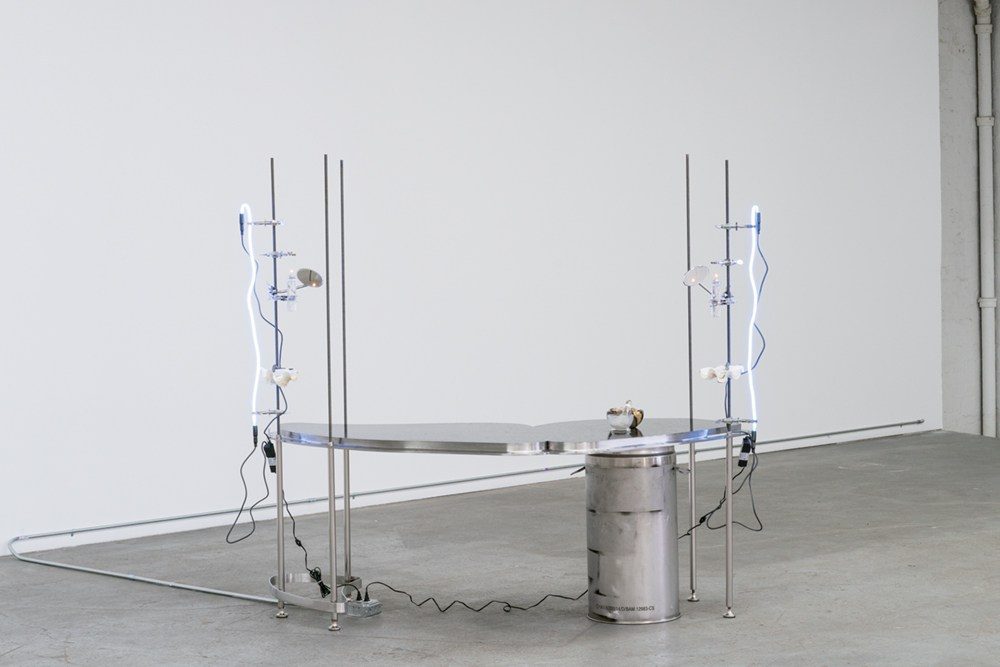
The object is simpler than its name. A lump of labdanum resin warmed on a laboratory heating mantle. Nearby, a piece of leather moulded into a shape that recalls Zorro's mask. The resin warms and gives off its smell. The mask covers no face.
Labdanum, a smell of skin
Labdanum is a resin taken from rockrose, a shrub of the Mediterranean. It is dark and sticky. Its smell is warm, slightly sweet, part leather, part skin at the end of a long day. Perfumers use it to give a sense of warmth and closeness.
Cool, the resin barely moves and its smell escapes slowly. Warmed, it softens and the smell spreads. Cameron-Weir's heater does exactly this: it holds the resin at just the temperature that keeps the smell coming. Like a body kept warm, not allowed to cool.
Setting labdanum beside a leather mask is not chance. The resin and tanned leather smell alike. The eye sees leather. The nose smells something like leather. Each sense confirms the other, and that confirmation makes the room feel occupied.
Bodies that are not there
The whole show was built around absent bodies. In dressing for altitude, chainmail hung from the ceiling with pewter body parts and leather harnessing. In wave form walks the earth, pewter feet hung from a treated leather harness. FOR MAKE ADMIT THIS VOIDE was a rubber jacket with leather straps, steel surgical hardware and raw amber. Two wall works used parachute silk, stainless steel and leather. The review also mentions Second World War oxygen masks and aged leather.
Harnesses, chains, masks, straps. These are things for holding a body, lifting it to altitude, tying it down. But the body is missing. Only what once held it remains.
Among these objects, the labdanum piece is the only one with warmth. The others show us the shape of a body. The resin lets us sense its temperature and its smell. It is the most intimate part, and the most unsettling.
Scent as a tether
The end of the title speaks of calming a captive with a smell. This is the sharpest point. Scent is usually thought of as free, drifting, impossible to hold. Cameron-Weir shows the other side. A familiar smell can quiet someone, keep them in place, make them yield, with no chain at all.
Desire here is not presented as something lovely. It is bound up with power, with master and captive, with pleasure and restraint together. Smell serves both sides.
Cameron-Weir has made other works with aromatic materials and technical equipment, such as Sentry Tactical Like Prey with Evolutionary Eyes of a Predator on the Wing 2. In Los Angeles in 2017 she kept it small: a resin, a heater, a mask. Visitors walk out with the smell on their clothes. They have been held a little, though no one touched them.
Olfactory Art