
Essays · Olfactory Art
Ernesto Neto. anthropodino.
Scent needs the right distance.
Art in America · Art in America
A canopy in a drill hall
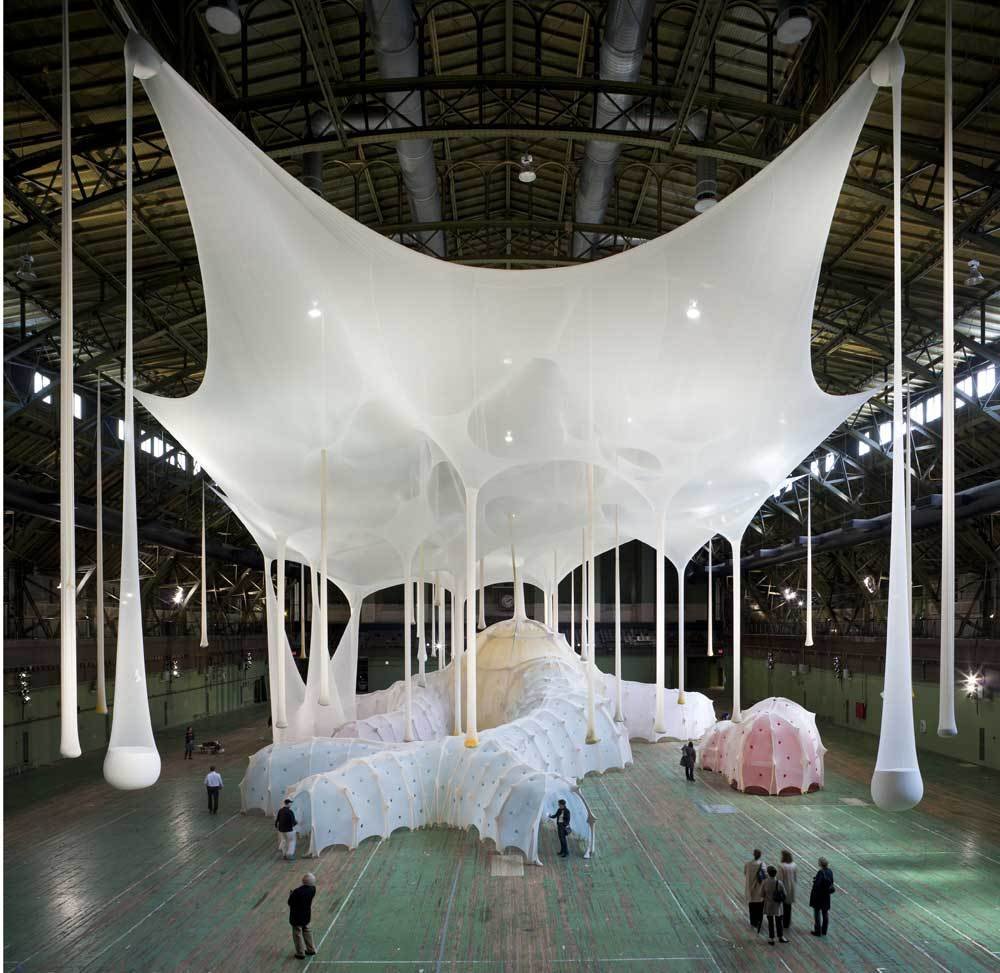
In May 2009, the Park Avenue Armory in New York opened its Wade Thompson Drill Hall to a specially commissioned artwork for the first time. The hall was built for a nineteenth century regiment to drill in. Roughly 55,000 square feet of floor, a ceiling some 80 feet high, and not a single column in the middle.
Ernesto Neto, the Brazilian artist born in Rio de Janeiro, filled that void with anthropodino. The project was organised by Creative Time and curated by Tom Eccles. It opened on 14 May and ran until mid June 2009.
From a distance, anthropodino looked like a sheer canopy stretched below the ceiling, light enough to seem afloat. Up close, the canopy rested on a wooden framework with Lycra tulle sewn onto each beam. Long fabric tubes hung down like stalactites, each ending in a heavy pouch. Inside the pouches were spices: cloves, cumin, ginger, turmeric, black pepper.
Below, the frame formed tunnel-like passages and small chambers where visitors could crawl in, sit or lie down. There were no signs forbidding touch. Neto asked people to touch.
The body enters the work
Neto belongs to a generation of Brazilian artists shaped by Lygia Clark and Hélio Oiticica, who from the 1960s insisted that art be held, worn, entered. For them the viewer did not stand outside an object. The viewer was part of the work, and the work was complete only with a body inside it.
anthropodino follows that line. The Lycra stretched under the weight of spice, of hands pulling down, of people lying in the chambers. Its shape never held still. It swelled, sagged and gave way with each person who passed.
The title has been explained as a fusion of anthropology and dinosaur: a giant creature that people walk inside. Moving under the canopy did feel like being inside a body, with its tubes, pouches and thin membranes. In an interview Neto said the piece was about comfort and affection rather than desire.
The spices drew the body in further. The eyes found the shape. The hands found the tension. The nose had to search on its own.
A hall too large for scent
The Art in America critic noted something few others did: in a hall that size, the spice smell dispersed quickly. The pouches of clove, turmeric and pepper were strong up close, but a few steps away the air of the hall had swallowed them.
This is not simply a technical failure. Scent is matter. It evaporates from a source, spreads, and thins with volume. A small room can fill with smell. A drill hall cannot. To fill it, one would have to spray synthetic scent, and the spice pouches would become props.
Neto did not do that. He left real spice in real cloth and accepted that its smell would travel only so far. The result worked at two scales at once. From afar it was architecture. To smell it, you had to be an arm's length away.
Spice as sculptural material
Before anthropodino, Neto had used spice in other works, taut fabric sacks hanging from ceilings, powders on the floor. For him spice is colour, weight and smell at once. A bag of turmeric is bright, heavy and fragrant. One material doing three jobs.
Sculpture usually works otherwise. Stone and bronze are mute to the nose. Spice is not. It changes with time, strong at first, softer over the weeks. A work made of spice is never the same on opening day and closing day.
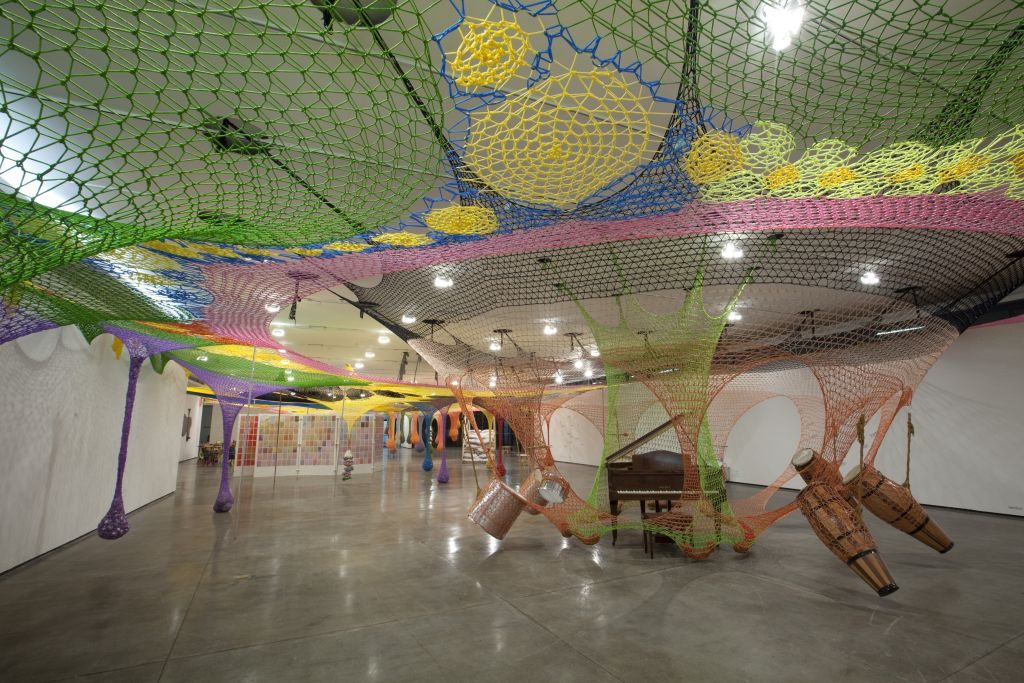
Neto later went further with large hand-crocheted structures such as GaiaMotherTree in Zurich's main station in 2018, where scent and ritual take more room; see the essay on GaiaMotherTree. But anthropodino remains a landmark: the first time an old Manhattan drill hall was used to ask how far the smell of a bag of spice can reach.

Olfactory Art