
Essays · Olfactory Art
Flying Object. Tate Sensorium.
Each scent is a reading of the painting, not the painting.
Tate · Tate
A dark room at Tate Britain
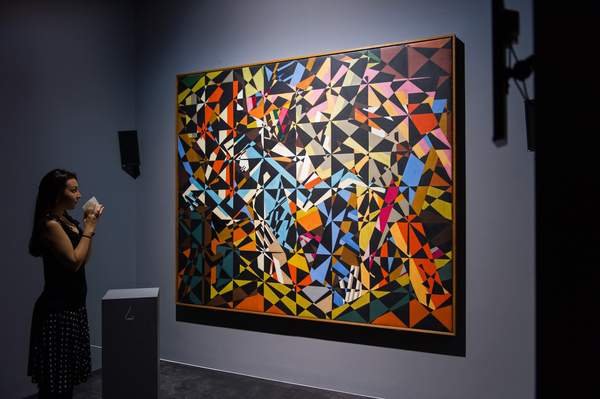
In the summer of 2015, gallery 34 at Tate Britain in London became a dark, closed space. From 26 August to 4 October, visitors entered in small groups to see four paintings from the museum's collection. But they did not only look. They listened, smelled, tasted, and felt something touch their hand when nothing was there.
The project was called Tate Sensorium. It won that year's IK Prize, a Tate award for ideas that use technology to bring people closer to the collection, supported by the Porter Foundation.
It was made by Flying Object, a creative studio. Around them stood a team of specialists, one for each sense. Nick Ryan handled sound. Odette Toilette, who works with smell, handled scent. Paul A Young, a chocolatier, handled taste. Annette Mees, an interactive theatre maker, and Cis O'Boyle, a lighting designer, built the space. The SCHI Lab at the University of Sussex, led by Dr Marianna Obrist, brought touch.
There was a good deal of technology. Binaural and directional audio created a sense of space. A perfume release system delivered smell at the right place and time. A device using ultrasound produced touch sensations on the hand through the air. And each visitor wore a wristband measuring the electrical response of the skin, recording how their body reacted to each painting.
Four paintings, four ways to smell
The first painting was Francis Bacon's Figure in a Landscape, from 1945. A blurred figure, a stretch of grass, an empty scene. Tate Sensorium set beside it the smell of grass and earth, with the sound of machines and the city. Visitors also tasted a chocolate that looked ordinary but held charcoal, sea salt, cacao nibs and Lapsang Souchong tea. Bitter, salty, smoky.
The second was David Bomberg's In the Hold, painted around 1913 to 1914 and inspired by dockers working in the hold of a ship. The picture is nearly abstract, broken into geometric shards. The project added the noise of a dockyard before the First World War and the smell of paint.
The third was Richard Hamilton's Interior II, 1964. A clean, flat, cool interior. The sound was footsteps alternating with the rustle of paper. The smell was hairspray, solvent and furniture polish. The smells of a house tidied every day, over and over.
The fourth was John Latham's Full Stop, 1961, a large black circle made with spray paint. Here the main sense was touch. Sound came with the ultrasound device, so visitors felt on their hand something like falling paint, though nothing touched them.
Interpretation, not reconstruction
It should be said plainly: none of these smells is the real smell of the painting. Bacon did not paint in a meadow with chocolate in his pocket. Hamilton left no can of hairspray behind. The smells are a reading by people living decades after them.
That is why Tate Sensorium is interesting: it exposes interpretation. A wall label beside a painting is interpretation too, but text looks neutral. Smell never looks neutral. When visitors smell hairspray in front of Interior II, they know at once that someone chose it, and they may agree or not.
The skin response wristband adds another layer. The museum does not only ask what you think of the painting. It records what your body does in front of it. The visitor becomes part of the data.
Adding smell to an image is not a new idea. In the 1960s, Morton Heilig's Sensorama already tried to let film viewers smell the scene on screen. Tate Sensorium brought that question into a museum of painting, where the image is usually thought to be enough. It does not answer that the image is lacking. It only shows that every viewer always brings a nose, ears and tongue to a painting, whether the museum mentions it or not.
Olfactory Art