
Essays · Olfactory Art
Alexander Scriabin. Mysterium.
A work that exists only in sketches and imagined smoke.
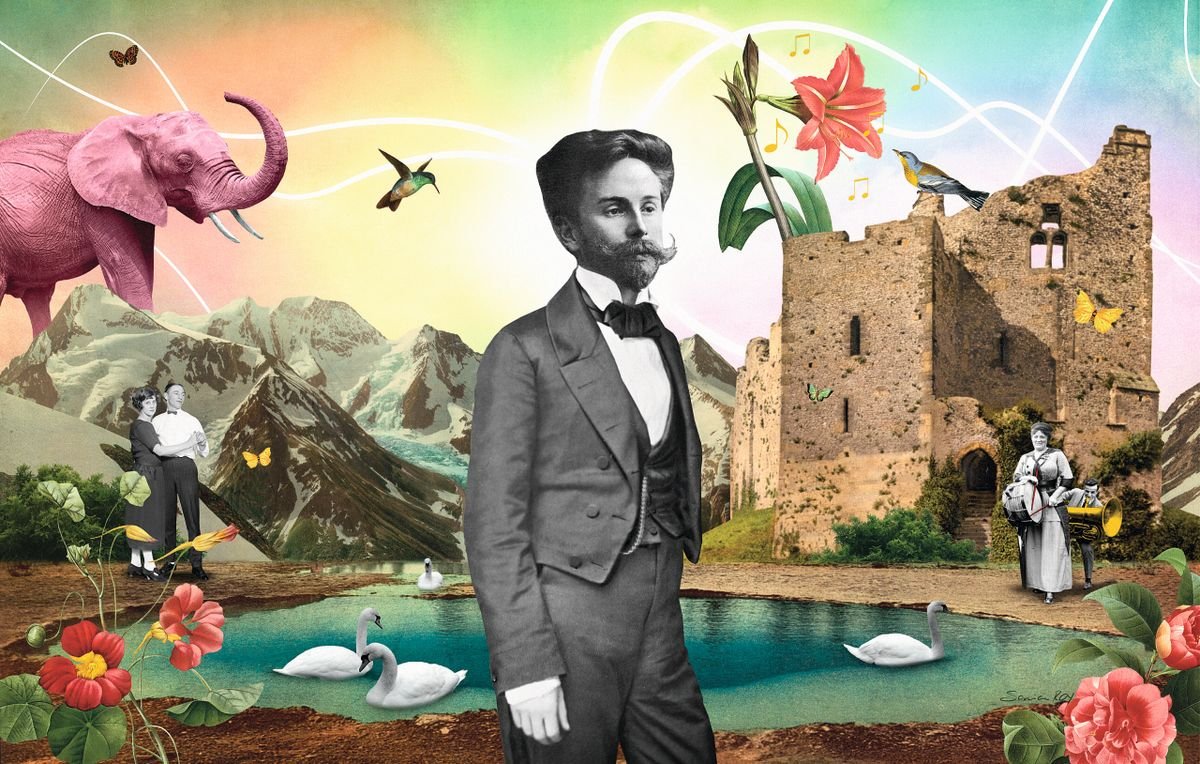
Illustration: Sonia Roy / BBC Music Magazine · BBC Music Magazine (classical-music.com)
A work lasting seven days
Alexander Scriabin, the Russian composer and pianist, spent his last years on a project he called Mysterium. From what he left behind, it was to be a work lasting seven days, performed in a purpose built temple in the Himalayan foothills, in India.
Mysterium was not music to sit and listen to. It was an event that would take over every sense. An orchestra. Bells hanging as if from the clouds. Processions moving in rhythm. Fire, smoke, shifting light. And columns of incense, perfumes changing with the music.
Scriabin believed that at the end of those seven days the world as we know it would close, and a new humanity would begin. He took this seriously. The audience would no longer be an audience; everyone would take part.
Sound, colour and smell
The idea of joining the senses did not come to Scriabin suddenly. He linked musical keys with colours and had already tried to bring light into his music. In Prometheus, the Poem of Fire, he wrote a separate part for a keyboard of light, so that colour would change with the harmony. The technology of the time could barely do what he wanted.
Mysterium was the next step, and a much larger one. If light could accompany sound, then smell, touch and movement had to be present too. Music was no longer an art of the ear. It became a frame for everything else.
Within it, smell holds a notable place. Incense is a ritual material in many cultures: it marks a space as sacred, set apart from ordinary space. By placing incense in Mysterium, Scriabin borrowed exactly that function. The smoke announces that something unusual is taking place.
What remains
Scriabin knew Mysterium was too large to make at once. He began with a prelude, the Acte préalable or Prefatory Action, meant to prepare listeners for the main work. He wrote its text and sketched its music.
In April 1915 he died of septicaemia, aged 43. What remained were several dozen pages of fragmentary piano sketches and a single page of orchestration. No temple. No seven days. No scent ever actually chosen.
What stands out is that the part lost most completely is the part that could not be written in notes. Sound left marks on paper. Light, smoke and smell survive only as description.
The composer Alexander Nemtin spent twenty eight years developing those sketches into Preparation for the Final Mystery, a work of about three hours in three parts. In 1996 Vladimir Ashkenazy recorded it. It is the closest one can come to hearing Scriabin's dream, but it is still only sound.
Why an unfinished project still matters
Mysterium is often cited as an example of excessive ambition. But it is also one of the earliest times a composer wrote smell into the plan of a work, on equal terms with sound and light.
Around the same time, in New York, Sadakichi Hartmann had tried a concert made only of smells and was booed off the stage. The two had nothing to do with each other. Yet both thought smell could be arranged like music, with sequence and climax.
Many later multisensory artists achieved a small part of what Scriabin imagined. No one managed seven days. Perhaps no one needs to. Mysterium remains as a question: if a work uses every sense, is the person inside it still an audience?
Olfactory Art