
Essays · Fashion as Design
Gabrielle Chanel. Fashion Manifesto.
A manifesto written in cloth, not in words.
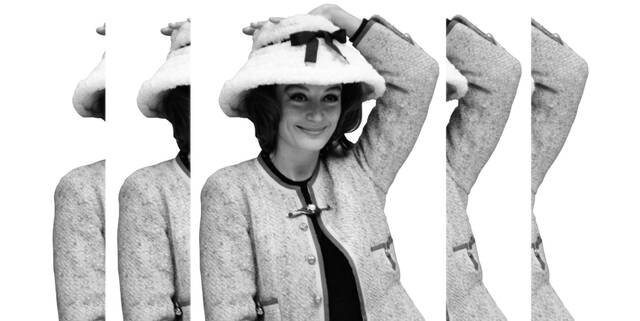
© CHANEL / Photo: Nicholas Alan Cope / Courtesy of Victoria and Albert Museum, London · Victoria and Albert Museum (V&A)
A first in Britain
Gabrielle Chanel. Fashion Manifesto opened at V&A South Kensington on 16 September 2023 and ran until 10 March 2024. The museum presented it as the first UK exhibition dedicated to the work of the French couturière.
It was made with Paris Musées and the Palais Galliera, the fashion museum of the city of Paris, where the project began before travelling to London. More than 200 looks were brought together. Many came from the Patrimoine de CHANEL archive in Paris; others belong to the V&A's own collection.
The aim was stated plainly: to trace the founding of the House of CHANEL and the way her style developed over the decades. Not a biography. A story told through objects.
A photograph from 1937 at 31 rue Cambon, Paris, shows Chanel at her desk, wearing glasses and a large necklace. The address works like an anchor. A place of work. A place where ideas became clothes.
Objects in the room
The earliest piece the V&A names is a marinière blouse from Spring/Summer 1916, cream silk with a V neck. The sailor's top was a working garment. Chanel brought its shape into the wardrobe of city women and kept its looseness and ease of movement.
Then a brown silk hat from 1917, tied with a ribbon. A red fishtail dress from Autumn/Winter 1932. Two dresses from 1935: one burgundy red, belted at the hip, with a white collar; one in white silk organza with a small floral print and puffed sleeves. A trouser suit from 1937 to 1938 in black sequins with ruffled white silk tulle, from the V&A's collection.
There were stage costumes too. In 1924 Chanel dressed the ballet Le Train Bleu in knitted tops and shorts of blue and pink, closer to beachwear than to costume. They make one point: the body needs to move, and clothes should keep up.
Then the tweed suit. A photograph shows the model Marie-Hélène Arnaud in tweed from the Fall/Winter 1959 collection, in Chanel shoes, carrying the 2.55 bag. Nearby, a cream suit from Autumn/Winter 1964, trimmed in navy and pink, with gold buttons. The same shape, season after season, only the trim and the cloth changing.
A scent inside a photograph
Among the clothes hung a photograph taken by Ed Feingersh in New York in 1955: Marilyn Monroe applying Chanel N°5. A couturière named a perfume with a number, just as a bag is named 2.55. No adjective, no evocative image. Only a sign.
Here perfume stands in line with clothes and jewellery. They belong to one system: objects simple in form, clear in use, made for every day. The V&A also filmed close studies, such as a hand sewn tweed suit worn by Lauren Bacall and a sequinned trouser suit worn by Diana Vreeland, so viewers could see the stitching, the lining, how a jacket is built from the inside.
The exhibition chose the word manifesto. Chanel barely needed words. Her manifesto was repetition: black, cream, jersey, tweed, chain, a number on a label. Repeated long enough, these became a language people recognise from across a room, before they can read a name.
What stays with you from Fashion Manifesto is its calm. No stage set swallowed the objects. Each look stood still, close enough to study the seams. Look long enough and it becomes clear that a style does not live in one famous piece. It lives in choosing the same thing, again and again.
Fashion as Design