
Essays · Olfactory Art
Goldie Poblador. The Rise of Medusa.
Fragile does not mean weak.
Artpace San Antonio · Artpace San Antonio
A room the colour of deep water
In autumn 2025, Goldie Poblador travelled to San Antonio, Texas, as the international artist in residence at Artpace. She stayed from late July to mid September. The result was The Rise of Medusa, which opened on 11 September 2025 and runs until 18 January 2026, curated by Regine Basha.
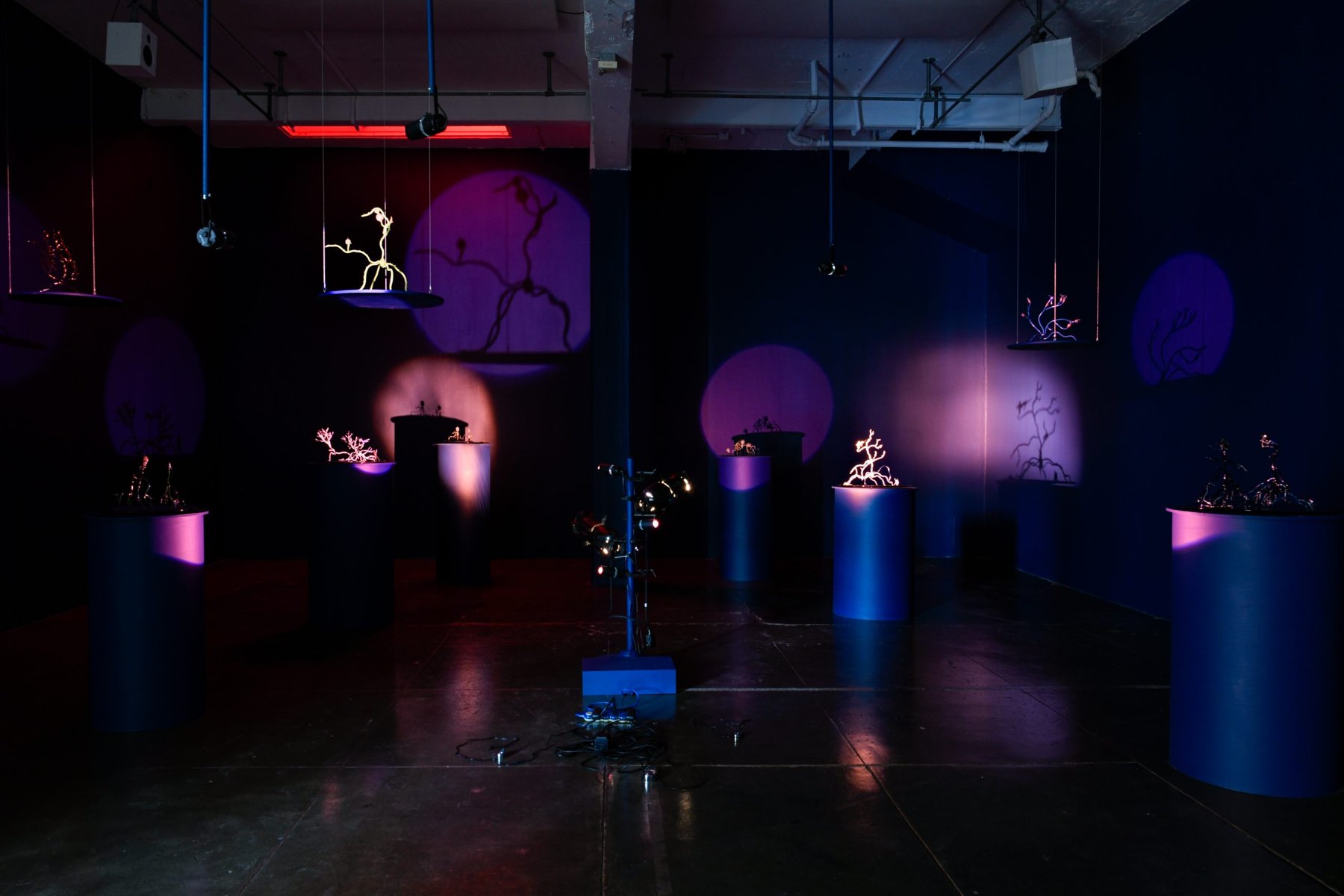
Visitors enter a room painted deep blue, the colour of water at the depth where light begins to fail. Nine glass sculptures hang inside. Their shapes recall jellyfish, coral, creatures without bones. They do not stand on plinths. They float.
Light passes through the glass and throws shadows onto the walls. Small forms made in the artist's hands become large, trembling shapes on the plaster. The viewer stands between the object and its shadow, unsure which is closer.
There is no water in the room. But everything in it is built so that one believes one is underwater.
Glass, sound and three scents
Poblador was born and works in Manila. She earned her MFA at the Rhode Island School of Design in 2015 and is the first Filipino artist collected by the Corning Museum of Glass. Glass is her first language; smell is her second.
The nine sculptures are lampworked: glass melted over a small flame, then pulled, twisted and bent into shape. The technique yields very fine threads and very thin domes. Exactly the material of a jellyfish.
The sound is by composer Ben Richter. According to Artpace, he built it from instruments shaped to accompany the glass forms. So the sound in the room is not background music. It belongs to the hanging objects themselves.
The scents are by M. Dougherty, a perfumer and artist. There are three, following one another through the space. Oil Slick: metallic and acrid, like oil spread on the sea. Dead Coral: mineral and saline, like reef that has bleached and stopped living. Verde: tropical flowers with ylang ylang and elemi resin, two materials tied to Filipino life and heritage.
Medusa, twice
The word Medusa has two meanings, and Poblador uses both.
In biology, the medusa is a stage in a jellyfish's life: the bell shaped, free swimming form we usually picture. Before it, many species live as polyps fixed to the seabed. The medusa is the moment the creature lets go and moves into open water.
In Greek myth, Medusa is a woman turned into a monster, with snakes for hair and a gaze that turns people to stone. The familiar story treats her as a threat to be beheaded. Many contemporary artists and writers read her again as a victim, an image of justified rage.
Put side by side, the two meanings change the title. The Rise of Medusa is the moment the softest creature rises. Not by hardening. By surviving.
A sea with a name
Verde takes its name from the Verde Island Passage, the water between Luzon and Mindoro in the Philippines. Marine biologists count it among the richest places for sea life anywhere. It is also water under pressure from shipping, oil and warming.
The order of the scents matters. Visitors move from oil, through dead coral, and only then to the living green. The work does not hide the damage. Nor does it stop there.
This is not the first time Poblador has used smell to speak of bodies and land. In Fertility Flowers she worked from flowers and fertility. In The Rise of Medusa she goes underwater. The materials hold: glass for looking, scent for remembering.
What stays after leaving the room is not the image. The glass is beautiful, but in a museum way. What follows the visitor out is the mineral salt of dead coral and, just after it, the flowers of a sea that is still there.
Olfactory Art