
Essays · Modern Art
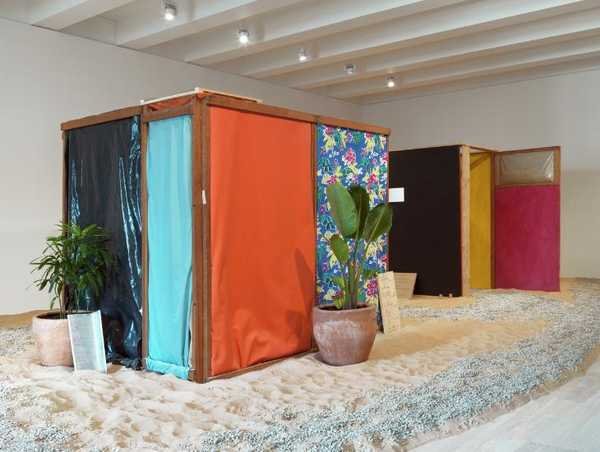
Hélio Oiticica. Tropicália, Penetrables PN 2 'Purity is a myth' and PN 3 'Imagetical'.
Not looked at from outside. Entered, barefoot.
Tate · Tate
A garden to walk into
Tropicália is an environment, not an object on a wall. According to Tate's record, when installed it stretches about twelve metres. Its materials include wooden frames, cotton fabric, plastic sheets, carpet, nylon fabric, patchouli root, cinnamon sticks, sand, plants, metal, terracotta, brick and more.
Visitors step onto a path of sand and gravel, with tropical plants on either side. Along the path stand two structures Oiticica called Penetrables, huts one can pass through. PN 2 is titled Purity is a myth. PN 3 is titled Imagetical.
The huts recall the improvised architecture of the hillside settlements of Rio de Janeiro: wooden frames, fabric walls, narrow winding passages. Inside it grows dark. At the end of PN 3, in the darkness, a television is switched on.
Oiticica made the work in 1966 and 1967. It was first shown in 1967 at the Museum of Modern Art in Rio de Janeiro, in the exhibition Nova Objetividade Brasileira. The original installation also had live parrots.
From viewer to participant
Hélio Oiticica was born in Rio in 1937. In the late 1950s he belonged to Brazil's Neo Concrete group, alongside Lygia Clark and Lygia Pape. The group wanted to pull abstract art off the canvas, into space, and then into the viewer's body.
Oiticica followed that path to its end. He made Parangolés, coloured capes to be worn and danced in. He grew close to the Mangueira samba school, learned to dance there, and found in the hillside neighbourhoods a living architecture, always changing.
Tropicália gathers all of this into a garden. The viewer does not stand outside to look. They take off their shoes, feel sand and gravel underfoot, stoop through fabric, smell root and wood, hear their own steps. The work is only complete when someone passes through it.
The tropical image and the television
The name Tropicália plays with the tropical image the world attached to Brazil: parrots, palms, sand, bright colour. Oiticica rebuilt exactly those images, but set them around the huts of a poor neighbourhood, and ended the path with a television screen.
The television at the end of PN 3 is a cold detail. After sand, plants and the smell of earth, the viewer meets an image emitted by a machine. Tropical nature and modern media stand in the same hut. The title of PN 2 reads like a reminder: there is no pure tropics.
In 1968 the musician Caetano Veloso took the name of the work for one of his songs. From then on Tropicália became the name of a whole movement in late 1960s Brazilian music and culture, mixing folk and electric sound, tradition and the modern.
Oiticica died in 1980. Tate bought Tropicália in 2007, the same year Tate Modern opened a major exhibition of his work, The Body of Colour.
Why it stays
Tropicália shows that a work can be made from very near things: sand, plants, fabric, spice. It does not ask the viewer to understand theory. It asks the viewer to be present with the whole body.
In the same year, 1967, Lygia Clark made Máscaras sensoriais, masks that carried smells. Two friends, two directions: Clark drew the senses close to the face, Oiticica opened them out into a whole garden. Both believed that smell, sound and the ground underfoot are also languages of art.
Modern Art