
Essays · Modern Art
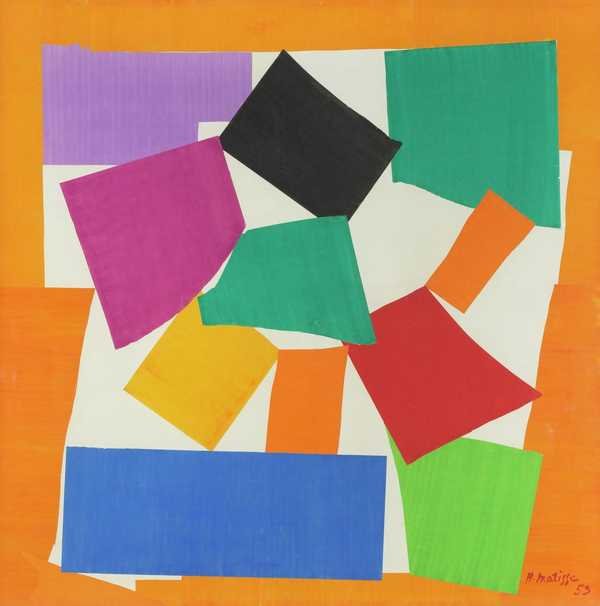
Henri Matisse. The Snail.
Drop the shell, keep the spiral.
Tate · Tate
Drawing straight into colour
After 1948, ill health kept Henri Matisse from standing at the easel. Much of the time he was confined to bed. He stopped painting in oil. Instead he cut or tore shapes from paper already painted with bright gouache. In French they are called gouaches découpées, cut gouaches.
Matisse had tried the technique earlier, in his picture book Jazz, published in 1947. In his last years it became his main path, together with the decoration of the Chapel of the Rosary at Vence.
He explained why quite simply. Cutting paper let him draw in the colour. No longer outline first and then fill with colour, each modifying the other. The scissors went straight into the colour, and the cut was the drawing. For him it was a simplification.
Some of the later cut outs, like The Snail, were very large. This one is nearly 2.9 metres each way, taller than a standing person.
Matisse's secretary, Lydia Delectorskaya, later wrote to Tate describing how the work was made. The Snail was made at the Hôtel Régina in Nice, where Matisse worked in his last years.
Matisse always had at hand sheets of paper painted in gouache by assistants, in every colour he used for cut paper. A white paper ground, in dimensions he specified, was put up on the wall. Matisse cut each piece and passed it to an assistant, indicating exactly where it should go. The assistant pinned it to the ground.
When Matisse judged the composition finished, the pieces were lightly stuck down. The panel was taken down when he needed the wall for the next work. According to Delectorskaya, there were no preparatory drawings for it.
The work was then sent to Lefebvre-Foinet in Paris to be mounted on canvas. Before anything was moved, the whole composition was traced with great precision, so that no piece would shift by even a millimetre.
From a real snail to a spiral
Matisse's daughter, Madame Duthuit, said her father made many drawings of snails at the time, and the idea for the large work grew from them. He told the writer André Verdet that he held the snail between two fingers and drew it again and again, until he became aware of an unrolling.
There is no snail in The Snail. Only patches of colour linked together, curling around a centre like a shell. The shapes in the middle form a concentric pattern that echoes the spiral of the shell.
Matisse set complementary colours side by side: red with green, orange with blue, yellow with mauve. Each makes the other brighter. The result is a vibrating surface, though not a single curve was drawn with a pen.
Delectorskaya wrote that the title comes from the form of the colour patches curling like a snail's shell, and that the spiral of the shell echoes the direction of universal movement. So the work is not abstract at all. But for anyone who wanted to see it as abstract, Matisse had chosen another title: La Composition Chromatique, Chromatic Composition.
The nearest to abstraction
Tate's catalogue calls The Snail one of the most nearly abstract of all Matisse's works. That is striking, since Matisse spent his life with figures, interiors, windows, flowers. In his eighties, from a small slow animal, he came closer than ever to the edge of the figurative.
Soon after, he also designed an iron gate for a mausoleum based on his snail drawings, though it was never made.
Tate bought The Snail in 1962 from Jean Matisse, the artist's son, with help from the Friends of the Tate Gallery. Before that it had travelled with the exhibitions of Matisse's late cut gouaches to Bern, Amsterdam, Paris, New York, Chicago and San Francisco.
Standing before it today, you see the cut edges of the paper and the brushed gouache. They are traces of working days in a room in Nice: a man who could no longer stand, still finding a way to draw with colour, much as Mondrian, by a very different route, believed that pure colour could carry a painting on its own.
Modern Art