
Essays · Olfactory Art
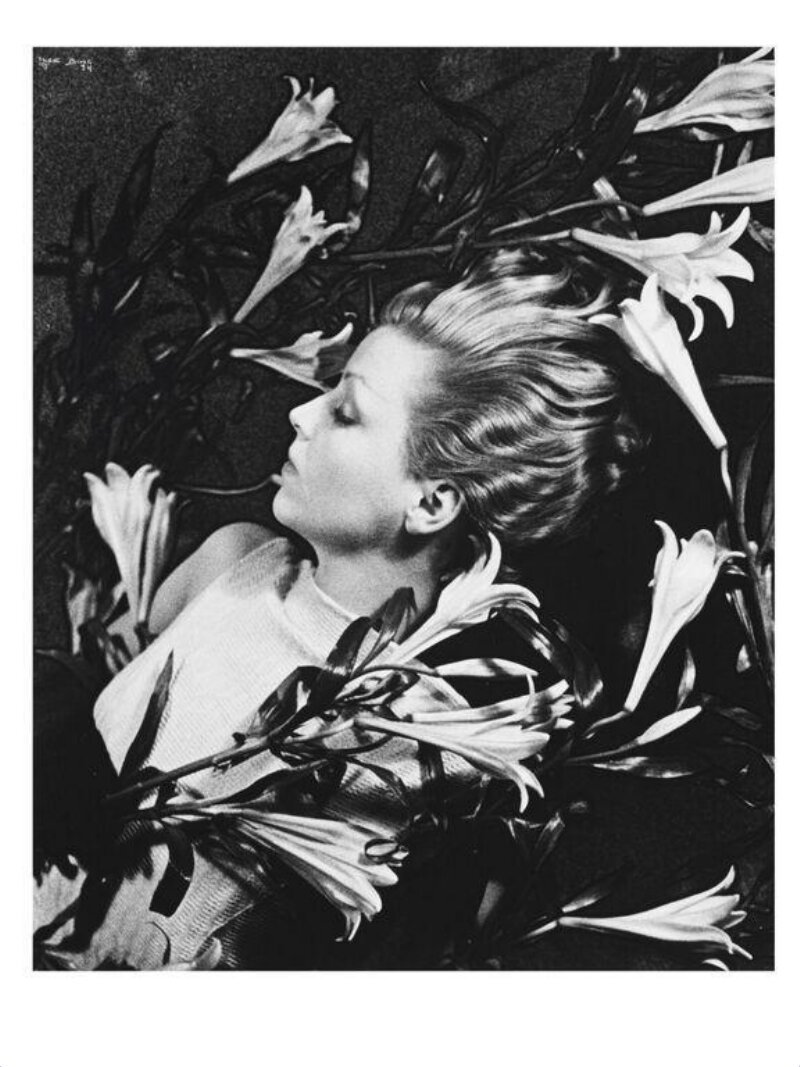
Ilse Bing. Salut de Schiaparelli.
If you cannot photograph a scent, photograph the light around it.
© Victoria and Albert Museum, London; Bequeathed by Ilse Bing Wolff · Victoria and Albert Museum (V&A)
Three perfumes for three hours
In 1934 Elsa Schiaparelli launched three perfumes at once, one for each part of the day. Schiap for daytime. Soucis for the afternoon. Salut for the evening.
According to the Victoria and Albert Museum in London, Salut carried the scent of lily and was conceived to accompany Schiaparelli's sportswear. A leading Paris couture house did not only sell dresses. It sold a way of living through the whole day, and perfume was part of that.
To advertise Salut, Ilse Bing made a photograph of Bettina Bergery, Schiaparelli's associate, reclining among lilies. The flowers are there to suggest the floral side of the perfume. The picture was published in the magazine L'Art Vivant in 1934.
The V&A's print is a gelatin silver print made in 1988 from the 1934 negative. The image measures about 32.8 by 26.4 cm. It came to the museum as a bequest from the photographer herself, under the name Ilse Bing Wolff.
Ilse Bing in Paris
Ilse Bing was born in Frankfurt in 1899 and died in 1998. She moved to Paris in 1930, when the city was the centre of European avant garde photography. She worked with a small, light camera that let her shoot quickly and from unusual angles.
In the interwar years Bing was one of the few women working as a professional photographer in Paris. Her pictures appeared in Vogue, Adam and other magazines. She photographed fashion, portraits, architecture and streets, and did not treat the line between art photography and commissioned work as a wall.
Salut de Schiaparelli sits right on that line. It is an advertisement, commissioned to sell a product. It is also a technical and visual experiment by someone looking for photography's own language.
Later Bing left Europe for New York, where she spent the rest of her life. The 1934 photograph belongs to her Paris period, the years for which she is best remembered.
Solarisation: light reversed
The Salut negative was solarised. The negative is exposed to light again in the darkroom while it is being developed. The result is a partly reversed image: some dark areas turn light, and fine bright lines run around the edges of things.
Bing said she discovered the technique on her own. At the same time in Paris, Man Ray and Lee Miller were also experimenting with it. Solarisation belonged to a shared climate: several photographers trying to make pictures that did not merely record what was seen, but made the seen unfamiliar.
For a perfume advertisement, the choice has its own meaning. Reversed light makes the scene seem to give something off. The lilies do not sit still as in a still life. They seem to carry a halo, the way a scent spreads from a flower where the eye cannot follow.
The photograph stays with us because it is honest about its limits. Photography cannot capture smell. Bing does not hide that. She uses what the picture has, light, and bends it just enough for the viewer to sense something outside the frame. In the same years Schiaparelli herself treated the perfume bottle as an object to be looked at. At this house, scent always had a life in images.
Olfactory Art