
Essays · Olfactory Art
Jay Muhlin. Kid.
No photograph is neutral, least of all in a room that smells.
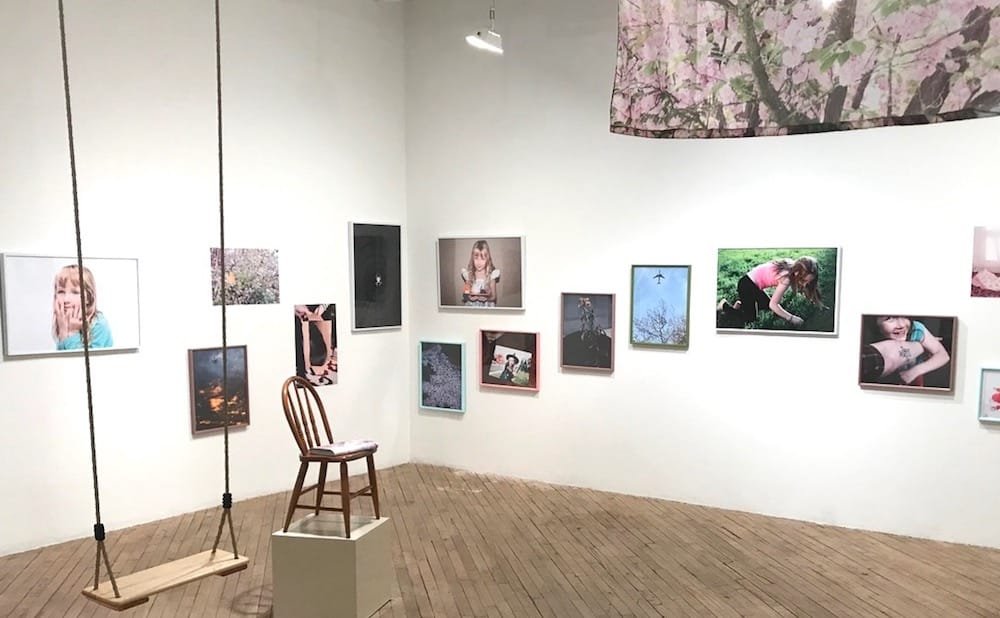
Photo: Deborah Krieger for Hyperallergic · Hyperallergic
A child, a cat
In January 2018, Vox Populi, an artist run space in Philadelphia, showed Jay Muhlin's series Kid. The exhibition ran until 21 January.
The main figure is a young girl. Muhlin does not call her his daughter. He describes her as a young girl he is helping raise. The phrasing is small, but it puts the photographer in an unusual place: close enough to be part of the child's daily life, yet not quite a parent.
The pictures follow her through the seasons. She plays in gardens. She wears costumes. She grimaces at the lens with plastic vampire teeth. She lies in the snow. She poses in front of a white backdrop wearing rings, as if at a portrait session. A cat keeps appearing, a supporting character that needs no introduction.
One picture shows only the cat, sitting on a stack of books. The titles of those books hint at ambiguity, and the viewer understands that the picture is talking about the series itself.
A room that smells of flowers
Kid is not only pictures on a wall. Vox Populi describes it as a mixed media installation, with moving parts, photographs made to be touched, and scent. Anyone entering the room smells flowers and forest before they have a chance to look closely at the first print.
The critic Deborah Krieger, writing for Hyperallergic, stops at exactly this point. Photography is usually trusted as a kind of record. The camera is placed before a scene, and the scene passes onto film or sensor. Scent works the other way. It is subjective, it goes straight to feeling, and it does so before reason can step in.
In Krieger's reading, a pleasant floral smell may push the viewer toward a positive interpretation. Pictures of vampire teeth, of a scrunched face, of cold snow, standing in a scented room, are easily seen as sweet memories rather than as the mixed moments of childhood.
That is not quite a complaint. It is an observation about how two senses work together. The eye trusts the photograph. The nose decides which way the eye should trust it.
Honouring, not only recording
Krieger reads Kid as a gesture that honours childhood rather than documenting it. Muhlin does not pretend to be objective. He knows childhood is short. He knows the girl in the pictures will grow up, into an adult future nobody can predict. The pictures keep what has passed, while the scented room insists that it mattered.
Seen this way, the scent is not a display trick. It is an admission. The photographer does not stand outside. He cares about the child, and he lets that care spread into the air, instead of pretending the camera is a cold eye.
The remaining question belongs to the viewer. If a scent can soften a photograph, then the pictures we treat as neutral, in newspapers, in family albums, are being read alongside which smells. The smell of the kitchen while we turn album pages. The smell of old paper. The smell of a room we do not notice.
Photography has never stood alone. As Penta's essay on photography as art points out, a picture is always read in a context. Kid simply gives that context a smell, so we can no longer forget it is there.
Olfactory Art