
Essays · Olfactory Art
Kai Althoff. and then leave me to the common swifts (und dann überlasst mich den Mauerseglern).
A whole life, hung under fabric, with its own smell.
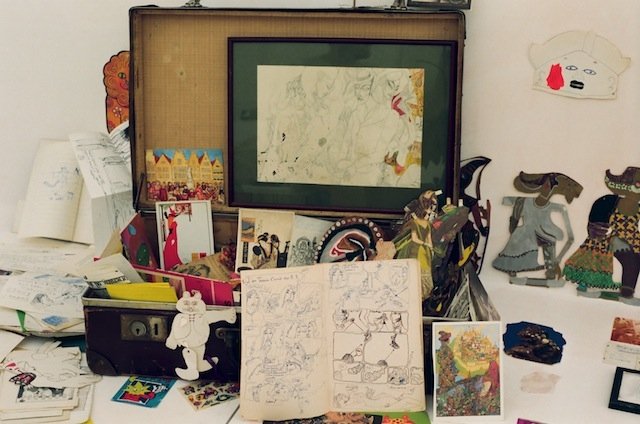
Kai Althoff, and then leave me to the common swifts, 2016 · ArtReview
A suite of rooms under white tents
From 18 September 2016 to 22 January 2017, the Museum of Modern Art in New York gave a suite of galleries to the German artist Kai Althoff. The exhibition was organised by Laura Hoptman, curator, and Margaret Ewing, curatorial assistant, of the Department of Painting and Sculpture.
Althoff did not hang work on the museum's familiar white walls. He stretched white fabric into linked tents, turning separate rooms into one continuous space. Inside were freestanding walls, shelves stacked with works still wrapped in brown paper, and vitrines.
In the vitrines: perfume bottles, feather boas, dolls, lace. In one corner, a diorama of a charred Central European village, beside torn upholstered furniture.
Music Althoff composed played softly in the background. And throughout the space hung a sweet perfume, also made by the artist. Visitors smelled it before they could properly see the first painting.
From childhood to now
The works spanned from Althoff's early youth to recent years. Paintings and drawings on paper and canvas, in every size. There were also fragments of earlier large environments, objects found and objects made.
The figures in the pictures seem out of time: androgynous people, Hasidic Jews, Wilhelmine era German students, rural youths. Echoes of Emil Nolde, Egon Schiele and André Thomkins can be felt. Near the entrance hung a painting inscribed Ich bins: it's me.
Writing in ArtReview, the critic Joshua Mack noted there was so much that no one could see it all. That may be part of the point. A life cannot be seen in full.
The title itself is an unfinished sentence: and then leave me to the common swifts. The bird, Mauersegler in German, spends almost its whole life in the air and rarely lands. The title reads like the words of someone who wants to fly off, leaving behind what he has made.
Smell as signature
Althoff has long combined unusual materials and formats to build all encompassing environments: detailed drawings, collage, textiles, soft sculpture, paintings, writing, video, song, and scent. At MoMA, smell was what tied it all together.
A painting stays in one place. A vitrine stays in one place. Music travels further but has a source. Smell is everywhere at once, with no direction. It makes very different things, a doll, a burned village, a school drawing, belong to the same person.
A sweet perfume is personal. It often attaches to someone specific: a mother, a grandmother, a former lover. By making a scent for the show, Althoff gave the rooms something like his own smell. Visitors did not only look at his paintings; they stood inside his air.
Using smell to portray a person has its own history in olfactory art, as with Clara Ursitti's Self Portrait in Scent. Althoff did not call his show a portrait. But leaving the rooms, visitors might forget many paintings. The sweet smell might follow them out onto the street.


Olfactory Art