
Essays · Olfactory Art
Kate McLean. Odours of the Morning and the Evening: Singapore.
A street has two smells, depending on the hour.
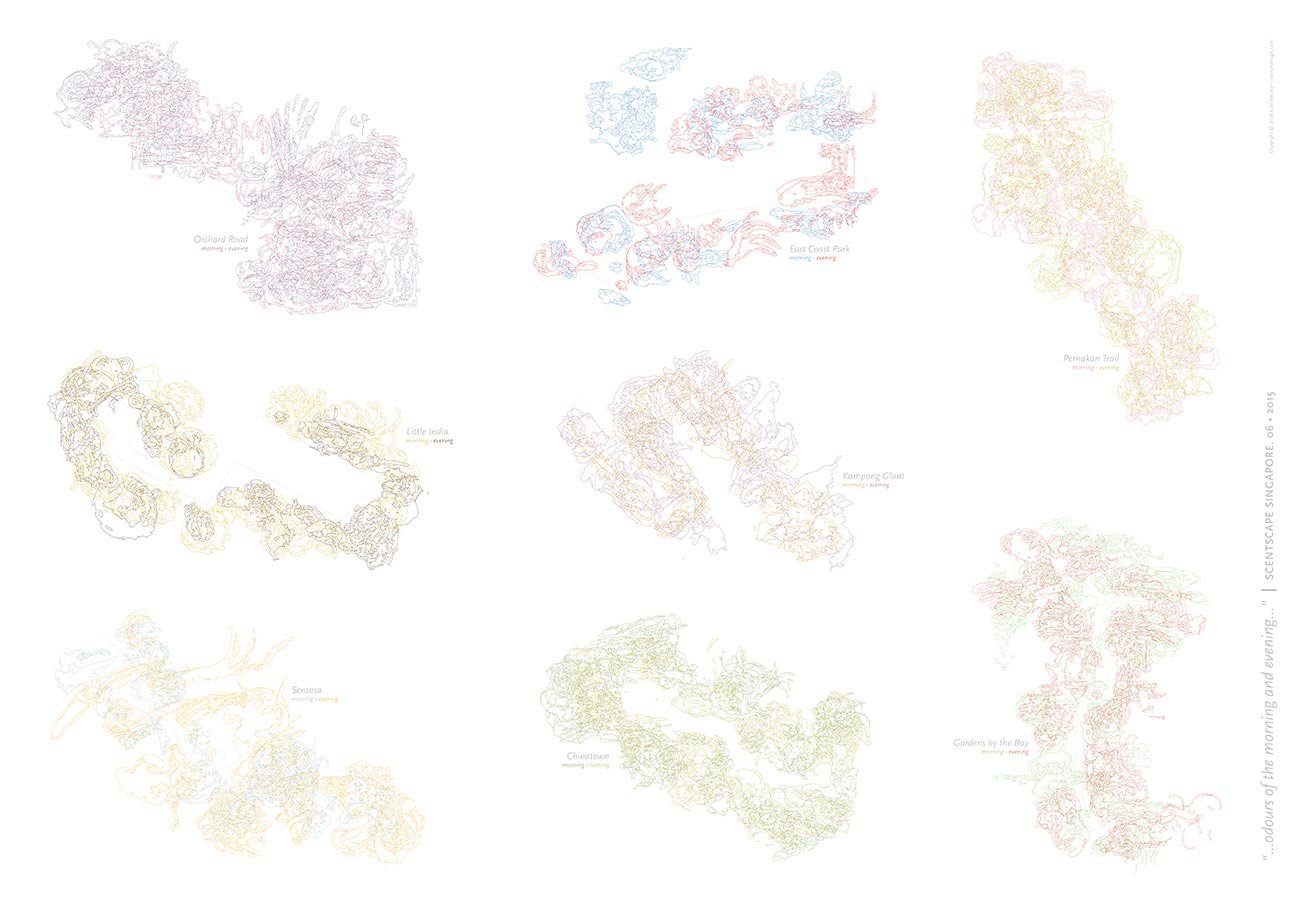
© Kate McLean · Sensory Maps (official site of Kate McLean)
One route, walked twice
In 2015 Kate McLean led smellwalks in Singapore. This time she asked a narrower question than usual: along the same route, how do morning and evening smell different?
Participants walked the same stretch at two times of day. They stopped, smelled and recorded what their noses caught. No meters, no sensors. Only people and notes.
From that material McLean made a series of large maps, completed in 2017. The large version is a digital print of 1089 by 841 millimetres. With it come individual maps at 297 by 210 millimetres, the size of an A4 sheet.
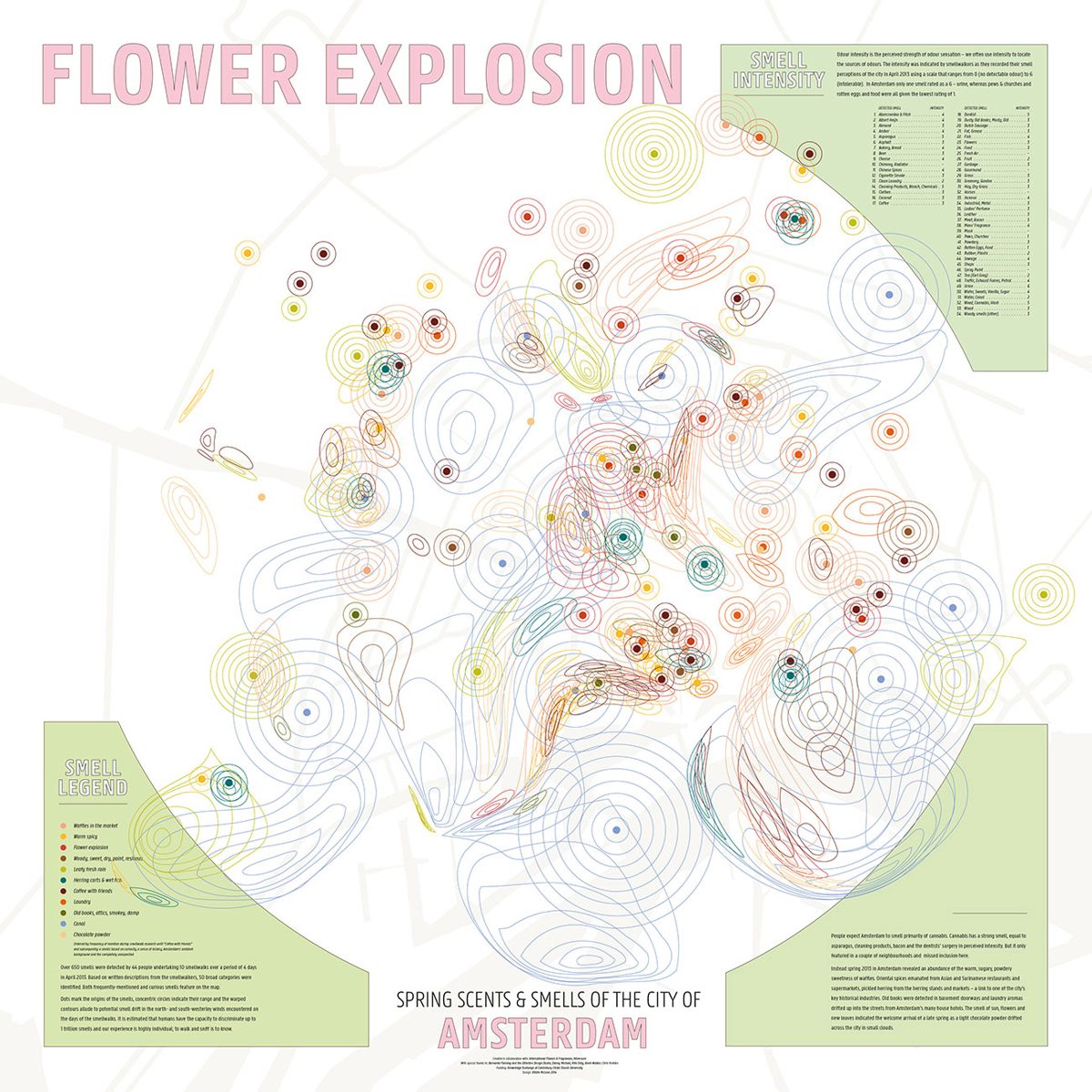
The work formed part of McLean's PhD at the Royal College of Art in London. Her approach in Singapore differs from her earlier smellmap of Amsterdam. In Amsterdam the question was what the city smells of. In Singapore the question was how long a smell lasts, and how it shifts with the hour.
Painting each smell by hand
To answer it, McLean developed a method of her own. She hand painted every smell perception the participants recorded along the routes. Each smell became a mark of colour on paper, placed where it was noticed.
Then she drew outlines around those marks. Then she laid the morning data over the evening data. Two layers on one street, and where they meet or part shows which smells stay, which vanish, which appear only at a certain hour.
McLean calls the result comparative topologies of smell duration. In other words, the map shows not only where a smell is, but how long it stays there.
Painting by hand is not decoration. Smell is vague, hard to measure, dependent on each nose. A hand painted map keeps that uncertainty. Its outlines are not as sharp as software lines. They resemble how a smell really spreads: without a clear border.
Many noses, one map
On her website McLean describes these maps as exploring collective difference across the hours of a day. The word collective matters. The map records not one nose but a group.
Everyone smells differently. One person notices what the next one misses. Two people give one smell two names. Laid together, those differences do not disappear. They form a soft field, dense where many noticed the same smell, thin where only one did.
It is another way of thinking about data. An ordinary map looks for a single truth: the road is here, the building there. McLean's smell maps accept that the truth about smell is plural. It lives in many noses at once.
From thesis to gallery
In 2019 the maps were shown at Show 2019, the Royal College of Art degree show at Kensington Gore, London. That year they also appeared in Nose-first, a private showing held as part of her PhD examination, attended by Professor Laurene Vaughan, Professor Teal Triggs and Dr Nina Morris.
McLean's thesis is freely available in the Royal College of Art repository. This gives the work a double life: an image on a wall, and a method others can read and reuse.
From a distance the maps are overlapping fields of colour. Up close they are a stretch of road in Singapore, walked twice in one day, by many people, and remembered by hand.
Olfactory Art