
Essays · Olfactory Art
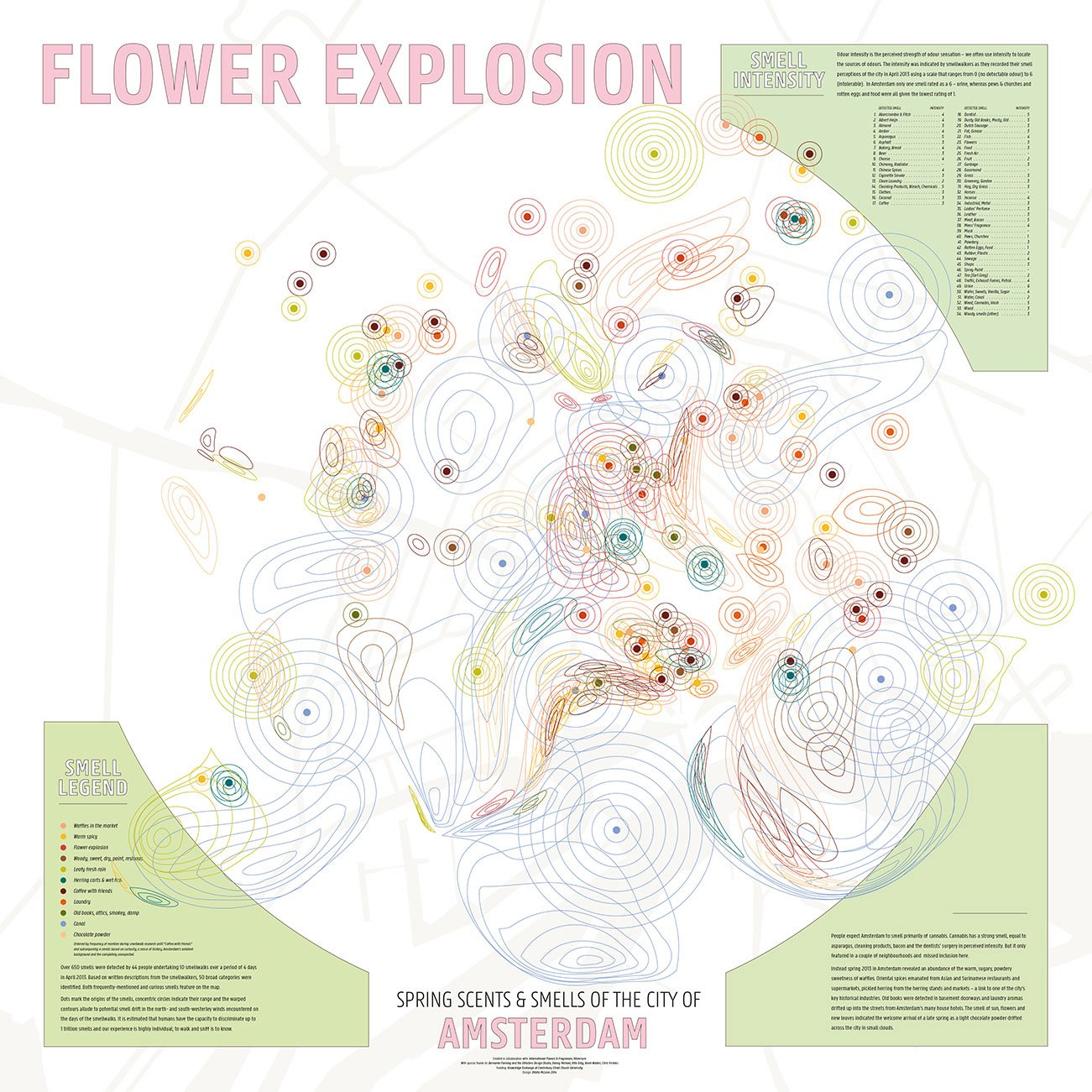
Kate McLean. Smellmap: Amsterdam.
A city smells different from its reputation.
© Kate McLean · Sensory Maps (official site of Kate McLean)
Four days in April
In April 2013, spring came late to Amsterdam. Over four days, 44 people walked through the city's neighbourhoods. They did not take photographs or look for directions. They smelled.
These were ten smellwalks led by Kate McLean, a British artist and designer known for smell maps of cities around the world. Her method is simple: lead a group slowly, stop, and record every smell they notice, in their own words.
After four days the walkers had noted more than 650 smells. From their written descriptions McLean identified 50 broad categories. Both the smells mentioned often and the curious ones noticed by a single person made it onto the map.
The map was finished in 2014, a digital print one metre square. It was made in collaboration with Bernardo Fleming and the olfactive design studio of IFF, a major flavour and scent company, in Hilversum, the Netherlands. In 2021 Fleming held his first solo show, about the smells he meets in his dreams, Dreaming in Smell.
What Amsterdam smells like
The strongest presence was waffles. Warm, sweet, sugary, powdery, drifting from the stands. Next came spices from Asian and Surinamese restaurants and supermarkets, traces of people who came to live in the city.
There was pickled herring at stands and markets, tying today's city to one of its oldest trades. There were old books in basement doorways. There was laundry steam rising into the streets from the city's small house hotels.
And there was spring. The smell of sun, flowers and new leaves announcing that a late spring had finally come. Now and then a small cloud of chocolate powder drifted past.
Read as a list, it describes a very particular city. Not a tourism brand, but a place where people cook, wash clothes, read and sell fish.
The missing smell
People expect Amsterdam to smell of cannabis. It is the smell tied to the city's reputation more than any other.
McLean notes that cannabis is strong, perceived as intense as asparagus, cleaning products, bacon or a dentist's surgery. But it turned up in only a couple of neighbourhoods. Not enough to make the map.
That detail is what makes the map interesting. It shows a gap between what people believe about a place and what they actually smell there. Reputation is built from stories, films, tourism campaigns. Smell can only be caught on the spot.
So a smell map is not only a map. It is a gentle correction.
Where the map went next
In 2014 Smellmap: Amsterdam was shown in a solo exhibition at Mediamatic, an art centre in Amsterdam, as part of the collaboration with IFF. The same year it was selected for the arts programme of IEEE VIS 2014 in Paris, a major conference on data visualisation.
Also in 2014 it received the British Cartographic Society's Avenza Award for Electronic Mapping. That is worth noticing: a map of smells recognised by mapmakers as a real map.
In 2018 it appeared in The Senses: Design Beyond Vision at Cooper Hewitt, Smithsonian Design Museum in New York, curated by Ellen Lupton and Andrea Lipps. The map is in the permanent collection of the University of Manchester Library.

Olfactory Art