
Essays · Contemporary Art
Lawrence Abu Hamdan. Walled Unwalled.
A wall is never as closed as we think.
Tate · Tate
Twenty minutes in an old studio
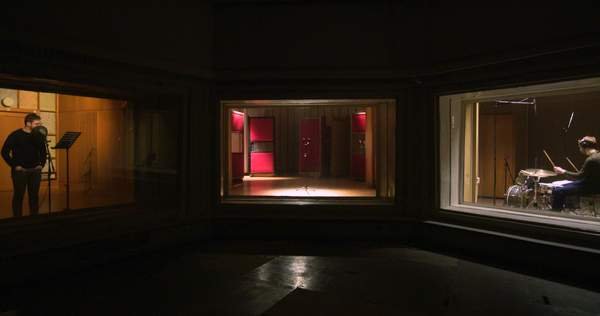
Walled Unwalled is a twenty minute video installation by Lawrence Abu Hamdan, made in 2018. In October that year it was shown for a week in The Tanks, the underground spaces of Tate Modern in London, free to enter.
It was filmed at Funkhaus, the recording studios in East Berlin that once housed the state radio of the GDR. A building made to control sound: insulation, reverberation, who hears what. Abu Hamdan did not choose it by chance.
In the video he stands among those studios and speaks a monologue. At Tate the projection was joined by moving walls and a sound performance. Semi transparent panels let light leak through, like the subject itself: information always finds its way past an obstacle.
Cases heard through walls
The monologue moves through a series of legal cases, in very different places and times, that share one thing: the evidence passed through a wall, a door or a floor.
There is the Kyllo case in the United States, where investigators used a thermal camera to read heat coming off a house, and the court had to decide whether seeing through a wall like that counted as a search. There is the Oscar Pistorius case in South Africa, where what neighbours heard in the night, through walls and across distance, became central to the trial. And there is Saydnaya prison in Syria.
Each case asks something slightly different. Is a wall still the edge of private life when technology can see through it? Can a human ear be trusted as a witness? And when a person is held in darkness, is sound through the wall all they still know of the world?
An investigator who works by ear
Abu Hamdan was born in Jordan in 1985 and lives and works in Beirut. He describes himself as an artist and audio investigator. His analyses have been used as evidence at the UK Asylum and Immigration Tribunal and in advocacy by Amnesty International and Defence for Children International.
In 2016 he worked with Amnesty International on an investigation into Saydnaya prison. Former detainees had been allowed to see almost nothing. They remembered the prison through sound. Abu Hamdan helped them rebuild the space from the memory of their ears. Walled Unwalled, and his exhibition Earwitness Theatre at Chisenhale Gallery in London the same year, both grew from this work.
He is also the author of [inaudible]: A Politics of Listening in 4 Acts, and completed a PhD at Goldsmiths, London, in 2017. Art and investigation, for him, share one tool: careful listening.
Why the wall still stands
The work passes no verdict on any case. It places them side by side so viewers see a pattern: the wall, the thing we believe is most solid in a house, is in fact porous.
The question keeps getting closer. Phones, smart speakers, cameras, heat sensors. Far more passes through walls now than in 2001, when the US Supreme Court decided Kyllo. Walled Unwalled does not speak about the future, but it shows that our laws and our sense of privacy still rest on an old idea of what a wall is.
Among works built mainly from sound, it stands near Janet Cardiff's walks guided by a voice. Both remind us that the ear knows more than the eye, and that what we hear often lies outside the frame.
Viewers leave The Tanks and hear other people's footsteps on the concrete. A very ordinary sound. After those twenty minutes it carries another meaning.
Contemporary Art