
Essays · Contemporary Art
Janet Cardiff. The Missing Voice (Case Study B).
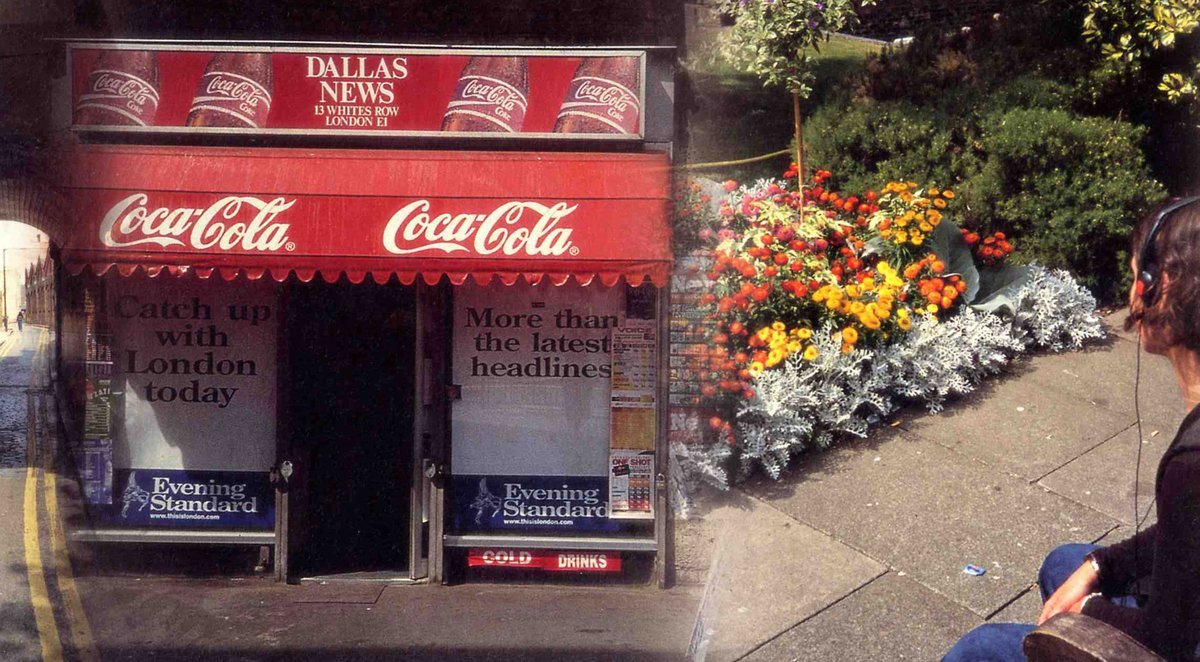
Two streets overlap: one real, one recorded.
courtesy Artangel · Artangel
Starting from a library
In 1999 Artangel invited the Canadian artist Janet Cardiff to make a work in East London. The result was The Missing Voice (Case Study B), an audio walk of about 45 minutes.
It began at Whitechapel Library. Participants received a player and headphones and pressed play. A woman's voice came through, very close, almost a whisper. The voice asked the listener to follow.
From there the listener left the library and walked through Spitalfields towards the City of London. Along the way: clothing shops, news stands, an empty church, a crowded station concourse. The voice said when to turn, when to stop, when to look up.
The library closed in 2005. The building is now part of Whitechapel Gallery. The work remains.
Two layers of sound
What sets it apart is how the sound was recorded. The headphones carry more than a voice: footsteps, traffic, people talking, a distant siren. These sounds were recorded on the very route the listener is walking.
So the listener hears two streets at once. The real one, all around, with today's noise. And the recorded one, with the noise of another day. The layers overlap so closely that it is often unclear which sound is real.
Some people turn round, sure someone is behind them. Some stop, sure a car is coming. The body reacts to sound before the mind can sort it out.
Cardiff uses that uncertainty as her material. The work is not in the headphones, nor in the street. It is where the two meet.
A missing woman
The story centres on a woman who has gone missing. There is a detective's voice. There are passages like confession, others like conjecture, others like dream. It does not run in a straight line.
Cardiff's voice tells, asks, and sometimes seems to talk to itself. The listener never learns everything, only fragments, while their feet keep following instructions.
The title can be read two ways. The missing one is the woman in the story. But the voice is also an absence: it is in your ear, and the speaker is not there. The listener walks beside someone who is not on the street.
The work is part detective story, part walk with a friend who has gone away.
Still audible
More than twenty years on, The Missing Voice has not ended. Artangel has put its three parts online to stream or download. Listeners start at Whitechapel Gallery and retrace the original route.
Only the street has changed. Shops have new owners. New buildings have gone up. The noise of 1999 in the headphones drifts further from the noise of today. The work stays the same, but the gap between its two layers keeps widening.
Time, you could say, has written itself into the work. It began as a story about a missing woman. It is now also a record of an East London that is gone.
Works that hold a moment for others to return to, like Cyrus Clarke's The Anemoia Device, all show the same thing: memory does not stay still. Each time it is opened, it meets a new present.
Contemporary Art