
Essays · Contemporary Art
Rebecca Horn. Concert for Anarchy.
An instrument that speaks only when it loses its order.
Tate · Tate
A piano upside down
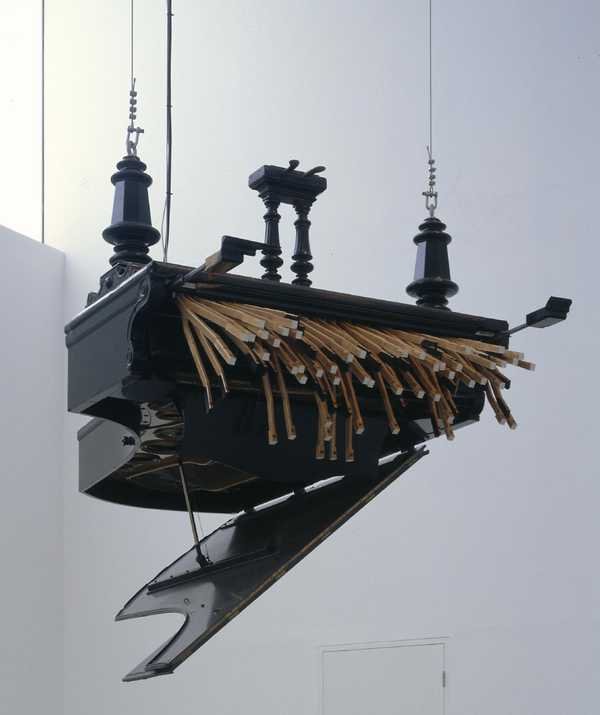
Concert for Anarchy was made in 1990. Tate, which holds the work, lists its materials in one line: piano, hydraulic rams and compressor. Only three things.
The piano is a real black grand, the kind found in concert halls. But it does not stand on its three legs. It hangs upside down from the ceiling, belly up, keyboard tilted toward the viewer. In that position it looks like an animal trussed by its feet and hoisted.
Then, after a silence, the hydraulics inside start to work. The lid springs open. The keyboard slides out, keys pointing down like a tongue pushed out of a mouth. At the same moment a broken chord sounds, following no melody. A few seconds later everything pulls back in. The lid closes. The room is quiet again.
The movement repeats at intervals. No one presses a key. There is no score. The sound is only the consequence of a machine disordering itself.
Machines with bodies
Rebecca Horn was born in Germany in 1944. She became known in the early 1970s for things worn on the body: masks, gloves with absurdly long fingers, frames of fabric and feathers that extended the limbs. They made the wearer stronger and clumsier at once, able to reach further and more restricted.
Gradually the human figure left the work, but the sense of a body stayed. Horn's machines flap, tap, tremble, open and close. Tate holds several of them, with titles like Ballet of the Woodpeckers and Mechanical Body Fan. They are not robots. They are more like creatures with habits.
Concert for Anarchy belongs to that line. The piano does not represent a person, yet it behaves like a body. It rests. It convulses. It lets out a cry. It recovers.
The piano may be the most disciplined object an artist could choose. It carries years of practice, bourgeois parlours, silent concert halls. Turning it over turns those habits over too.
Chaos on a schedule
The title is a paradox. A concert is among the most arranged things there are: a start time, an order of pieces, an audience sitting still. Anarchy is the opposite. Horn puts the two words side by side and lets the piano hold both.
Because the chaos here is programmed too. The compressor fills, the rams push, then retract. The eruption is a planned event. Only the viewer does not know when it will come. What looks like loss of control turns out to be another, quieter kind of control.
The harsh sound does not damage the piano. After each outburst it returns to its shape, ready for the next. The breakdown has no ending. It becomes a rhythm, like breath or a pulse.
Standing beneath it, visitors do not hear a piece of music. They hear the moment an object is allowed to come apart a little, then gathers itself again.
Why it stays
Many kinetic works impress at first sight and then become a repeated trick. Concert for Anarchy differs because the silences between movements are longer than the movements. The work teaches its audience to wait.
While waiting, people look harder. The glossy black paint. The cables. The shadow of the piano on the floor. The fact that such a heavy thing is hanging in the air, and that its hanging is already a kind of tension.
Horn does not explain what the piano means. It repeats one gesture: open, cry out, close. Viewers fill in the rest from their own memory of moments when something that seemed solid suddenly showed its inside.
Instruments no longer played in the usual way carry their own weight. Elsewhere, Susan Philipsz recorded the sounds of instruments damaged by war. Horn keeps the piano intact and takes away only its order.
Contemporary Art