
Essays · Photography
Lee Friedlander. Self-Portraits.
Present without standing in the middle of the frame.
Fraenkel Gallery · Fraenkel Gallery
The photographer steps into the frame
Lee Friedlander was born in 1934 in the United States and is one of the most important street photographers of the second half of the twentieth century. Most of his pictures show American life: shopfronts, signs, cars, street corners crowded with things layered on top of one another.
From the early 1960s he began something few had done systematically. He put himself into the picture. Not by turning the camera on his face like an ordinary portrait, but in quieter ways.
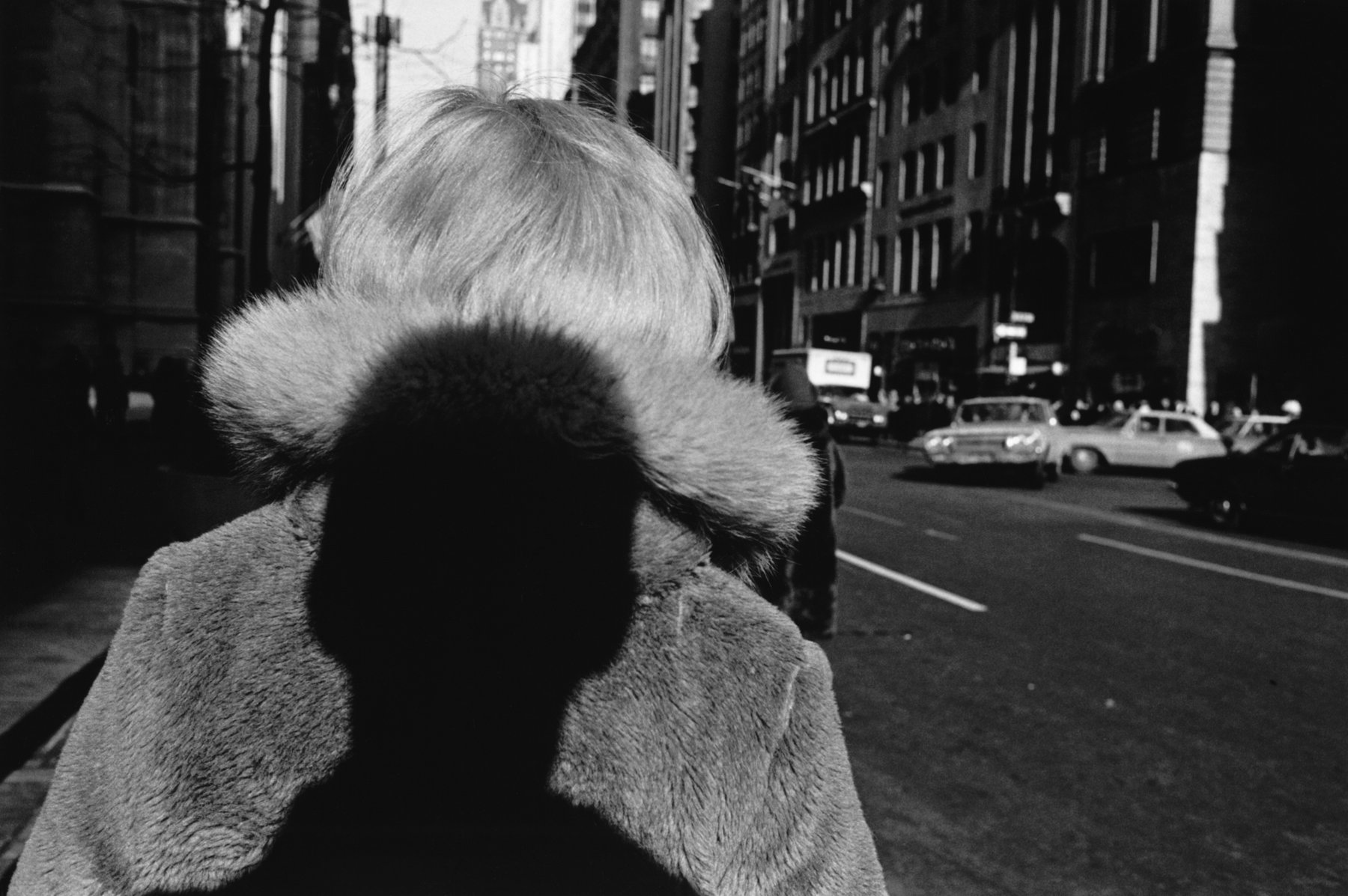
His shadow falls on a pavement, on a lawn, on the side of a house, sometimes on the back of a woman walking ahead. His reflection appears in shop windows, in rear view mirrors, in a hotel room mirror. Sometimes only part of his body slips into the edge of the frame.
The photographer, usually outside the picture, becomes part of the composition. No more prominent than a lamppost or a sign. Just one more shape in the scene.
A book in 1970
In 1970 Friedlander published Self Portrait through his own press, Haywire Press. It was his first book. It held more than forty black and white pictures, most made during the 1960s, and was designed by Friedlander with Marvin Israel.
The book was carefully printed by the Meriden Gravure Company in Connecticut, from duotone separations made by Richard Benson. The greys of the gelatin silver prints were kept on the page.
The pictures were taken across America: New York, New Orleans, Chicago, Colorado, Florida, Wisconsin, Kentucky, Cape Cod, along roads such as Route 9W and the Palisades Parkway. Each place a different scene, yet the photographer always lurks somewhere in the frame.
Seen as a whole, the book gives the sense of someone who is everywhere and nowhere at once. He passes through, leaves his shadow, and moves on.
Funny and serious
Many of the self-portraits have a dry humour. Friedlander's shadow falls squarely on a stranger's back, as if the two were joined. His reflection slips into a shop window among the goods on display. The viewer smiles at a coincidence caught at just the right moment.
Behind the humour is a serious question for photography: where does the photographer stand in relation to what is photographed? Pictures often pretend the photographer is absent, that the scene simply appears. Friedlander refuses that pretence. He shows that he is always there, always part of the scene.
He also uses himself as a foil. Placing his shadow beside other people adds a layer: the photographer looks, and is seen looking.
This is related to the self-portraits of Vivian Maier, also full of shadows and reflections. But Maier's pictures became known only after her death. Friedlander published his early, as an open part of his work.
More than sixty years
Friedlander did not stop after the 1970 book. He went on photographing himself for more than six decades. Later pictures sometimes show his face more clearly, sometimes show age, the stages of a life.
Fraenkel Gallery, which represents him, describes the series as an interweaving of his professional, personal and creative life. He photographed while working, while travelling, while at home. The camera was always with him, and he was always slipping into it.
Taken together, Self-Portraits is not portraiture in the usual sense. It does not tell us what Friedlander looks like, thinks or feels. It tells us something simpler: he was here, and here too. A record of presence, stretched across decades.
Photography