
Essays · Photography
Trent Parke. Dream/Life.
Shadow does not hide the city. It gives the city another shape.
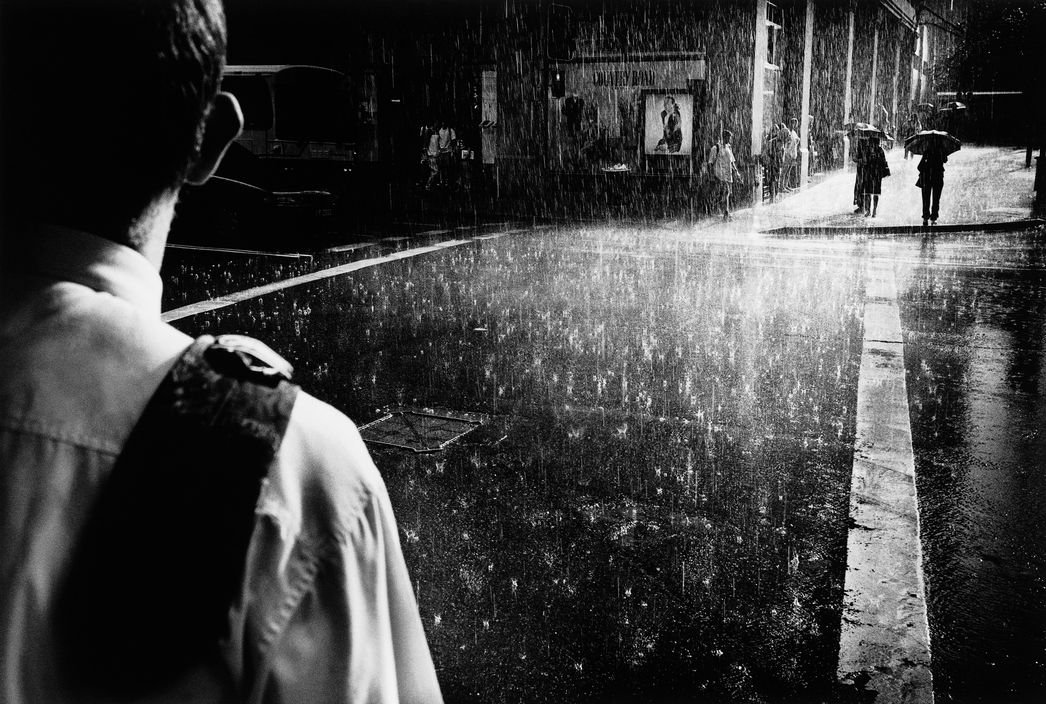
© Trent Parke · Magnum Photos
A newcomer
Trent Parke is an Australian photographer. He left a country town for Sydney, and according to the account that accompanies the series, his first feeling in the city was isolation. The city was crowded, yet he belonged nowhere.
He began to walk and photograph. Over about five years he shot Sydney's streets in black and white. The pictures selected are mostly dated 1998 and 1999.
In 1999 the work became Parke's first book, Dream/Life, published by Hot Chilli Press in Sydney. The title sets a slash between two words, as if dream and life were two sides of one sheet of paper.
Years later Parke became the first Australian full member of Magnum Photos. But Dream/Life is where his way of seeing first took shape.
Hard sun, deep shadow
Sydney's light is strong. Midday sun creates blinding patches and pools of almost total black. Many photographers avoid that light. Parke walked straight into it.
In his pictures, shadow is not what is left over. It is the main form. A pedestrian is cut in two by a band of sun. An office worker seems to dissolve into the shadow of a building. A face keeps only one half; the other sinks into black.
Weather joins in. A man shelters under an awning after running through a thunderstorm in 1998. A man stands in the rain at the overseas passenger terminal looking out at the Opera House in 1999. Rain, sun, shadow: the city is rebuilt from things that cannot be held.
The result is a dark, mysterious, dreamlike Sydney. Not the postcard city of blue harbour and clear sky, but a city of strange moments that pass before anyone notices.
Small scenes
Parke did not photograph events. He photographed very small scenes, often lasting a single second.
A blind woman singing at Circular Quay as a couple walks past. A tulip dangling from a woman's handbag. A boy peering out of a Volkswagen in Balmain. An old man conducting a street band in Martin Place. A boy carrying a watering can through Waverley Cemetery. Children playing on a sculpture near Manly. Boys building a skateboard ramp at Bronte. A man dressed as Jesus on Pitt Street.
Alone, each scene is a small oddity. Together they form a portrait of loneliness in a crowd. The people are usually alone even when others surround them. They are in the city, but each seems inside a private dream.
Black and white sharpens that feeling. No colour anchors the time. Only light and dark, and figures passing between them.
Why it stays
Dream/Life shows that street photography can travel far from record keeping. Every picture is a real scene in a real place. Yet the way Parke uses light turns them into another world, closer to a dream than to the news.
Beside the black and white work of Daido Moriyama, we see two ways of looking at a city from its edges. Moriyama uses rough grain and tilted frames. Parke uses hard light and deep shadow. Both photograph the city as a place at once familiar and strange.
A city has two lives. One by day, on the map. Another in bands of light and shade that only a slow walker sees.
Photography