
Essays · Photography
Sunil Gupta. Christopher Street.
A street keeps the walk of those who pass through it.
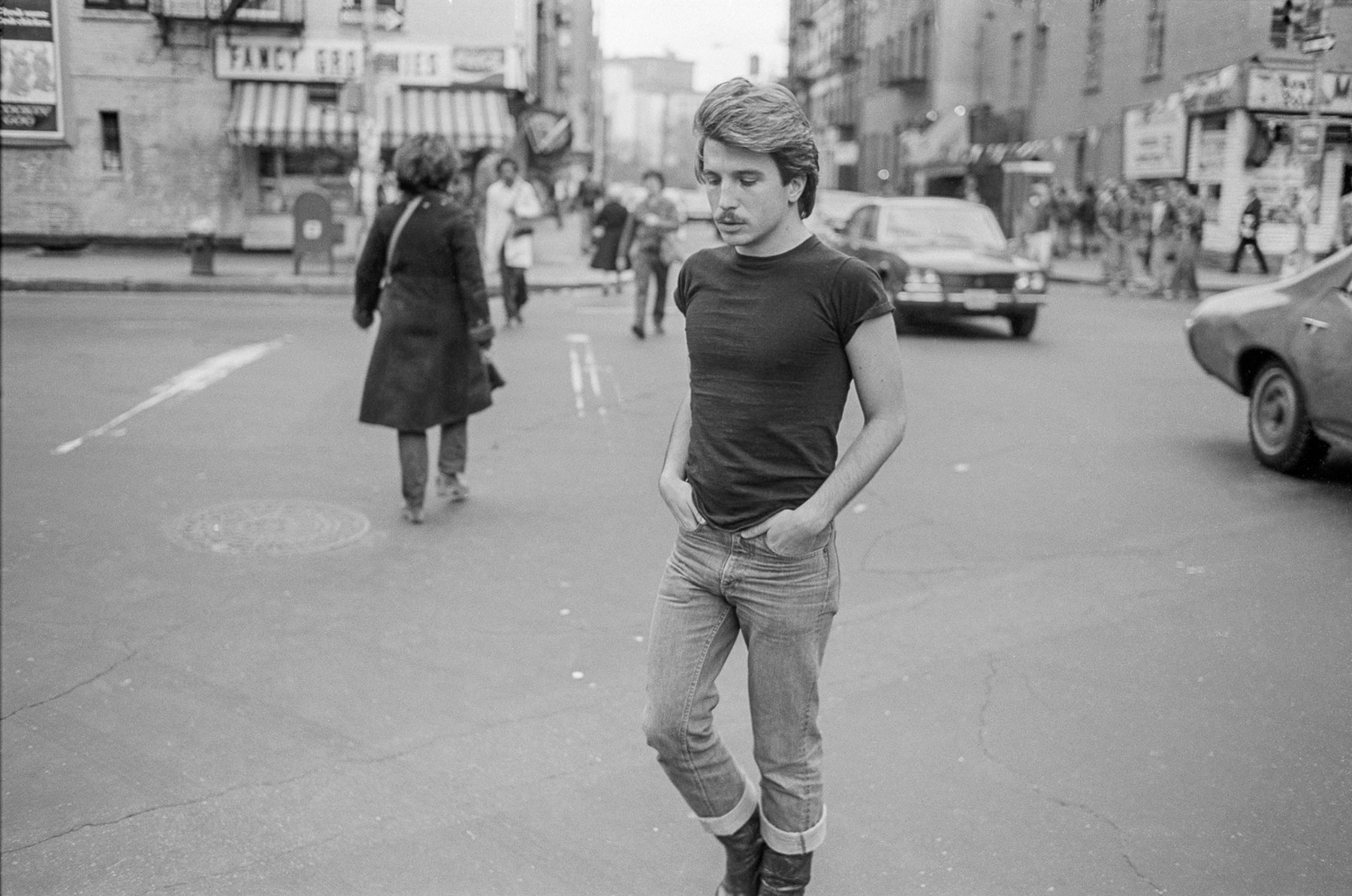
courtesy the artist and Hales Gallery, New York and London · Aperture
A student with a handheld camera
Sunil Gupta was born in New Delhi. In 1969, at fifteen, he moved with his family to Montreal. It was the summer of Stonewall, the New York uprising later seen as a turning point for gay rights. In Montreal, as an undergraduate, Gupta joined gay activist groups and took pictures for a campus paper.
In 1976, aged twenty two, he moved to New York to study for an MBA. What held him in the city was the camera. He enrolled in Lisette Model's class at The New School, one of the key teachers of American street photography.
That same year he took his camera to Christopher Street in the West Village. The street was then the centre of gay life in New York: bars, clubs, and above all the sidewalk, where people strolled, waited, looked at each other. Gupta made about sixty pictures, in black and white, with a handheld camera.
Daylight, outdoors, clothed
What stands out most is what Gupta chose not to photograph. No bathhouses, no parties, no interiors. Everything happens in public, mostly in daylight.
In the frame are young men leaning against walls, walking in pairs, pausing on corners. Some look straight into the lens. Some have no idea they are being photographed. Their gestures are ordinary: a hand in a pocket, a glance over the shoulder, two men standing slightly closer than they need to.
The approach places the series within American documentary photography of the 1970s, after the generation of Garry Winogrand, who walked and shot in crowds. But Gupta did not stand outside. He was part of the street. The gaze in these pictures is not a stranger's. It belongs to someone walking alongside.
The result is both private and public. The pictures show a community appearing openly on the street, while keeping discreet signals only insiders could read.
Before everything changed
In 1977 Gupta left New York for London. The pictures sat for almost forty years. In the meantime, AIDS arrived in the early 1980s and transformed life on streets like Christopher. Many of that generation did not survive.
So, looking back, the 1976 pictures carry a weight they did not have when made. They record a short window: after Stonewall, before the epidemic. A summer when freedom was still new and no one knew what was coming. In those same years, Nan Goldin was photographing her friends in closed rooms, pictures that later became The Ballad of Sexual Dependency. Two ways of looking, one out on the street, one indoors.
In 2015, twenty two of them were printed at 8x10 inches and shown at sepiaEYE in New York, then in Houston. In 2018 they became a book, Christopher Street 1976. In 2019 Hales Gallery in New York showed them again.
Gupta went on to become one of the most important photographers of queer life and migration. From 2004 to 2012 he lived in India and documented LGBTQ communities there. But it began with a twenty two year old walking down one street with a camera, looking.

Photography