
Essays · Photography
Nan Goldin. The Ballad of Sexual Dependency.
Each picture stays a few seconds, then goes. The people stay.
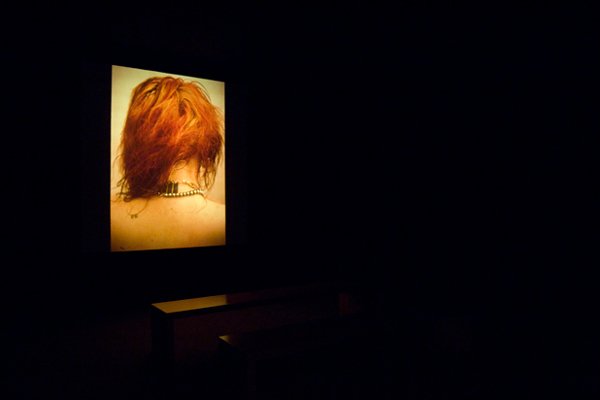
Courtesy the Museum of Fine Arts, Houston · Aperture
A diary in slides
The Ballad of Sexual Dependency is a projection. More than seven hundred colour photographs appear one after another on a screen, each for about three or four seconds, set to a soundtrack. The whole runs for around forty minutes.
The pictures were taken from the mid 1970s to the mid 1980s, in Boston, in Berlin, on New York's Lower East Side. The people in them are friends, lovers, the people Goldin lived and went out with. They are in bedrooms, bathrooms, bars, on beds, in front of mirrors.
Goldin has called the work the diary she lets people read. She did not shoot from outside like a reporter. She was inside, part of what she photographed.
The work does not stand still. Over the years Goldin changed the order, added and removed pictures, changed the music. Each showing is a version of the same diary.
Music is half the work
The title comes from a song in The Threepenny Opera by Bertolt Brecht and Kurt Weill. The music is not decoration. It sets the pace and the mood, and joins single pictures into passages of feeling.
The soundtrack runs from the Velvet Underground to Maria Callas, from James Brown to Dean Martin, with Petula Clark, Dionne Warwick, Yoko Ono, Klaus Nomi, Ennio Morricone. Opera sits beside soul, sixties pop beside post punk. That mixture resembles the community in the pictures: many origins, many voices, living in the same rooms.
In 2009 the critic Greil Marcus wrote about the music of The Ballad for Aperture. He listened again to the songs in it, then imagined the ones left out, songs that might also have been playing in those rooms. His reading shows that The Ballad can be heard like an album, not only seen as a set of pictures.
Marcus reads the work as the history of a re created family: not a family of blood, but one its members chose.
Photographing so as not to forget
Nan Goldin was born in Washington in 1953. When she was eleven, her sister took her own life. She began photographing at eighteen. Many who write about Goldin suggest that photographing the people she loved, again and again, was a way of not losing anyone else.
Her pictures do not avoid the hard things. There is love, desire, dependency, violence, loneliness. There is Goldin herself, bruised in the face. Nothing is made pretty. Harsh flash, saturated colour, hurried framing.
Goldin photographs herself with the same frankness she turns on others. She does not keep the safe position of the one holding the camera. That makes her pictures of others more trustworthy: the photographer lets herself be seen too.
Later, many of the people in the pictures died, most in the years of the AIDS epidemic. The diary became a record of a community that is no longer there.
From the bar to the museum
The Ballad was first shown in places close to the world in the pictures: clubs and small art spaces in New York. Sometimes the audience were the people on screen.
In 1985 it was included in the Whitney Biennial. In 1986 Aperture published it as a book. From a showing for friends it became one of the most discussed photographic works of its time.
What gives it weight today is not daring. It is closeness. Like Sophie Calle's The Sleepers, The Ballad brings the viewer into the most private places: the bed, the room, someone just waking. But Goldin does not observe from outside. She is lying there too.
Photography