
Essays · Photography
Uta Barth. Ground.
A photograph focused on empty air.
Whitney Museum of American Art · Whitney Museum of American Art
A corner of a room, with no subject
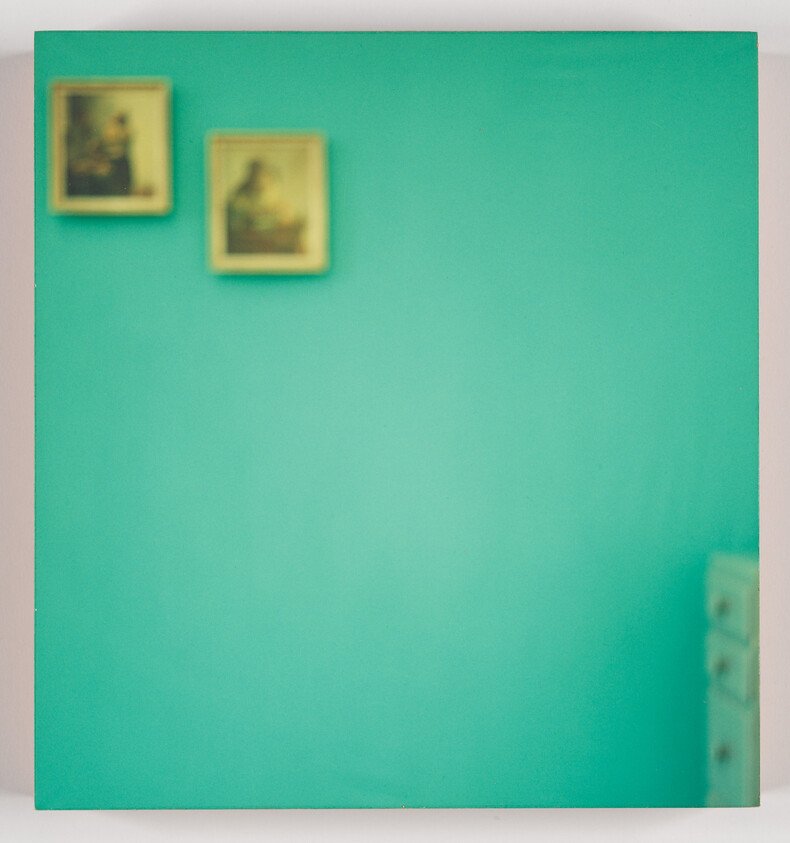
Ground #42 is a small picture. About 28 by 27 cm, a colour print mounted on a panel almost 5 cm deep, so it hangs on the wall more like an object than a sheet of paper. 1994. The Whitney Museum of American Art in New York bought it for its collection with funds from its Photography Committee.
It shows a corner of a lived in room. A wall of green leaning teal. Two small frames at upper left. On the right, part of a chest of drawers. No people. No event. And nothing sharp.
Anyone used to photographs will think of a technical fault. A shaken camera, a missed focus, a hurried hand. But Ground is not a failed picture. It is focused with great precision, only on a point where there is nothing at all.
Focusing on empty space
Uta Barth's method is almost too simple. She sets up the camera and focuses on an empty point in the middle of the room, where a sitter would normally stand. The sitter never comes. Because the focus sits there, everything behind it blurs: wall, frames, the edge of the dresser.
The result is a photograph made only of background. What is usually pushed back to let a subject stand out now fills the whole frame. Writers on Barth often say she photographs the volume of a room rather than its walls, the air rather than the objects.
With the subject removed, the eye has nowhere to rest. It slides backward, looking for a hold, and finds that the container itself, the room, is what is being shown. The picture becomes a statement about how pictures work more than about any particular place.
One detail makes the Ground series quieter still. According to accounts of this period, many of the first interior pictures were taken inside a Los Angeles exhibition space and then hung on the very walls they recorded. Visitors stood in the room and looked at pictures of that room, gone soft.
Seeing from the edge of the eye
We tend to think that seeing means looking straight ahead. Yet most of the time the world reaches us through the edge of the eye. We know where the table is, where the window is, without looking at them. That periphery is blurred, without detail, and almost never photographed.
Barth moves that blur to the centre. She tells no story, offers no face to love, no object to want. She offers only the conditions of looking: light on a wall, the depth of a room, a sense that someone has just been here.
These pictures are often placed closer to the tradition of painting with colour and light than to documentary photography. They recall abstraction, yet they come from a very real room, much as the cinemas of Hiroshi Sugimoto end up as a single white screen. Shift the focus a few dozen centimetres and the wall would snap into view, and the room would go back to being an ordinary room.
After Ground, Barth kept to this path in later series, always around the walls, windows and patches of sun in her own home. Her question stayed the same: can a photograph show us the act of looking, not only the thing looked at?
Why a blurred picture stays with you
Ground #42 has nothing to retell. No one could describe it over the phone in a way that would make someone want to go and see it. But standing before it, it is easy to notice what the eye is doing: searching for focus, failing, then agreeing to stay with colour and light.
That is a rare moment of attention. We are not led anywhere, not told what to feel. We have a corner of a room and time to be in it. Barth's proposal is modest: notice the things that are always around you, before they disappear into habit.
Photography