
Essays · Contemporary Art
Taryn Simon. Paperwork and the Will of Capital.
Flowers stood between the signatures. Then they wilted.
The bouquet in the press photo
The project begins with photographs. Not art photographs, but press and official pictures taken at signings: agreements, declarations, memorandums, treaties, moments of accord staged to be recorded. Looking at many of them, Taryn Simon noticed a detail that kept returning. There were almost always flowers.
Flowers on the table, between the two signatories. Flowers behind, beside the flags. They are never the main character, but they are always present, part of the stagecraft of power. Simon decided to rebuild those very bouquets.
The signings she chose range across time and place. The Bratislava Declaration of 3 August 1968. The Agreement Establishing the International Islamic Trade Finance Corporation of 30 May 2006. A Memorandum of Understanding between Cambodia and Australia of 26 September 2014. Each agreement is one photograph.
What those documents say varies widely, from politics to finance. Yet in the pictures they look strangely alike: a few people in suits, a table, some pens, and a bouquet. That sameness shows how much the ritual matters, as much as the content.
Four thousand specimens and a botanist
To rebuild the bouquets, Simon imported more than 4,000 flower and plant specimens from Aalsmeer in the Netherlands, the largest flower auction in the world, where some twenty million flowers arrive and leave each day. She worked with botanist Daniel Atha of the New York Botanical Garden to identify each species in the original pictures.
Each work's text records where the flowers came from. Carnation from Colombia. Hybrid tea rose from Ecuador. Gerbera and big leaf hydrangea from the Netherlands. Dendrobium from Thailand. A bouquet on a signing table turns out to be a small map of global trade.
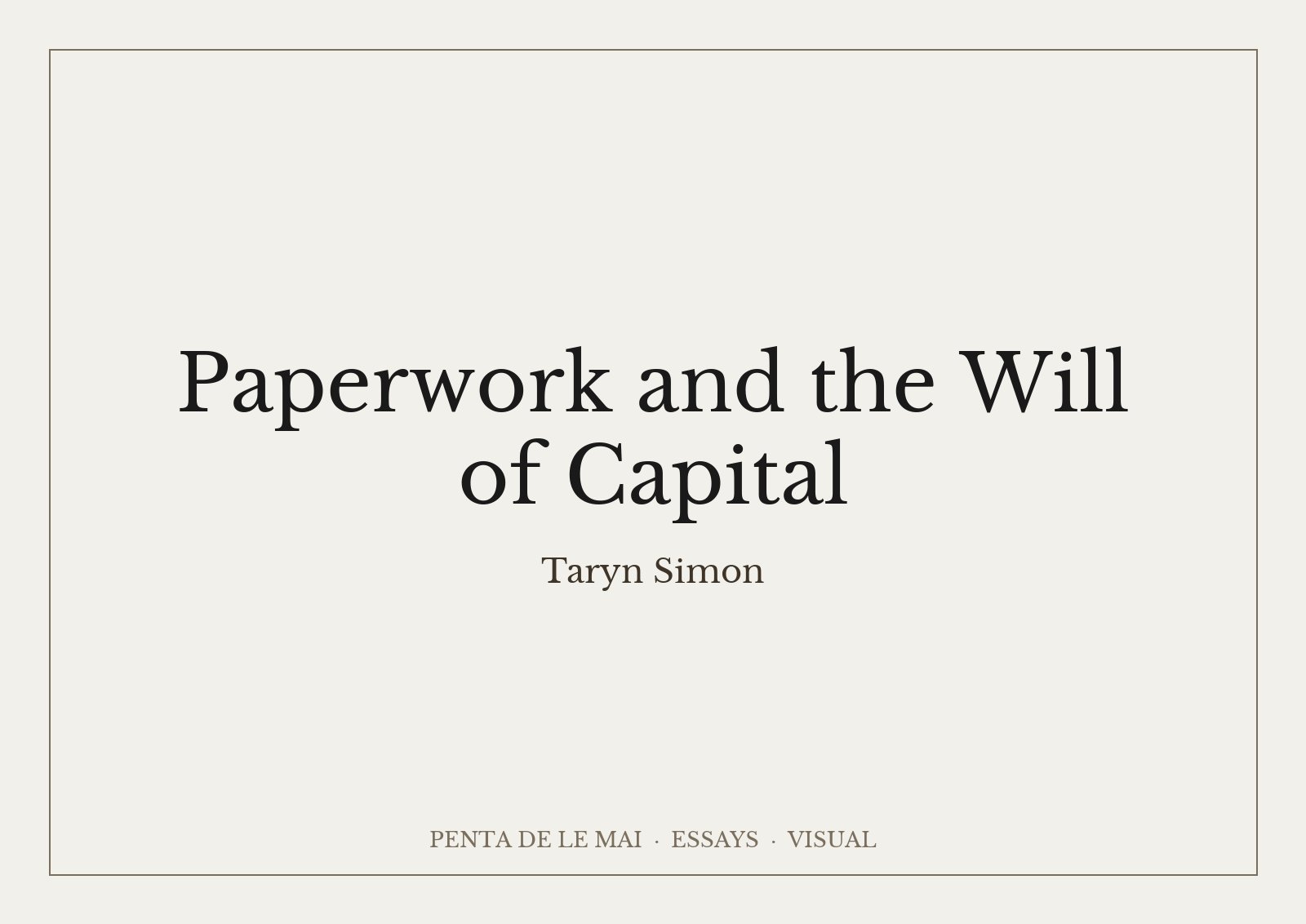
The photographs number 36. Each shows a rebuilt bouquet, an archival inkjet print with text on herbarium paper. The frames are mahogany, in the manner of boardroom furniture. Each stands about 216 cm high. The pictures are large and bright, closer to Dutch flower painting than to documentation.
Dried, sewn, cast in concrete
The second part of the project is sculpture, a medium Simon was trying for the first time. Specimens from the 36 bouquets were dried, pressed and sewn onto herbarium paper, the way botanical gardens keep plant records. A complete set of the 36 botanical sheets was placed in each press made of pigmented concrete with steel braces. Twelve presses in all.
The image is plain. Flowers, the most fleeting thing in the room, held by concrete, the heaviest and most lasting. Treaties can be torn up, forgotten, replaced by others. The specimens stay pressed, waiting for someone in the future to open them.
Paperwork and the Will of Capital was first shown at the 56th Venice Biennale in 2015. In 2016 Gagosian showed it at 555 West 24th Street, New York, from 18 February to 26 March. The catalogue, published by Hatje Cantz and Gagosian, includes botanical texts by Daniel Atha and a short story by Hanan al Shaykh.
As in An American Index of the Hidden and Unfamiliar, Simon sets image beside text. But here what is hidden is not behind a locked door. It sits in the middle of the frame, on the table, in front of everyone. Only no one looks at it.
Contemporary Art