
Essays · Photography
Zanele Muholi. Somnyama Ngonyama (Hail the Dark Lioness).
Everyday objects carry history too.
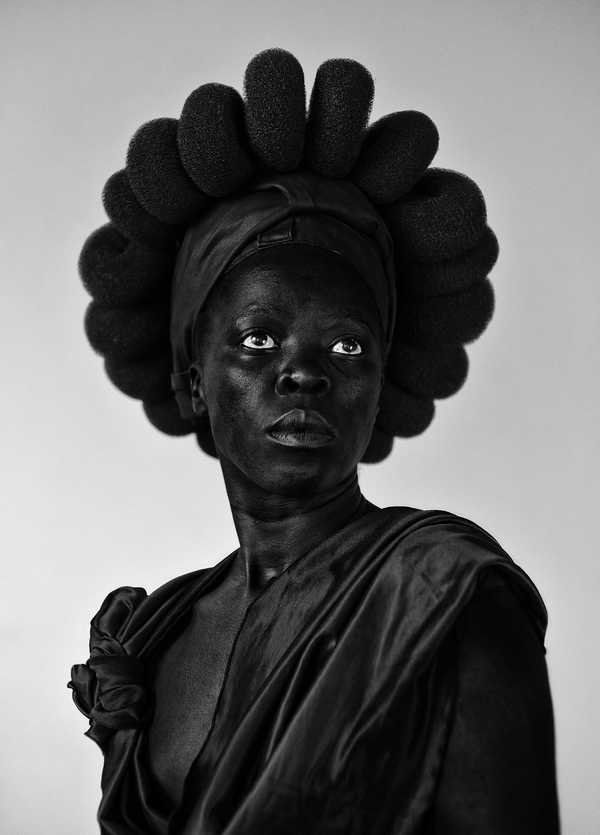
Courtesy of the Artist and Stevenson, Cape Town/Johannesburg and Yancey Richardson, New York · Tate
A visual activist
Zanele Muholi was born in 1972 in Umlazi, Durban, South Africa, and lives in Johannesburg. Muholi uses they/them pronouns and describes themself as a visual activist. Photography, for Muholi, is a way to record marginalised communities and make them visible.
Before Somnyama Ngonyama, Muholi made several series about lesbian, transgender and gender non conforming people in South Africa. Faces and Phases is an ongoing archive of portraits of black lesbian and transgender people, each paired with the sitter's own testimony. Brave Beauties portrays non binary people and trans women, many of them pageant winners. Only Half the Picture, the earliest work, deals with love and with trauma.
Those series point the camera at others. From 2012, Muholi turned it on themself.
Props from the kitchen
Somnyama Ngonyama is Zulu for Hail the Dark Lioness. It is a series of self portraits, mostly black and white, made in many cities around the world.
In each image Muholi wears, wraps or balances everyday things. Scouring pads. Latex gloves. Rubber tyres. Cable ties. Things found in any home and noticed by no one. Placed on the head, the neck, the shoulders, they look like ceremonial headdresses, collars, crowns. Yet the viewer never forgets what they are.
Each object brings a story. Cleaning materials point to domestic work, a job tied to black South African women under apartheid and after. Tyres can recall violence. None of this is written in the pictures. It is already inside the objects.
Bester, the mother
Several works in the series are titled Bester. That was the name of Muholi's mother, Bester Muholi, a domestic worker who endured great hardship under apartheid. She has died. The pictures are Muholi's way of remembering her, through the tools of the work she did.
Here self portraiture is not only about the self. Muholi takes up the mother's tools, stands in the mother's place, and looks straight out as the mother perhaps was never allowed to. A self portrait becomes a portrait of two people.
Muholi also darkens their own skin by raising the contrast in the print. Muholi has said this is a way of reclaiming their blackness, which they feel is constantly performed by a privileged other.
The direct gaze
From 5 November 2020 to 7 March 2021, Tate Modern in London held Muholi's first major survey in the UK, with 260 photographs spanning their career. Somnyama Ngonyama was one of its most discussed parts.
What stays is the gaze. In most images Muholi looks straight into the lens. No smile, no turning away. The history of photography holds countless pictures of black people being looked at. Here a black person looks back.
Self portraiture has a long history, from Vivian Maier catching herself in mirrors and shadows to elaborate staged images. Muholi uses the form not to find themself, but to answer the images others have made of them.
Photography