
Essays · Photography
Santu Mofokeng. The Black Photo Album / Look at Me.
Each photograph is a choice to be seen.
Tate · Tate
Pictures he could not recognise
Santu Mofokeng (1956 to 2020) was a South African photographer who grew up in Soweto. He worked through the apartheid years, and much of his career turned on one question: what do photographs say about black South Africans, and who is doing the telling.
While working on a research project about life in Soweto, Mofokeng came across very old black and white photographs in many family homes. They were portraits of grandparents and great grandparents, taken in studios, in formal dress. He said he could not relate to them. They looked like no image of black people he was used to seeing.
That sense of strangeness led him to this work.
Eighty slides
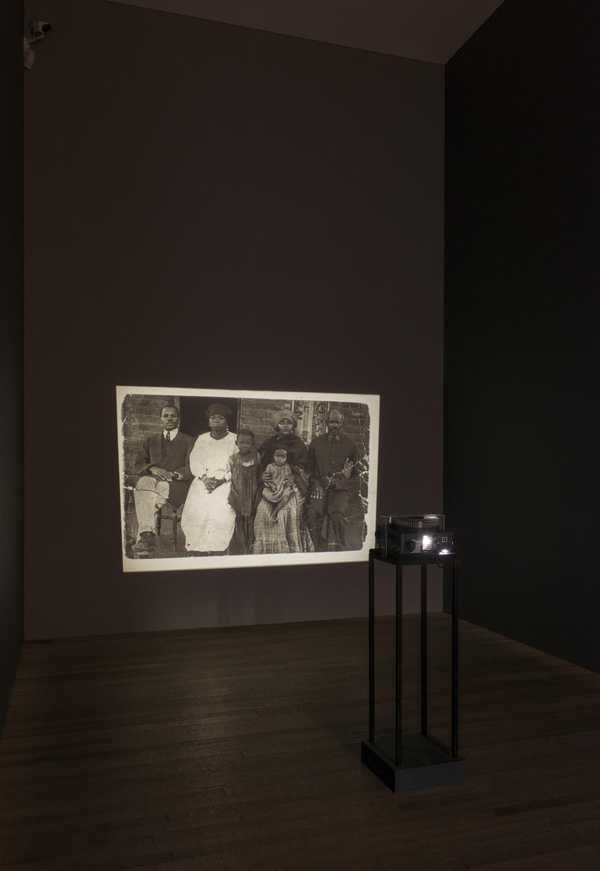
The Black Photo Album / Look at Me: 1890 to 1950 premiered at the Johannesburg Biennale in 1997. It is a projection: 80 black and white 35mm slides shown in sequence in a dark room. About half are scans of photographs from the albums of nine families across South Africa, digitally reworked by Mofokeng.
The sitters were middle class black South Africans, photographed between 1890 and 1950. They commissioned the photographers themselves. They stand or sit in the manner of Victorian portraiture: suits, starched collars, long dresses, high backed chairs, painted backdrops. Many were retouched in the studio fashion of the day.
The work is now in the Tate collection and has been shown at Tate Modern. It is one of the slide based works Tate holds, a format whose projectors and film are slowly disappearing.
A counter archive
To see why these family pictures carry weight, remember how images of Africans were usually made in the same period. Mostly by outsiders: anthropologists, missionaries, postcard makers for European buyers. The people pictured were objects to observe and classify. They chose nothing.
Mofokeng's album does the opposite. Each portrait here is a moment when black South Africans ordered their own image. They chose their best clothes and their most dignified stance. They wanted to be seen as people with names, homes, standing. Scholars describe the work as a counter archive, set against fixed ideas of what Africans looked like.
One can also ask: why the Victorian manner? It was the visual language of colonial power. Using it, the sitters both complied and claimed something back. Mofokeng does not answer for them. He leaves the question open in the projection room.
Look at me
The title has two halves. The Black Photo Album names an object: an album. Look at Me is a sentence, in the first person. The sitter speaks, not the person behind the camera.
In a dark room, each slide appearing and fading, these unfamiliar faces become hard to ignore. The viewer does not know their names. Often their own descendants no longer know. But the gaze remains, and it looks straight out.
Mofokeng did not make these photographs. He found them and gave them a room in which to be seen again. His work was that of a keeper, not a photographer. A similar gesture appears in Newsha Tavakolian's Iranian photo album, where a family album also becomes a place to ask who has the right to tell whose story.
Photography