
Essays · Photography
Mikhael Subotzky. Beaufort West.
A place people pass through. And a place people stay.
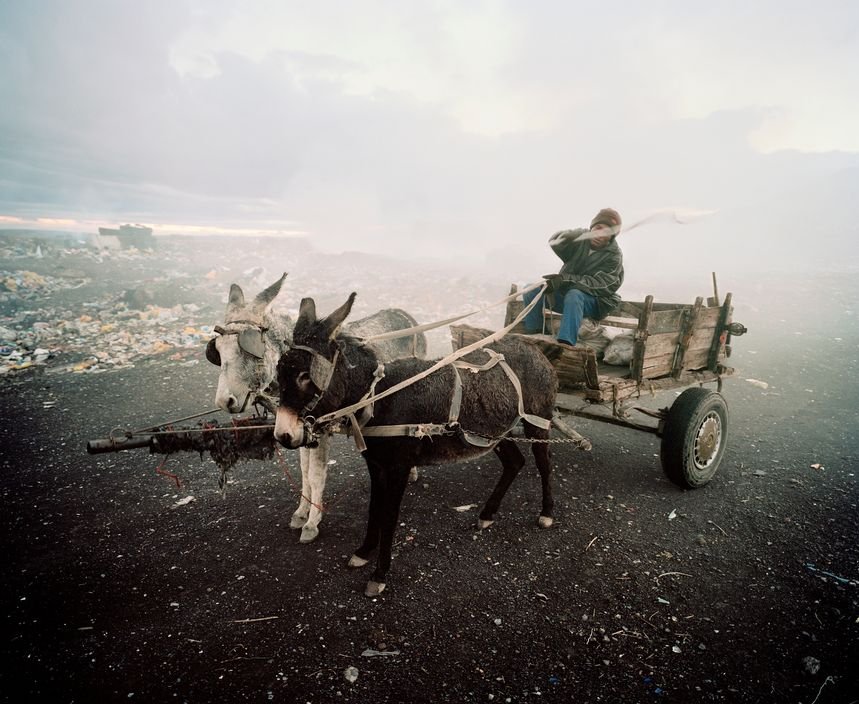
© Mikhael Subotzky · Magnum Photos
A town halfway
The N1 is the great highway linking Cape Town and Johannesburg. Beaufort West sits almost exactly at its midpoint, in the wide, dry Karoo. For most South Africans the name means a stop: fuel, a quick meal, a night's rest, then on.
The town has one strange detail. Its prison stands in the middle of town, on an island in the highway itself. Trucks and buses circle its walls. The men inside hear traffic all day. The people on the road see the wall and think nothing of it.
Mikhael Subotzky, a South African photographer, photographed the town in 2006 and 2008. He did not stay on the road. He went inside: into the prison, the police stations, private homes, the rituals and daily work of the people who remain.
What the passing traffic misses
The pictures in Beaufort West are in colour, looking closely at each person and each street corner. There are Sunday church services inside the prison. There are police stations. There are sangomas, traditional African practitioners, with their muti. There are jackal hunters, a trade in the farming country around the town.
None of it is a tourist view. None of it is decoration. These are slices of a place living with its problems: poverty, crime, violence, faith, and old boundaries still marked on the ground after apartheid.
Subotzky did not shoot from the outside in. He came back to the town over several years and was allowed into places that are hard to enter. The faces in the pictures either meet the lens or ignore it. Both show that the photographer had been there long enough.
One book, two voices
Beaufort West became a book in 2008, published in a large format by Chris Boot in London. It was Subotzky's first photobook, with 45 colour photographs.
It opens with an essay by Jonny Steinberg, a South African writer known for his work on prisons, policing and life in neglected places. It closes with Subotzky's own commentary on each picture. The two voices give the images context without turning them into illustrations.
So the reader both sees and knows. They learn who the people are, where they are, why they are there. Yet each picture keeps something of its own: a light on a wall, a glance, a gap between two people.
Why it stays
When it appeared, Beaufort West was read as both document and visual manifesto for a new wave of South African art photography. A document, because it records a real place in real years. A manifesto, because it shows a way of looking: not from above, not from outside, but from within a small community.
Beside Alec Soth's river journey in Sleeping by the Mississippi, two uses of a road appear. Soth follows the river and stops in many places. Subotzky stops at a single point on the highway, and stays. Both have a prison in the frame. Both know that a country shows itself most clearly in the places people only mean to pass through.
Beaufort West draws no conclusion about South Africa. It simply stands the viewer in the middle of the traffic circle, beside the wall, and asks: have you ever stopped here?
Photography