
Essays · Fashion as Design
Tenue correcte exigée, quand le vêtement fait scandale.
Scandal reveals the rules no one wrote down.
Musée des Arts Décoratifs (MAD Paris) · Musée des Arts Décoratifs (MAD Paris)
Four hundred objects on rue de Rivoli
Tenue correcte exigée, quand le vêtement fait scandale opened at the Musée des Arts Décoratifs, 107 rue de Rivoli, Paris, from 1 December 2016 to 23 April 2017. The title borrows a phrase seen at the doors of restaurants and clubs: proper dress required. The second half names the subject: when clothing causes scandal.
More than 400 objects were shown. Not only clothes and accessories, but portraits, caricatures, objects. Scandal does not live in a garment. It lives in other people's eyes, and caricature is where those eyes are recorded most clearly.
The curator was Denis Bruna. The designer Constance Guisset created the exhibition space.
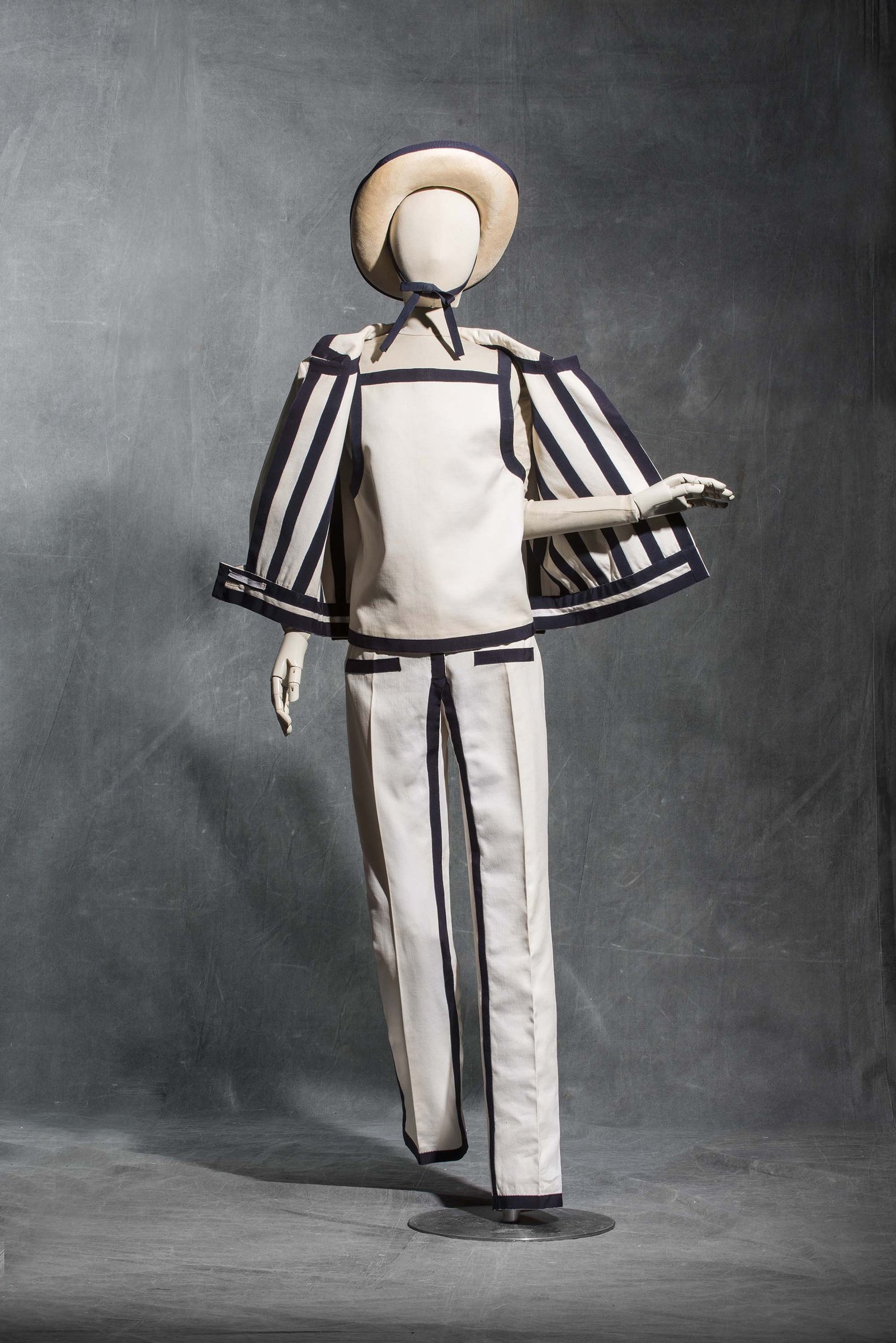
The show had three parts. The first on dress codes, from biblical times to today's television makeover shows. The second asked: girl or boy?, about wardrobes crossing gender lines. The third on provocative excess: too short, too wide, too sheer.
Trousers and skirts
The most memorable story is women's trousers. In Paris, a regulation from 1800 barred women from wearing trousers without permission. It had long gone unenforced, but was only formally repealed in 2013. For more than two centuries a piece of paper sat in a file while women had long been wearing trousers in the street.
The reverse is the man's skirt. The exhibition set skirts designed for men beside the history of trousers for women. Two movements in opposite directions, asking one question: why does a piece of cloth belong to one gender?
Then the tuxedo for women, which the French call le smoking. The miniskirt, baggy trousers, jeans. Each was once deemed indecent, unsuitable, unacceptable somewhere, at some point.
The names in the show span generations: Marlene Dietrich, Gabrielle Chanel, Elsa Schiaparelli, Yves Saint Laurent, Jacques Esterel, Mary Quant, André Courrèges, Jean Paul Gaultier, Yohji Yamamoto, Rei Kawakubo, Alexander McQueen, John Galliano, Rick Owens.
A queen in muslin, a minister in a Mao collar
Scandal did not come only from the street. It came from the palace too. The exhibition recalls the robe volante, the loose flowing gown of the eighteenth century, once seen as too casual.
And the portrait of Marie Antoinette in a light muslin dress, painted by Élisabeth Vigée Le Brun in 1783. The public saw the queen in what looked like underwear, and the reaction was strong enough that the painting had to be replaced with another. Even the most powerful woman in the country was not outside the dress code.
Two centuries later, in 1985, culture minister Jack Lang entered the French National Assembly in a Mao collar suit by Thierry Mugler, with no tie. The suit caused debate. Not because it was revealing or short, but because it ignored a convention: men in parliament wear ties.
Side by side, the two stories show that scandal has no fixed shape. It can be cloth too thin, or simply a collar without a tie.
Invisible rules
The exhibition does not conclude that every dress code is wrong. It shows that such codes are always social and political. Who may wear what, where and when, is a question of rights, gender and class.
Many once scandalous items are now everyday wear. Women's trousers, jeans, the miniskirt. Looking back, it is hard to believe they were banned or mocked. That disbelief is the lesson: today's lines will look just as strange to those who come after.
Penta has written about Gabrielle Chanel, a name present in this exhibition, who brought into women's wardrobes things that had belonged to men. Each time, a line was moved.
Fashion as Design