
Essays · Modern Art
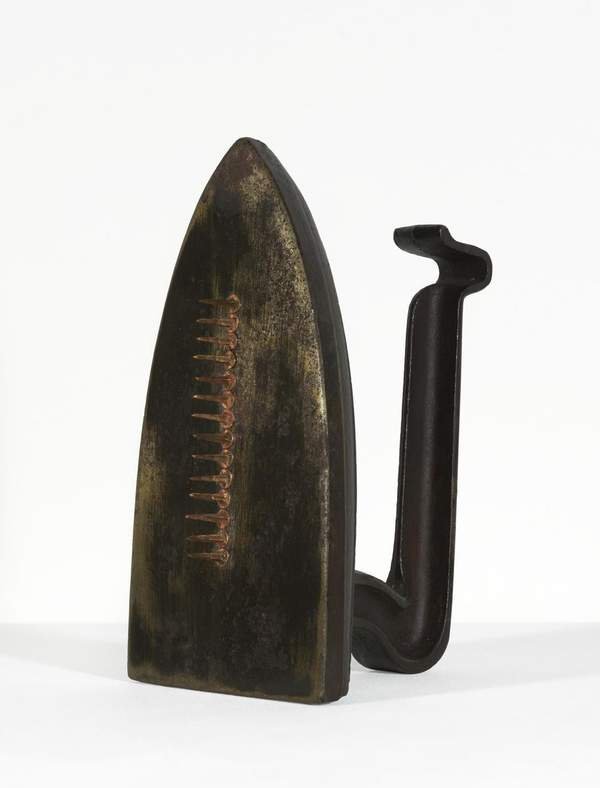
Man Ray. Cadeau.
One row of nails, and a tool becomes a question.
Tate · Tate
An afternoon in Paris
In 1921 Man Ray opened his first solo exhibition in Paris. He had just arrived from New York and his French was still poor. As he later told it in his autobiography, on the day of the opening he had a drink with the composer Erik Satie. Leaving the café, the two passed a hardware shop.
Satie helped him buy what he wanted. An iron, some glue, some nails. Man Ray carried them to the gallery and made the work on the spot, gluing a row of nails along the base of the iron, points facing down.
He called it Cadeau, French for gift. He meant his friends to draw lots for it. But in his telling, the gift disappeared from the gallery that same afternoon. The original is gone. What remains is Man Ray's photograph of it, and it was the photograph that made Cadeau famous.
Paris was then at the height of Dada, the movement of artists who distrusted reason after the war and liked to overturn whatever passed for sense. Man Ray stood at its centre, a close friend of Marcel Duchamp, who had brought ready made objects into the exhibition room a few years earlier.
A household tool made strange
The iron in Cadeau is the ordinary continental flat iron of the time, the kind heated on a stove before use. An object of housework, of laundry afternoons. Man Ray did not change its shape. He added a single row of fourteen nails.
That was enough. The smooth, flat base now bristles with points. The tool meant to make cloth flat can only tear it. Its function is reversed. The familiar thing becomes hard to name.
Tate describes the work as one of the famous icons of Surrealism. Turning an everyday object into something strange and unnameable showed the power objects held in Dada and Surrealism: to escape logic, and the usual pairing of words with things.
There is tension in the title itself. A gift is given in goodwill. This object is heavy and sharp, and if heated like a real iron it would both burn and cut. Tate notes that the nails and the hot metal suggest a hidden violence at odds with the word gift. Man Ray explains nothing. He lets the name and the object stand side by side.
The remakes
The Cadeau at Tate is not the object of 1921. It is a replica of 1972, under twenty centimetres high.
Many of Man Ray's early objects were lost or damaged, as were many of Duchamp's. Some are known mainly through photographs in Surrealist magazines. Man Ray sometimes made an object only to photograph it, then discarded or reused it. In the 1960s and 1970s, as collectors grew interested, he remade some works and had them produced in editions.
Cadeau had an edition in 1963 and an edition of eleven in 1972, both published by Galleria Il Fauno in Turin. Tate's piece is one of about five trial pieces made before the 1972 edition. According to Man Ray's assistant Lucien Treillard, they exist because it was hard to find a glue that would hold the nails. Each is inscribed essai, and each is in effect unique.
The trials used different irons from between the wars, since identical irons from the 1920s and 1930s were hard to find. The nails are copper, of the type used in tapestry making. A coat of varnish probably protects the inscriptions in oil crayon. The Tate Collectors Forum presented the work to Tate in 2002.
An object that needs a name
Man Ray is best known for his photographs, so his objects are less familiar, though he was one of the pioneers of art between the wars. Cadeau is the exception. Almost anyone who has studied Dada has seen it.
Man Ray once said, in effect, that some objects need names. Cadeau is one. Without its name it is a broken iron. With it, it becomes a question about giving, about use, about what a familiar object can hold without our noticing.
More than a century after that afternoon in Paris, the iron still stands at Tate Modern, in the room for international Surrealism. It does not heat up. It glides over no cloth. It rests there, nails pointing down, waiting to be looked at.
Modern Art