
Essays · Modern Art
Jean Arp. According to the Laws of Chance.
A torn edge is where time is let in.
Tate · Tate
Pieces of black paper
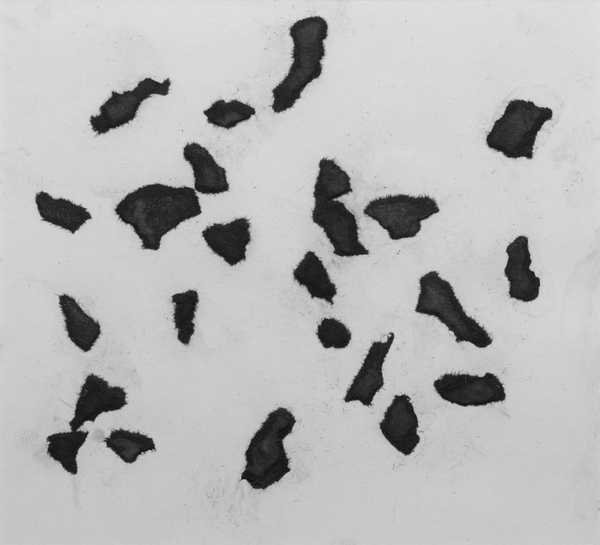
The work is small, about sixteen by seventeen centimetres. On a thin off white board lie pieces of torn black paper, irregular in shape. None overlaps another. A few just touch.
The paper is sugar paper, coarse and soft, the kind used in schools. Torn, its edges turn feathery. Up close you can still see small black fibres that came loose as the pieces were laid on the glued surface, left behind on the white.
Arp made a number of similar collages in 1932 and 1933. Most are known only as papiers déchirés, torn papers. The title Selon les lois du hasard, according to the laws of chance, was probably not Arp's own. Tate notes that a Galerie Cramer label on the back shows it carried this title at least by 1961, when the collector Robert Lewin bought it. In 1987 Mr and Mrs Lewin gave it to Tate.
The word chance suggests Arp may have let the pieces fall onto a glued surface, and Tate's gallery label describes it that way. But the museum's catalogue entry also notes that the placing here looks quite controlled. For Arp, chance was never simply letting go.
Chance is not senselessness
In 1915 Arp gave up traditional oil painting. He made embroideries, tapestries and paper collages, many with Sophie Taeuber, whom he married in 1922. These were the Dada years in Zurich. Arp read pre Socratic philosophy, was drawn to Eastern mysticism, and used chance and flux as a protest against the West's over reliance on reason.
Some works from that time were also titled according to the laws of chance. Arp later explained that since the arrangement, proportions and colours seemed to hinge on chance, he named them so, and that chance for him was part of an inexplicable order, like the order of nature.
He drew a firm line between chance and senselessness. In a manuscript found after his death, he complained that people used the word chance as if it meant nonsense, and stressed that he had never titled a work according to the law of senselessness. He did not work carelessly. He simply did not follow a fixed plan.
Tate's label records that Arp compared the artist to a plant bearing fruit. The fruit is not designed. It grows.
The attic
If chance was there from the Dada years, what led Arp to tear paper in the early 1930s? Tate's catalogue suggests the cause was less formal than a new preoccupation with mortality. His mother died in May 1929, which distressed him deeply, and he wrote about death in the following years.
But in Arp's own account of 1958, the greatest shock came from something else. He had cut paper with extreme precision, smoothing edges with sandpaper, unable to tolerate a stray fibre. A small crack could make him destroy a whole collage. Then, asked to show some old collages made with Sophie Taeuber, they brought them down from the attic where they had lain for years in heat, cold and damp.
The papers had come unstuck. Mould, cracks, blisters between paper and card. After weeks of confusion he began to tear instead of cut. He smeared paste carelessly, was glad when ink ran, and welcomed cracks. He wrote that he had accepted the brevity, fading and withering of existence, and welcomed them into the work as it was being made.
Black, white and stillness
In According to the Laws of Chance, decay shows in the feathery edges and softness of the paper. Tate reads the seemingly unordered placing, free of struggle or tension, as an image of rest, perhaps of death. Black and white, the non colours, draw attention to each contour, to the contrast of being and non being.
The form has roots in the wooden reliefs called Constellations of 1929 and 1930, one of which, also titled according to the laws of chance, is at Tate. The use of the unplanned returns in other Dada artists too, such as Man Ray and his objects with shifted meanings.
Arp first showed the torn papers in 1933 at Jeanne Bucher's gallery in Paris, and most went to the United States. Late in life he felt they had anticipated the all over painting of the new American art. In 1954 he even tore up one of his own woodcuts from 1920 to make a new work in the same way.

Modern Art