
Essays · Contemporary Art
Gerhard Richter. Cage.
Not controlling everything. Only deciding what to keep.
Tate · Tate
Six square canvases
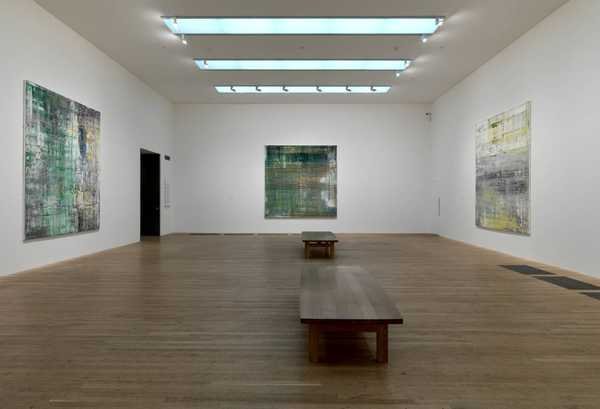
Cage (1) to Cage (6) are six square abstract paintings in oil on canvas. Three measure 2.9 metres a side. The other three are slightly larger, 3 metres a side. They are meant to hang together in one large gallery.
All six have a thick, rough, textured surface. Across it run horizontal and vertical bands, along with scratches and indentations going in many directions. In places the top layer of paint has been pulled away, exposing several layers beneath.
Each is different. Cage (1) is mostly lime green, with a bottle green bar across the upper part and a white vertical band on the right. Cage (2) is pale grey, white and lime, flecked with bright red and charcoal. Cage (3) is dense with scratches. Cage (5) is mainly grey. Cage (6) shows the widest range of underlying colour: green, white, yellow, black, blue.
Gerhard Richter, born in 1932, painted the series in his studio in Cologne in 2006.
The squeegee as protagonist
The art historian and curator Robert Storr followed Richter through the making of Cage, recording each stage in photographs and text. He noted that there are hardly any brush marks in these paintings. The main tool is the squeegee.
Richter's squeegees are large, sometimes several metres wide, with a clear flexible edge. He drags one across the canvas, spreading paint laid down in advance. As Storr describes it, depending on the amount, consistency and placement of the paint and the pressure used, the new layer may cover the old one smoothly, merge with it into streaks and blooms, or fail to stick and leave small hollows.
Richter also used a retarder so the paint would not set too fast. That let him drag, scrape and drag again over the same canvas. Each pass laid a new layer over the history of the earlier ones.
Listening to John Cage
The series is named after the American experimental composer John Cage. Richter admired him greatly and listened to his music while painting the series in 2006.
Richter first encountered Cage in the 1960s as a student at the Düsseldorf Academy. Cage performed a piece there in which he wrote with a pen fitted with a microphone, so the scratch of the nib on paper was amplified for the room.
In a 2006 conversation with the curator Hans Ulrich Obrist, Richter spoke of the lasting importance of Cage's ideas: discipline, chance, coincidence. He explained that however practised he is, he cannot always foresee what will happen when he applies or removes a large amount of paint. Some surprises disappoint, some please. He has to think them through before going on.
Storr suggested that what Richter and Cage share is a willingness to give up one kind of control so that other things can happen.
Chance, worked over
But Richter does not let chance decide everything. He has said coincidences only become useful to a painting once they have been dealt with: eliminated, allowed, emphasised, or brought into a particular form. That, for him, is what makes the work skilled and artistic.
The Cage paintings were first shown at the 52nd Venice Biennale in 2007, in an exhibition curated by Storr. Since 2007 they have been lent to Tate from a private collection and have hung many times at Tate Modern.
Before the six canvases, the viewer finds no image to recognise. There are only the marks of the squeegee's passes, and layers of colour uncovered on purpose. The surface is a record of the time of painting, as Twombly's streaks of paint record a year going by.
Contemporary Art