
Essays · Olfactory Art
Mandy Aftel. A museum of curious smells.
Raw material deserves to be looked at too.
Berkeley: a perfumer on her own road
Mandy Aftel works in Berkeley, California. In her own words, she began making perfume from natural materials about thirty years ago. Aftelier Perfumes, her studio, uses no synthetics. Everything is blended and bottled in small batches, in a working space not open to the public.
Her route to smell was not straight. Her list of books includes titles with nothing to do with perfume: a biography of Brian Jones of the Rolling Stones, books about storytelling and conversation in daily life. Then came smell, and she stayed.
She describes how she sources materials: often smelling a dozen versions of the same oil, from different places, to choose one. Her palette includes essences aged for decades, grown old in their own way.
Since 2003 she has also made essences for cooking, for chefs and mixologists. Smell and taste, for her, are two doors into the same room.
Essence and Alchemy: rewriting the history of materials
In 2001 Aftel published Essence and Alchemy. The book is not a blending manual. It goes back through the history of natural materials: how they were extracted, what they were used for, in the kitchen, in the temple, on the body. It has been translated into eight languages and won the Richard B. Solomon Award of the Sense of Smell Institute.
Other books followed. Aroma and The Art of Flavor, written with chef Daniel Patterson, tie smell to cooking. Fragrant, in 2014, looks at the bond between smell and human appetite. Scents and Sensibilities is about solid perfume.
Read together, her books share a habit: start with the material, then the product. A flower, a strip of bark, a drop of resin. Then what people did with them.
The Institute for Art and Olfaction in Los Angeles, where she is an advisor, gives an annual award in her name. In 2022 the institute gave her its Septimus Piesse Visionary Award for her life's work.
A cottage at the end of a brick drive
The Aftel Archive of Curious Scents sits in a small cottage at the end of a brick driveway, at the same address as her studio. It opens only on Saturdays.
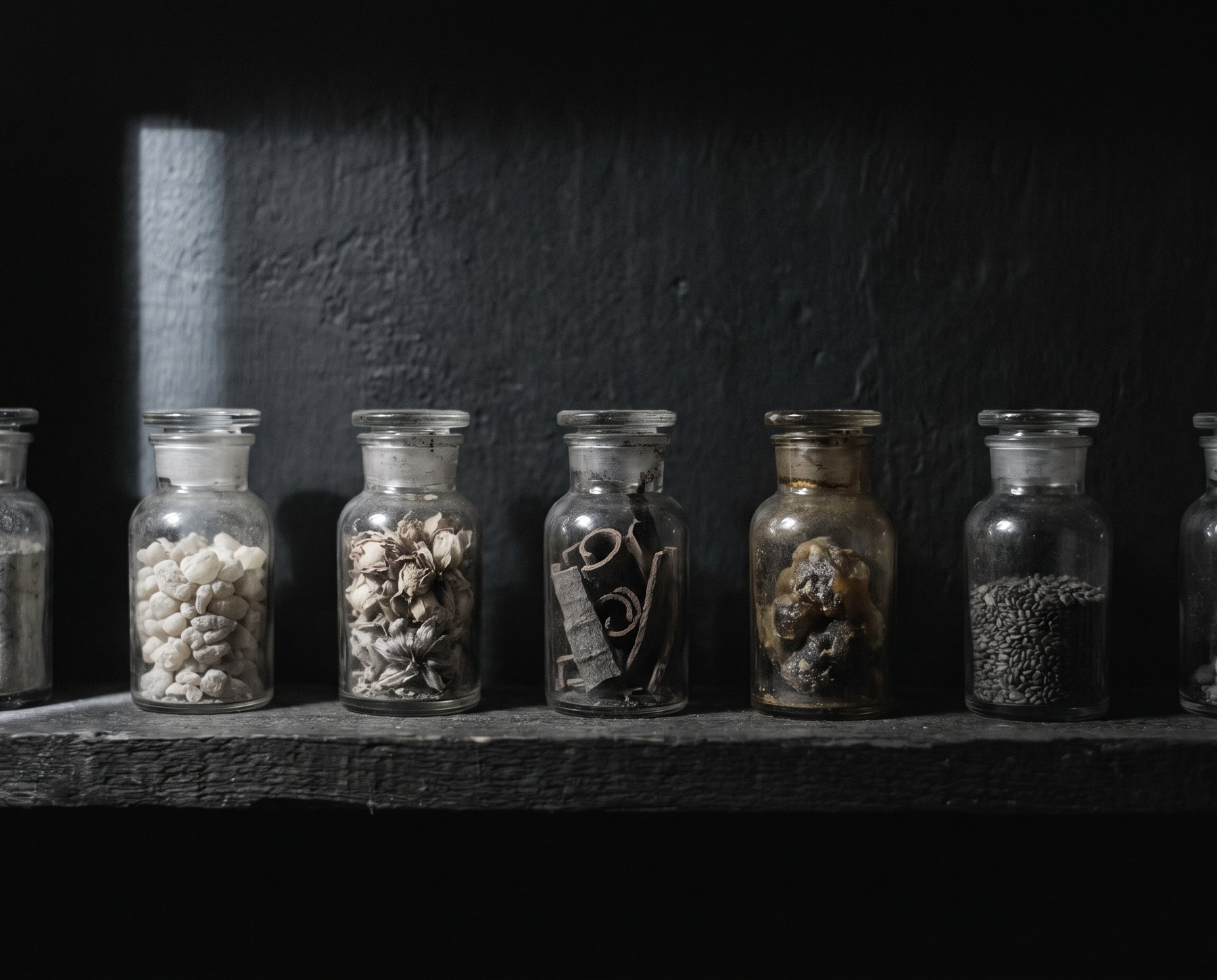
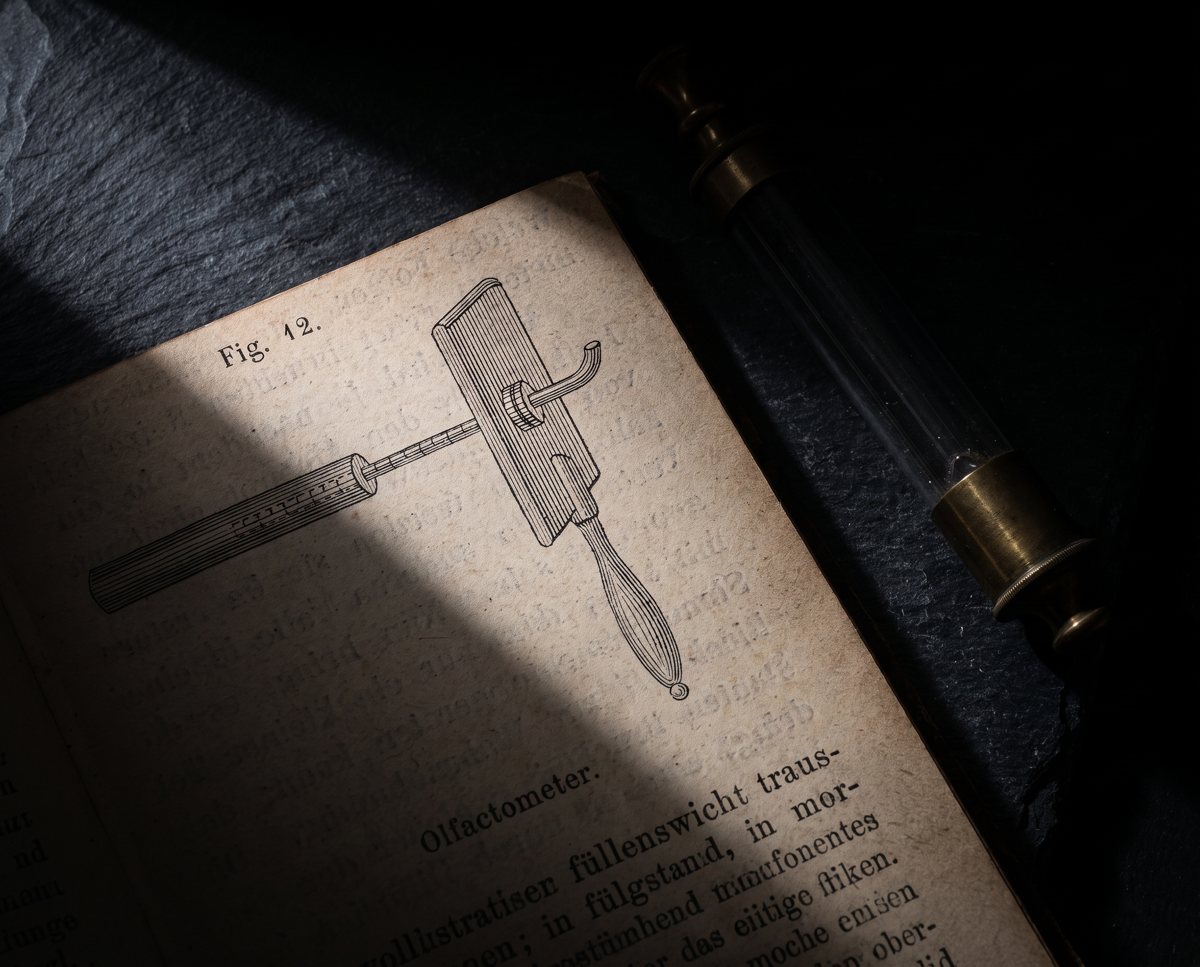
Inside is a cabinet of curiosities, old wooden drawers of botanical materials, more than a hundred antique books on aromatic materials, engravings and hand tinted postcards, some over four hundred years old. There is a sixteenth century book of symbols. There is a perfumer's organ.
Visitors can handle raw things: vetiver grass, benzoin resin, bushman's candle. They wear a glove to turn the pages of the old books. They choose samples from more than two hundred essences drawn from fruits, flowers, trees, grasses and resins.
In the garden there are fifty more essences to smell, among them historical animal scents, essences over a century old, and oud.
Raw material as exhibit
In an art museum, material usually hides behind the work. We look at the painting, not the pigment. We look at the statue, not the block of stone before the chisel.
Aftel's archive reverses that order. Here the material is what is shown. An essence is not presented as a step on the way to a pretty bottle, but as a complete thing, with an origin, an age, a history of use.
That makes the small house in Berkeley closer to a study room than a shop. Visitors are not asked to buy anything. They are asked to look closer, smell longer, and take home a few scent strips.
It is also the spirit of the Institute for Art and Olfaction, which Aftel advises: smell as something to understand and discuss, not only to use.
Olfactory Art