
Essays · Olfactory Art
Zwaardemaker. Nine classes and a machine.
A smell with a number still has no name.
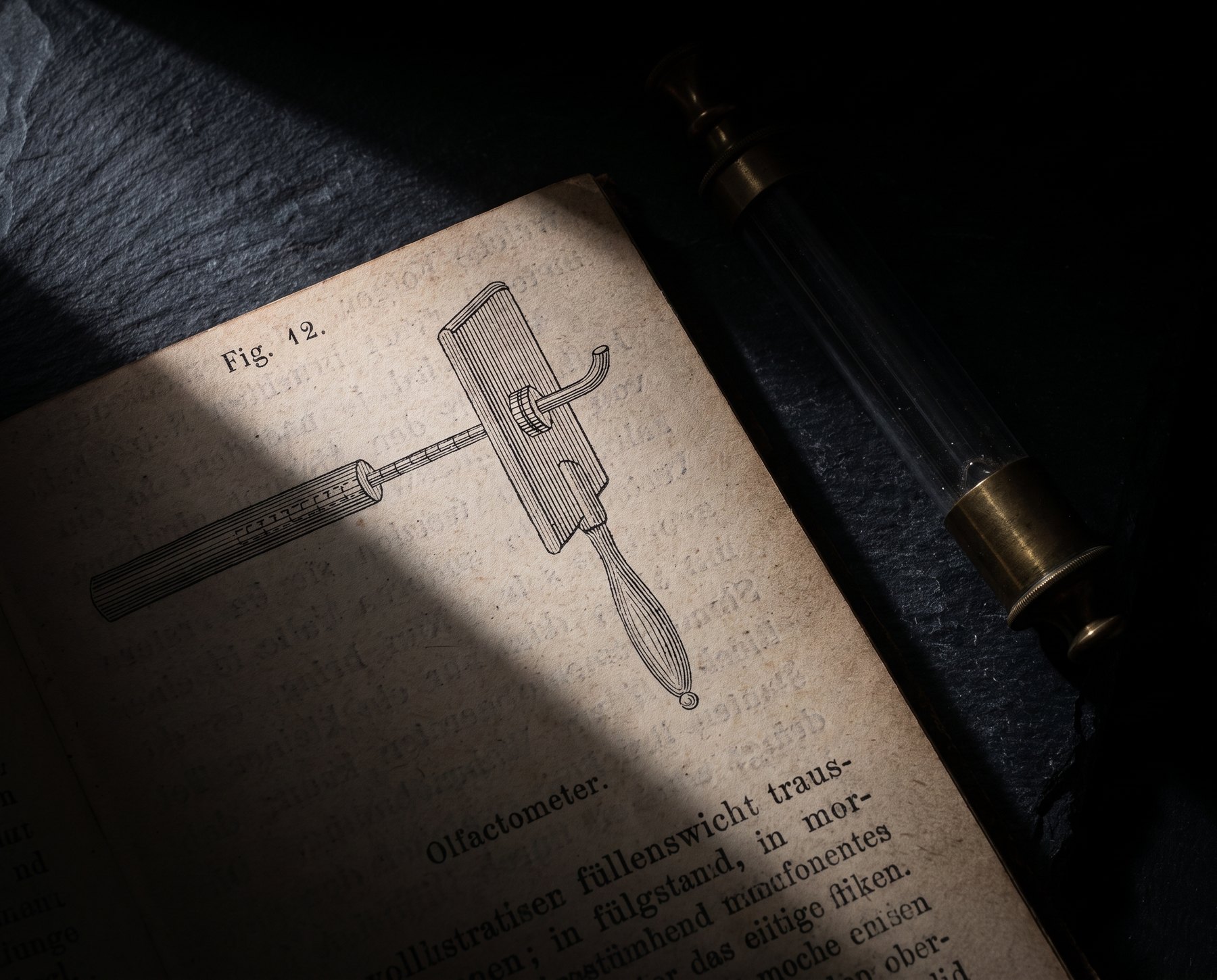
Utrecht, 1888: the olfactometer
Hendrik Zwaardemaker lived from 1857 to 1930. He was a Dutch physician and physiologist. In 1888, while an army doctor in Utrecht, he first described a device he called the Riechmesser, a smell meter, or olfactometer. The description appeared in a volume honouring the ophthalmologist Donders, then in a Berlin medical weekly the same year, and in The Lancet the year after.
Its construction was simple. A curved glass tube, one end placed in the front of a nostril. The tube slid inside a cylinder ten centimetres long, made of or soaked in an odorous material. Pull the cylinder away from the inhaling end and more of the scented surface meets the airflow, so the smell grows stronger. A wooden screen covered the other nostril.
What mattered was the length. It could be read on the tube. Now an experimenter could say that one person began to smell at this mark and another at that one. Smell, a private sensation, became something that could be compared between people.
From this measurement Zwaardemaker defined a unit he called the olfactie, based on the threshold of a person with a normal sense of smell.
Nine classes and their subclasses
Seven years after the device came the book. Die Physiologie des Geruchs, the physiology of smell, was printed by W. Engelmann in Leipzig in 1895; the preface is dated Utrecht, March of that year. Most of it concerns measurement: thresholds, intensity, fatigue of the nose, and the way two smells can weaken each other. The classification sits in chapter thirteen.
The nine classes are ethereal, aromatic, fragrant or balsamic, ambrosial, alliaceous, empyreumatic, caprylic, repulsive and nauseous. Most have subclasses. The aromatic class, for instance, splits into camphor, spicy, anise and lavender, lemon and rose, and almond groups.
The novelty lies in the examples. Where he could, Zwaardemaker chose a compound of known structure to stand for each subclass: eugenol for the spicy group, benzaldehyde for almond, geraniol and citral for lemon and rose. The burnt class gathers roasted coffee, toasted bread, tobacco smoke.
At the end of the chapter he tries to fold the nine into two large groups: the first four are the smells of food, the last five the smells of decay.
Building on Linnaeus and Rimmel
Zwaardemaker did not start from nothing. He kept the seven class frame Linnaeus had set out in 1752 and added two. The ethereal class came from Lorry, the burnt class from Haller. The old seven, he explained, had been made for the remedies of Linnaeus's day; modern chemistry needed room for fruit esters and for the smells of smoke, tar and benzene.
He also cited Eugène Rimmel's The Book of Perfumes again and again. The ethereal class begins with Rimmel's fruit series, with the pear as its type. Chemistry had since shown that pear, apple and pineapple all owe their smell to esters, so a group that perfumers had gathered by nose coincided with a chemical group.
He also recorded where things did not fit. Similar smells often have similar structures, he wrote, but similar structures do not necessarily smell alike. That question is still open.
When smell gets a unit
The olfactometer could not say what a smell is. It answered another question: how strong a smell is, and whose nose is more sensitive. A narrow question, but one that could be answered with a number that others could check.
In Zwaardemaker's book, classification and measurement stand side by side as two halves of one task. The nine classes still rest on the nose and on tradition. The device rests on a ruler. Between the two lies the whole science of smell of the twentieth century.
Looking back, Zwaardemaker is the one who put the nose on the laboratory bench. He did not make it less mysterious. He showed that one part of it, however small, could be counted. The rest still belongs to the one who smells.
Olfactory Art