
Essays · Olfactory Art
Piesse. The gamut of odours.
Borrowing the words of sound to speak of smell.
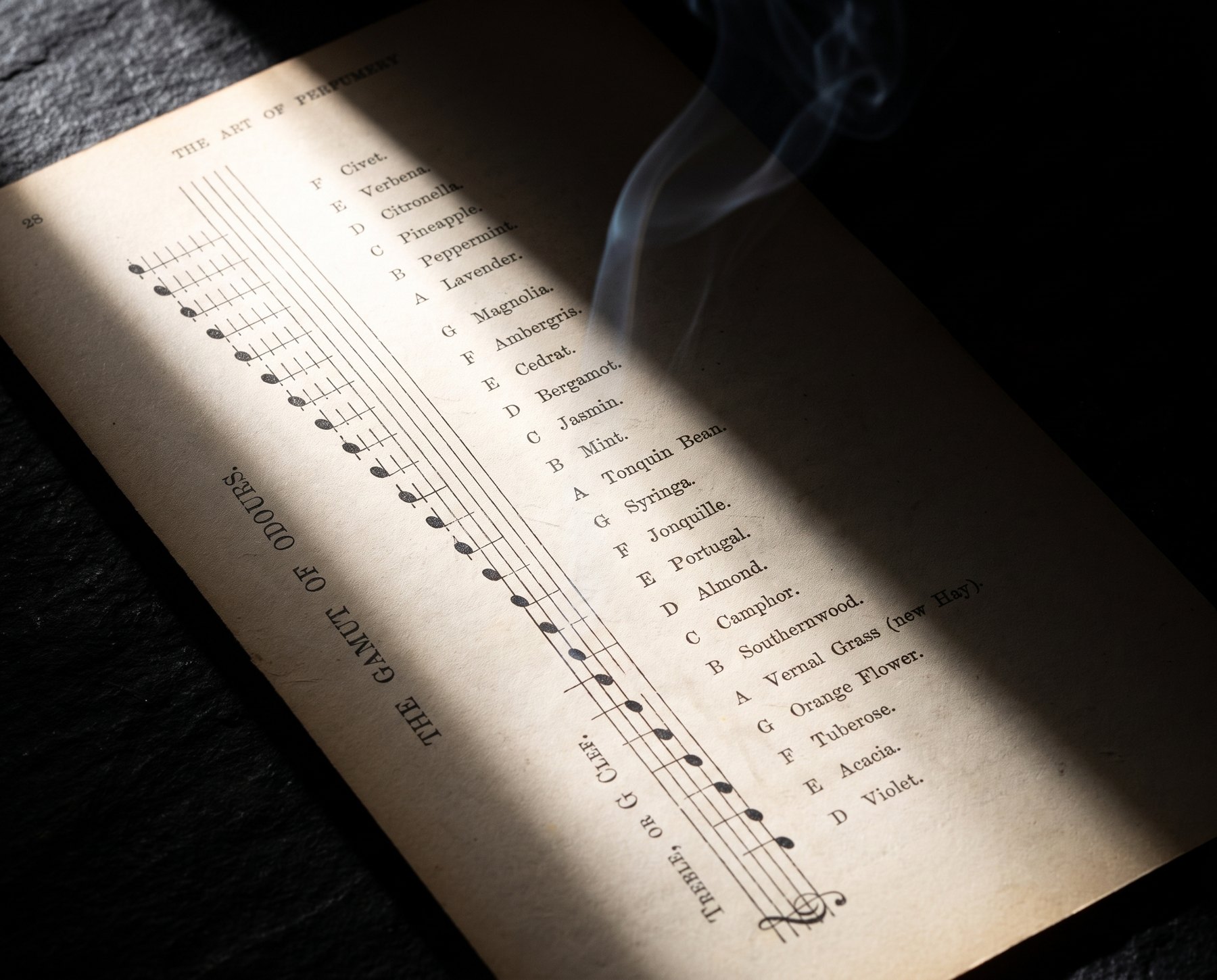
Piesse and The Art of Perfumery
George William Septimus Piesse lived from 1820 to 1882. He was a chemist and perfumer in London, co-founder of the house Piesse & Lubin. In 1855 Longman published his The Art of Perfumery. Two years later a Philadelphia edition appeared; it is the one now on Project Gutenberg, which is why many sources give 1857.
The book is a trade manual: materials, recipes, methods for perfumes, soaps and scented powders. But among the recipes of the first edition sits a short passage unlike the rest.
Piesse writes that odours act on the olfactory nerve in definite degrees, as sounds act on the ear. There is an octave of odours. Almond, heliotrope, vanilla and orange flower give one impression. Citron, lemon, orange peel and verbena form a higher octave. Rose and rose geranium are a semitone apart.
The idea grew through later editions. In 1862 the third London edition gave it a chapter and a table printed on staves. In 1887 his son Charles Piesse gave the scale a name: the odophone.
Forty six odours on two clefs
The 1862 table places 46 odours on two staves. The treble runs from a top F, civet, down to violet. The bass runs from rose down to the lowest C, patchouli. Piesse wrote that there was no odour in the laboratory to which he could not assign a key.
The easiest way to read it is to gather odours by note name. On D, vanilla, heliotrope and almond sit together, the same group the 1855 passage had called one impression. On C, near patchouli, sandalwood, geranium and rose in the bass, are camphor, jasmine and pineapple in the treble.
For Piesse, odours that form a chord make a harmonious bouquet, and he printed a few bouquet recipes written as chords. He used the logic at the bench too: vanilla fixes orange flower because both sit on one key, so as the scent fades on a handkerchief it does not drift into another idea.
High and low do not consistently follow volatility. Patchouli, vanilla and benzoin lie at the bottom of the bass, which suits their weight. Yet civet, one of the longest lasting materials, is the highest note of all.
Why the scale does not stand as science
Sound has a measurable quantity, frequency, and an octave is a doubling of it, so a C in two octaves is truly related. Smell has no such quantity. A place on Piesse's scale rests only on his own nose, and he gave no way for anyone else to check it.
In 1916 the psychologist Hans Henning noted that smell shows no octave repetition. In 1991 Linda Buck and Richard Axel described a large gene family for odorant receptors; humans have about four hundred working receptors, and each smell is recognised through a combination of them. There is no single axis on which smells run from low to high.
A borrowed vocabulary: note, chord, harmony
The gamut is no longer used. The way of speaking survived. The 1862 chapter already had the full set of words: key, note, chord, harmony, discord. Perfumers still speak of notes, and call a group of materials that blend into a new impression an accord, the French word for chord.
There is no clear evidence that the perfumer's word note descends directly from Piesse. But his usage in 1862 is very close to how the trade later spoke.
Perhaps his value lies somewhere other than where he claimed it. He did not find the physics of smell. He offered a common language to people who worked with smell, in a craft that until then passed mostly by word of mouth. A stave that is wrong as science can still be a right tool for conversation.
Olfactory Art