
Essays · Olfactory Art
The scent wheel. Rereading a map.
A map is useful. But a map is not the land.
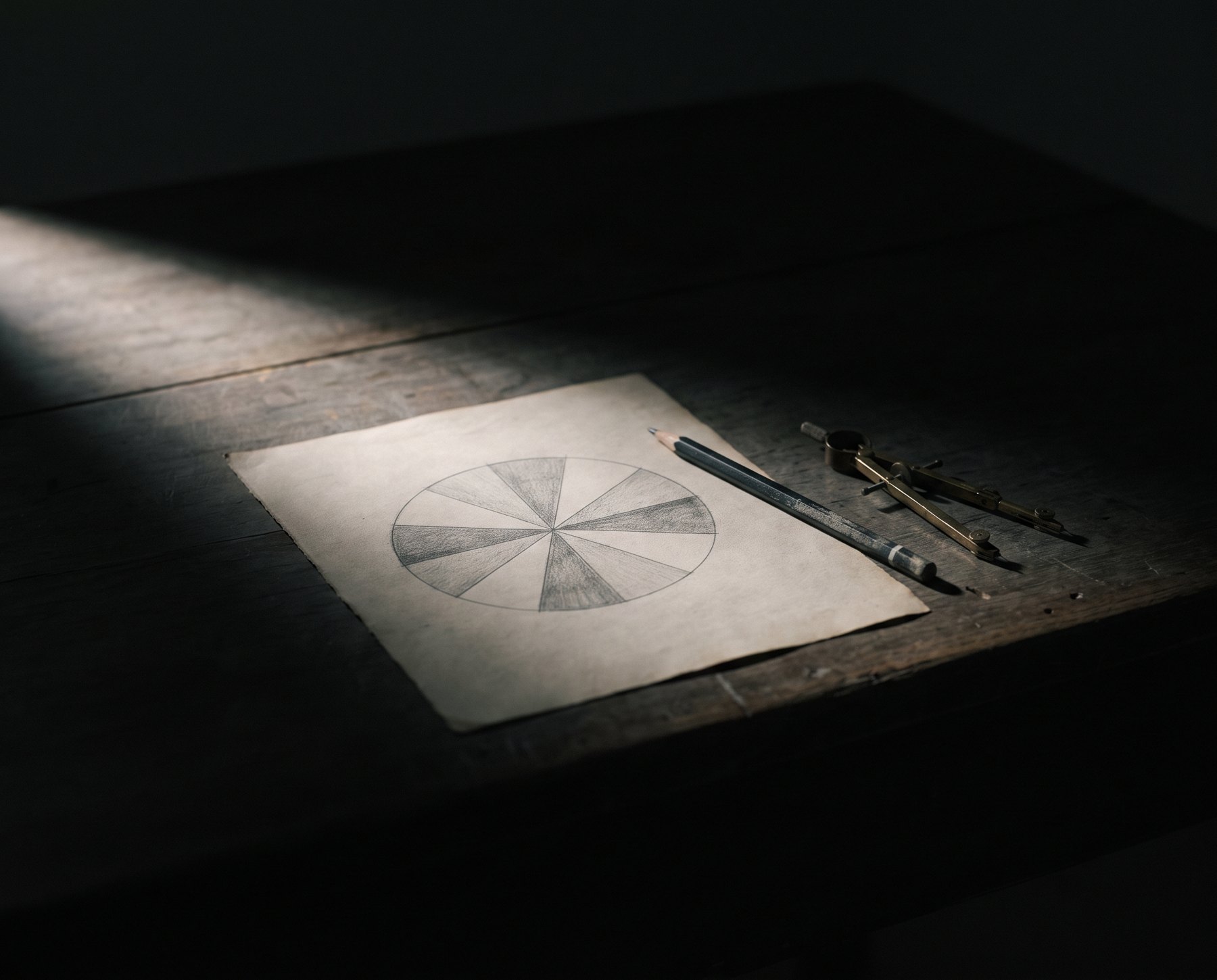
Why a circle
People draw circles for things without a beginning or an end. In 1704, in Opticks, Newton arranged the colours around a circle, and the colour wheel became a familiar tool for painters. Later, wine tasters and coffee tasters made wheels of their own, with general words at the centre and specific ones at the rim.
A classification wheel does two things a list cannot. It shows which groups sit next to each other, and it puts none of them first. Go all the way round and you return to where you began. For smell this fits well: many smells slide into one another, as Henning saw when he built his prism in 1916.
But a circle also imposes something. Each family has only two neighbours, while a real smell may be close to three or four families at once.
Edwards and the wheel of families
In 1984 Michael Edwards, then working in Sydney, self published a guide to help retail staff suggest perfumes to customers. According to the sources checked, the 1992 edition was the first to print a wheel: families arranged around a circle, each blending into its neighbours. The guide was renamed in 2000, and the wheel has been revised several times since.
The wheel suits a shop counter for a simple reason. It shows a path from a smell someone already likes to the smells next to it. The seller need not explain chemistry, only point to the next segment. On his own site Edwards presents the wheel as a link between each person's natural preferences and the families.
This essay does not redraw his wheel. It is Edwards's work, and what matters here is the thinking behind it: arranging smells by closeness rather than rank.
The SFP: France's official classification
In the same year, 1984, the technical committee of the French perfumers' society, now the Société Française des Parfumeurs, published its first classification of perfumes. The team was Raymond Chaillan, Jean Kerléo, Raymond Pouliquen and Guy Robert. That edition covered women's perfumes only, in five families: floral, chypre, fougère, amber, leather.
The 1990 edition added citrus and woody, making seven, to take in the growing market for lighter perfumes. Further revisions followed in 1998 and 2001. According to the SFP, the current table has seven families and 47 subfamilies, covering women's, men's and unisex perfumes.
The SFP table is a list, not a circle. But it does the same job: it gives people inside and outside the trade a shared set of words. Several of its families are named after a single perfume: chypre after Coty's Chypre, fougère after Fougère Royale. A family name is the memory of an object.
A map for selling or for understanding
Earlier classifications, from Linnaeus to Henning, looked for the structure of smell itself. The scent wheel and the SFP table do something else: they arrange existing perfumes, for work and for sale. That is not a flaw. It is a different purpose.
So reading a scent wheel means knowing whom it was drawn for. It was drawn for a counter, where time is short and a customer's vocabulary is small. There it is genuinely useful. But it does not answer where a smell comes from, or why it touches us.
What does not fit on the wheel
Some smells always sit at the edge. Tobacco is sweet and smoky, leaf and fire at once. Moss is both wood and earth. Roasted tea is near both grain and smoke. Place them in any segment and you are partly right and partly wrong.
Perfumers know this. Wheels are redrawn again and again, families added, split, renamed. Each revision admits that the map cannot keep up with the land.
Perhaps the best way to use a scent wheel is as a question, not an answer. What does this smell stand near? Then put the map down and return to the material.
Olfactory Art