
Essays · Olfactory Art
Máret Ánne Sara. Gutted / Gávogálši.
The gut knows before the mind understands.
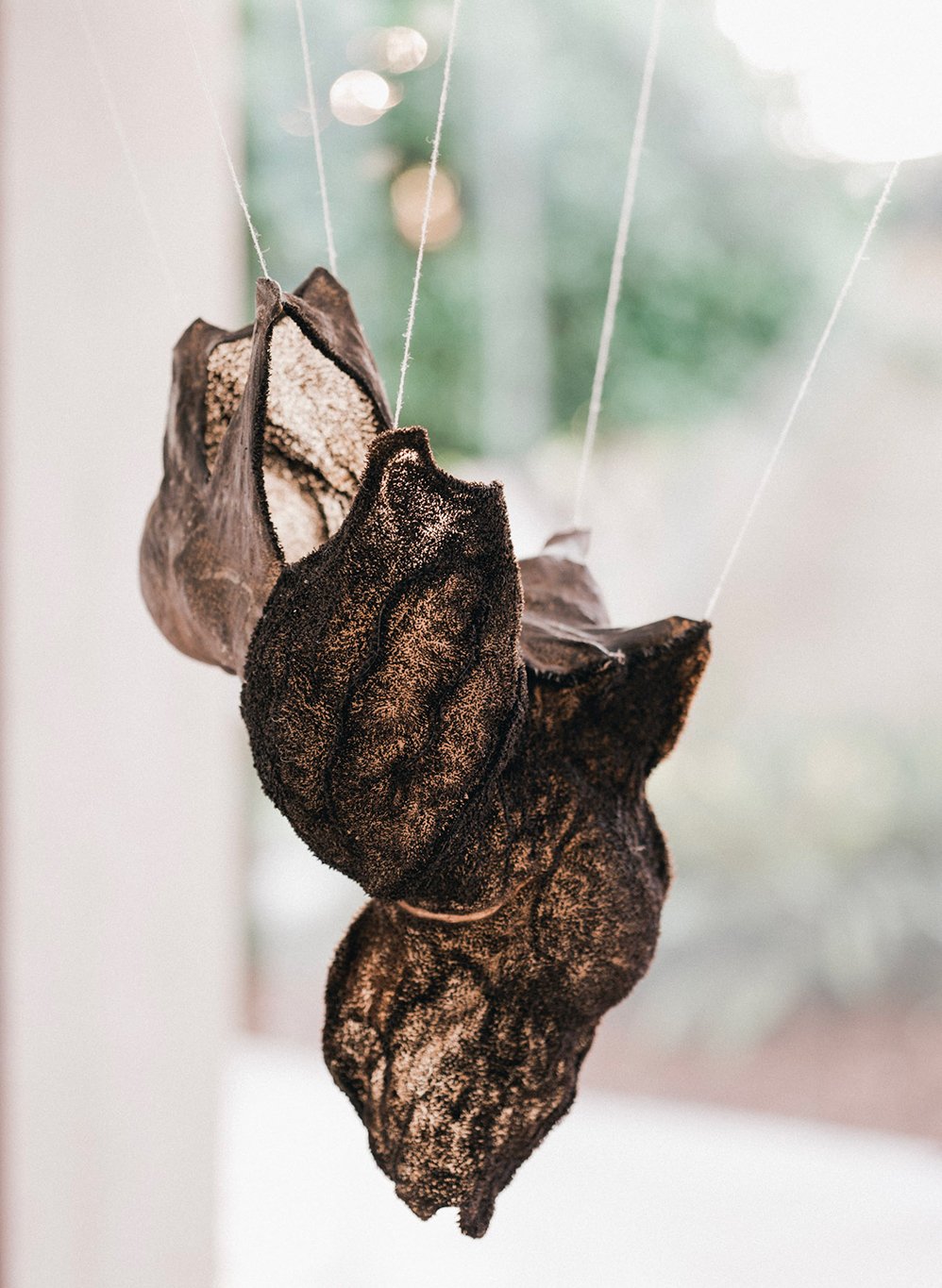
Máret Ánne Sara, Gutted – Gávogálši (detail), 2022. Photo: Michael Miller / OCA · ArtReview
A pavilion renamed
In 2022, at the 59th Venice Biennale, the Nordic Pavilion in the Giardini became the Sámi Pavilion. It was the first time the Sámi, the Indigenous people whose land stretches across northern Norway, Sweden, Finland and part of Russia, had a space in their own name at the Biennale.
Three artists were invited: Máret Ánne Sara, Pauliina Feodoroff and Anders Sunna. The curators were Liisa-Rávná Finbog, Katya García-Antón and Beaska Niillas. Feodoroff documented environmental damage to Sámi land. Sunna made a five-panel frieze about his family's fifty-year legal battle.
Sara's work there is called Gutted in English and Gávogálši in North Sámi. The English word means both disembowelled and devastated.
Dried stomachs, hanging
The main material is reindeer stomach, dried into thin, dark husks with a softly furred surface, together with reindeer sinew. They hang from the ceiling on almost invisible threads, forming fungus-like shapes suspended in the air.
From a distance they might pass for a plant or a mushroom, something that simply grew. Up close they are an animal's organs. Something that belongs inside now hangs outside, in front of everyone.
Sara grew up in a reindeer-herding family. For Sámi herders, no part of the animal is wasted. Meat, hide, bone, sinew, antler and stomach all have uses. Her work honours herding and the animals that supplied the material. It is an ethic of resources much older than the word sustainability.
A smell made to speak of fear
The second part of the work is in the air. A collaborator of Sara's made a pungent smell that fills the room. That year visitors still had to wear masks, and the smell got through anyway. According to ArtReview, it was designed to express fear, and hope as well.
The choice is deliberate. Sámi thought values what might be called gut feeling, knowing by instinct. As the Office for Contemporary Art Norway, which organised the pavilion, describes it, the stomach in this work is the first place the body reacts to events in the world, a parallel intelligence connecting humans, reindeer and other life.
Smell and stomach do the same thing: they bypass reason. We do not decide to be afraid. The gut tightens first. We do not decide to smell. The nose has already received it. Sara places visitors in that position, so they feel something before it is explained.
Fear with a source
The fear in the room is not abstract. Years earlier Sara became known for Pile o' Sápmi Supreme, a curtain of 400 bullet-pierced reindeer heads arranged as the Sámi flag, a protest against the state-ordered culling of her family's herd.
Many Sámi have had to go to court to keep the right to herd. According to OCA, each stomach in Gutted stands for a person responsible for the conflicts the Sara family has lived through. In this way she sends the trauma back towards those who caused it, and frees herself from it.
Three years later Sara worked with reindeer and smell on a far larger scale in the Hyundai Commission at Tate Modern. In Venice, everything was still compact: a few dried stomachs, some sinew, and a smell that passed through a mask. Enough to be understood in the gut before the head.
Olfactory Art