
Essays · Contemporary Art
Mariko Mori. Tom Na H-iu.
The death of a star leaves a signal too.
Benesse Art Site Naoshima · Benesse Art Site Naoshima
A glass form in a bamboo grove
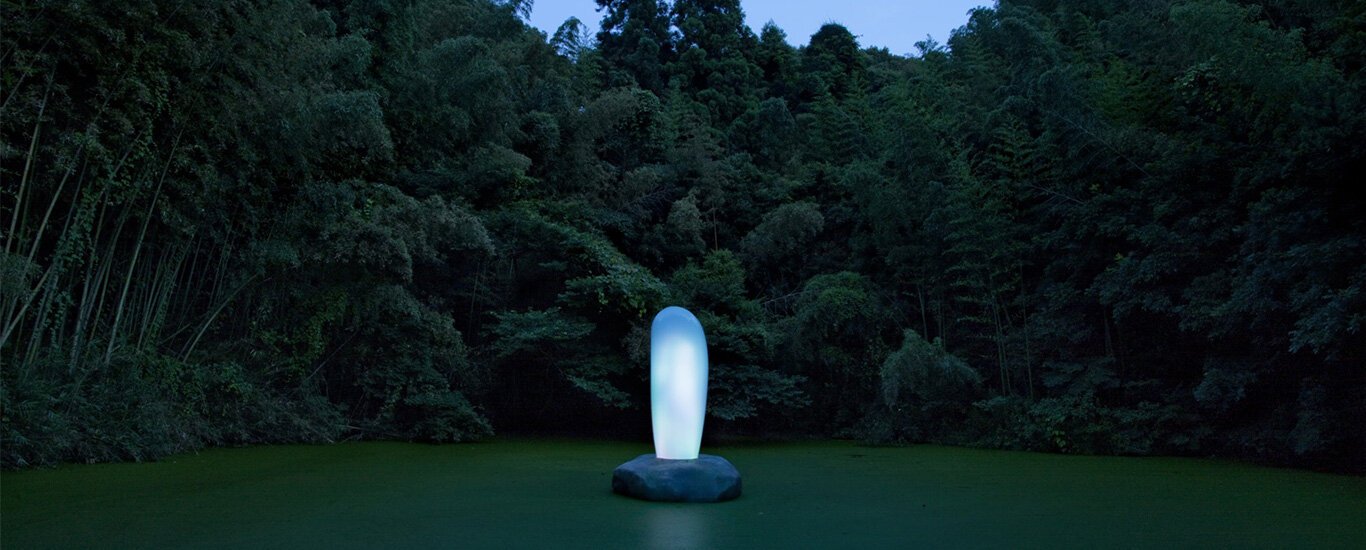
On Teshima, an island in Japan's Seto Inland Sea, there is a pond inside a bamboo grove. In the middle of the pond stands a tall glass form. This is Tom Na H-iu, completed by Mariko Mori in 2010.
Benesse Art Site Naoshima, which runs the art on these islands, describes it as a colossal glass object. No walls, no roof, no gallery. Only water, bamboo and glass.
Most of the time the glass stands still. It does not light up on a schedule. It waits for a signal from very far away.
A signal from exploding stars
The work is linked by computer to the Kamioka Observatory in Hida, home of Super-Kamiokande, one of the largest neutrino detectors in the world. The detector lies deep underground: a vast tank of water lined with light sensors.
Neutrinos are tiny particles that barely interact with matter. Every second countless numbers of them pass through our bodies and through the earth, leaving nothing. Only very rarely does one strike the water in the tank and leave a faint flash, enough for the sensors to record.
Some neutrinos are born in supernova explosions, when a large star reaches the end of its life and collapses. According to Benesse, Tom Na H-iu glows when it receives data on such neutrinos. Each time the glass lights up, a signal from a dying star has reached the island.
That light falls onto the pond. Benesse calls neutrino light the soul of the universe, and invites viewers to think about our bond with the cosmos and about our own limited time.
A name from the Celtic world
The title comes from an ancient Celtic site. According to Benesse, it was believed to be a place where souls paused to transmigrate before moving on. A place between two states.
Mariko Mori made the work as a monument, a symbol of life and death in our time. But it is an unusual monument. It carves no names. It recalls no past event. It responds to deaths happening far away, in real time.
Mori often moves between science and belief. In Tom Na H-iu the two meet easily. A particle detector built for physics. An old name for the passage of souls. A glass form in between, joining them with light.
Waiting for light
Tom Na H-iu does not give viewers a fixed image. You can stand by the pond a long time without the glass lighting up. It may glow after you have turned away. The work does not follow a visitor's timetable.
That turns looking into waiting. Viewers hear the bamboo, watch the water, notice the wind. They are in a real grove while waiting for a signal from space. Near and far are present together.
Other light works also draw viewers into waiting, as James Turrell did when he turned the Guggenheim's spiral into a slowly changing sky. But Turrell's light is programmed. No one can schedule Mori's.
For now, Benesse lists the work as closed to visitors. The glass still stands in the pond, in the grove, still waiting. Whether or not anyone watches, stars keep dying, and their signals keep arriving.
Contemporary Art