
Essays · Modern Art
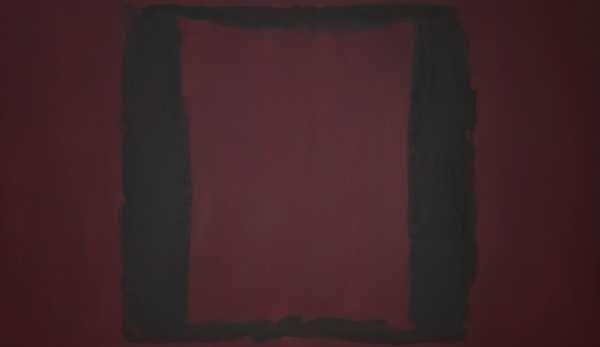
Mark Rothko. Black on Maroon.
A painting that turned down its room.
Tate · Tate
Black on deep red
Black on Maroon is a very large horizontal canvas: about 2.67 metres high and more than 4.5 metres long. Mark Rothko painted it in 1959 in oil paint, acrylic paint and glue tempera. Today it belongs to Tate in London.
The title says almost everything we see. Black, laid over a deep maroon ground. No figure, no object, no horizon. The edges of the colour are soft rather than ruled, as if the forms breathed in and out of the ground behind them.
At that scale, no one standing before it can take it in at once. The eye must travel along it, as along a wall. That was Rothko's intention. He was not painting a picture to hang on a wall. He was painting part of a room.
Tate's records reveal one more small thing. The materials vary from canvas to canvas within the series. Some are oil and acrylic alone. Some add glue tempera; others add loose pigment and glue. Rothko did not repeat a recipe. He tested, mixed and adjusted, looking for a surface both matte and deep, one that absorbs light rather than reflecting it. Up close, the paint seems to have soaked into the cloth rather than resting on it.
The Seagram commission
In 1958 Rothko agreed to paint a series of murals for the Four Seasons restaurant in the new Seagram Building on Park Avenue in New York, designed by Ludwig Mies van der Rohe with Philip Johnson. For a painter at the time it was a prestigious and very large commission.
Rothko worked on the series through 1958 and 1959. His palette darkened sharply from the glowing fields of earlier years: black, maroon, deep red. The forms are often described as frames or open windows, gaps that both invite and block the eye. Rothko said he had in mind the vestibule of Michelangelo's Laurentian Library in Florence, a closed, heavy, almost oppressive space.
Then he withdrew. Rothko returned the money and kept the paintings. The usual account is that he realised the luxurious room, where people went to dine and be seen, was no place for paintings that asked for silence. Whatever the exact reason, the series never hung in the restaurant.
Nine paintings reach London
Nearly a decade later Rothko decided to give part of the series to Tate. Tate's records show one painting presented in 1968 and eight more in 1969, all given by the artist through the American Federation of Arts. This Black on Maroon was part of the 1969 gift.
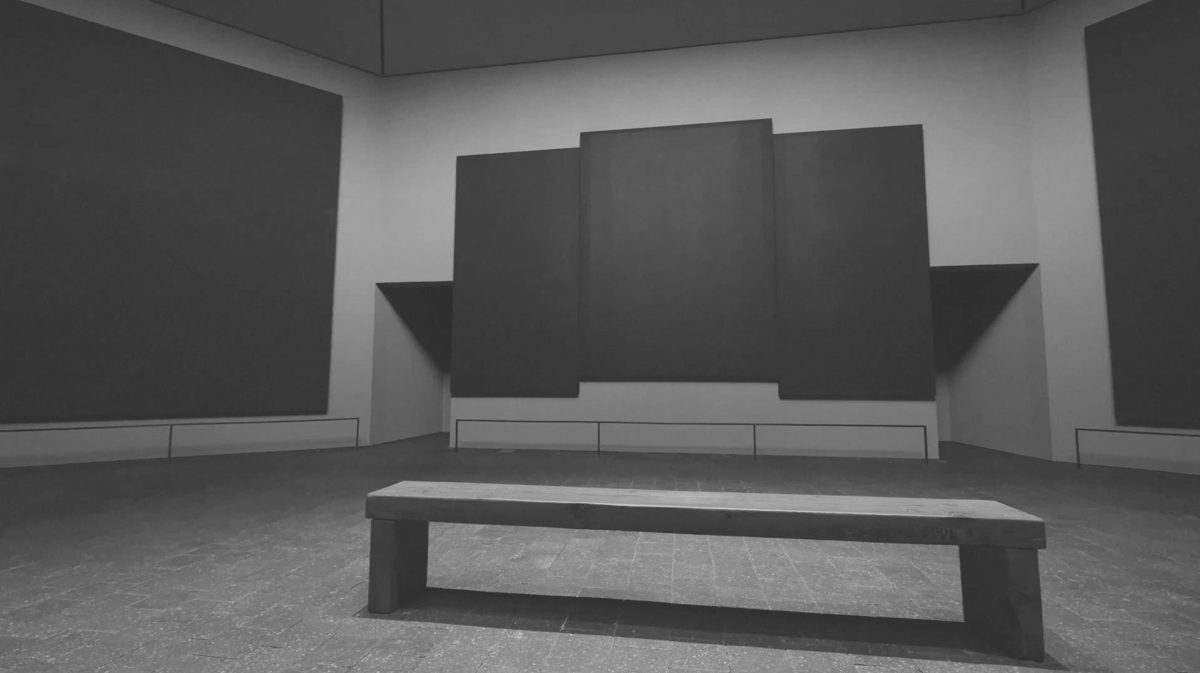
Rothko cared closely about how they would hang: together, in a room of their own, in low light. The paintings arrived at Tate in 1970, at the very moment of Rothko's death in New York.
Today the Seagram paintings are usually shown together in a dimly lit room. They are currently on view at Tate Modern, in the display In the Studio. Visitors need a few minutes for their eyes to adjust, and only then do the reds beneath the black begin to surface.
From restaurant to chapel
The Seagram story does not end in London. It was these very paintings for the Four Seasons that led John and Dominique de Menil to Rothko, and to commission from him a sacred space in Houston, later the Rothko Chapel.
Set the places side by side and a path appears. A luxurious dining room, where paintings are a backdrop to dinner. A dark museum gallery, where they stand on their own. A chapel, where room and paintings are one. The later Rothko grew, the more he insisted on deciding the space around his work.
Black on Maroon marks a turn on that path. It was painted for a place, then held back because of that same place. A painting is sometimes best understood through the room it refused.
Modern Art