
Essays · Olfactory Art
Martynka Wawrzyniak. Eau de M.
An advertisement for something no one sells.
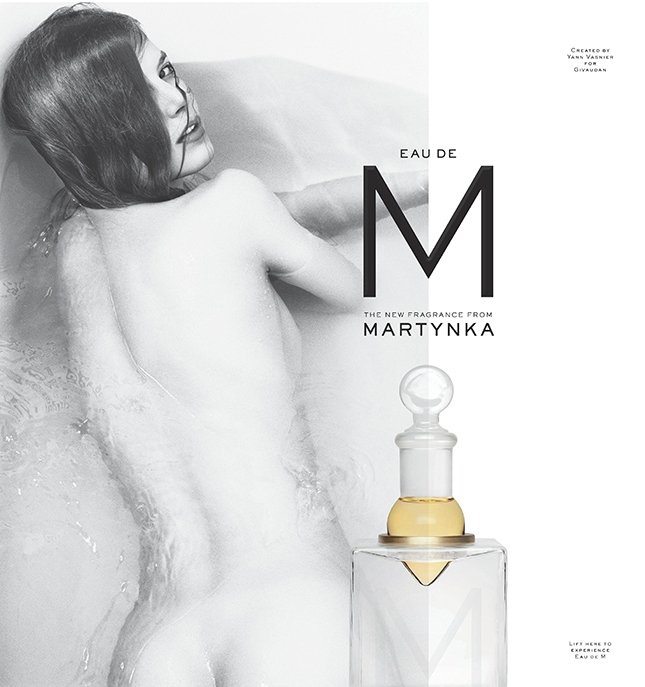
© Martynka Wawrzyniak · Martynka Wawrzyniak (official site)
An advertisement
In 2014 an advertisement for a perfume called Eau de M appeared in the pages of Harper's Bazaar. It looked like every other perfume ad in the issue: an image, a name, and a scent strip for the reader to peel open and smell.
No perfume called Eau de M was for sale. The page was a work by Martynka Wawrzyniak, an artist based in New York. The smell on the strip was the essence of her own sweat.
The essence came from an earlier project. In 2012, for Smell Me, Wawrzyniak spent a year with chemists extracting smell from her sweat, tears and hair. Eau de M isolated the sweat and changed where it was shown: from gallery to printed page.
The magazine as gallery
Wawrzyniak calls the insertion a guerrilla gesture. The work slipped into commercial advertising space without being announced as art. It wore the clothes of a product.
That choice changed the audience. A New York gallery receives a small crowd, mostly from the art world, people who know they are looking at art. A fashion magazine reaches ordinary readers turning pages for clothes and watches, expecting nothing from a scent strip beyond something pleasant.
The magazine is also where the scent strip was born. Readers already know the routine: peel, lift to the nose, decide. Wawrzyniak did not need to teach anyone how to view the work. The way of viewing was already there. She only changed what was inside.
In a gallery, a work is protected by the frame of art. On a magazine page it has to stand like every product around it. And it did.
The people who asked
According to the artist's site, after the issue came out, Barneys New York received enquiries from customers who wanted to buy Eau de M. A perfume that did not exist, made from a stranger's sweat, asked for at one of the city's best known luxury stores.
That detail completes the work. People do not buy a smell. They buy a smell inside a story. The same sweat on a stranger's shirt on the subway makes people step back. On a strip beneath a French name, it sends them to a store.
Wawrzyniak does not say the readers were fooled. Perhaps they genuinely liked the smell. The smell of the human body runs deep in the history of perfume. What the work reveals is the gap between the reflex of the nose and the prejudice of the mind: when no one tells us it is sweat, what do we smell?
Object and label
Many artists have borrowed the form of the perfume bottle. In 1921 Marcel Duchamp put a photograph of himself as Rrose Sélavy on a perfume bottle, in Belle Haleine. Eau de M follows that line and turns it around: the label is fake, and what lies inside is real to an uncomfortable degree.
The work places side by side two things consumer culture keeps apart. On one side the body, with everything it releases that we want to deodorise. On the other a luxurious image, built so that we want to own it. A small strip of paper joins them.
Smell Me asks how we know a person. Eau de M asks something more practical, and more uncomfortable: what do we want, and who decides that for us?



Olfactory Art