
Essays · Photography
Masao Yamamoto. A Box of Ku.
A photograph can be held in the hand.
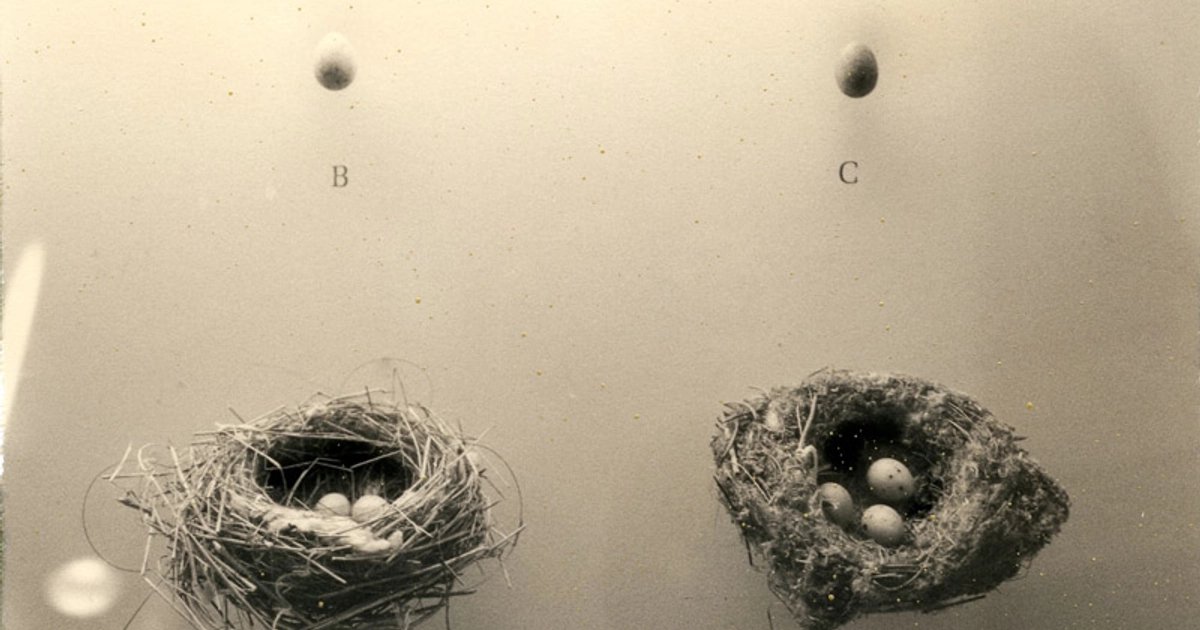
Stephen Bulger Gallery · Stephen Bulger Gallery
A box of small pictures
Masao Yamamoto was born in 1957 in Gamagori, in Aichi Prefecture, Japan. He studied oil painting before turning to photography. That painter is still visible in the way he treats each print.
A Box of Ku is a series he began in the late 1980s and continued for more than thirty years. The pictures have no titles, only numbers: #3, #154, #715. The count runs into the hundreds. It resembles a notebook more than a portfolio.
The series title contains the word Ku. In Japanese, the character 空, read ku, means sky, and also emptiness. A box that holds emptiness. It sounds like a riddle, but looking at the pictures, the riddle resolves itself.
The photograph as object
Yamamoto's prints are small. Many fit in the palm of a hand. They are black and white gelatin silver prints, but he does not leave them as they came out of the darkroom.
He tones them, paints on them, ages them, wears down the edges, folds them lightly. Some carry flecks of gold. Some have creases like a letter opened and closed many times. So each print differs from the next, even from the same negative. He wants every picture to be a singular object with a life of its own.
The prints were first kept in a wooden box, and viewers were invited to pick them up and turn them over. The photograph is no longer something only hung behind glass. It becomes a thing again, like an old family snapshot kept in a drawer.
When he exhibits, Yamamoto does not hang the prints in straight rows. He scatters them across the wall at varied intervals, some high, some low, leaving a great deal of white wall between. Each hanging is a new composition. The space between the prints is part of the work.
Haiku in pictures
Writers on Yamamoto often call his pictures visual haiku. The comparison makes sense. Haiku is a very short poem that records a moment of observation, often tied to a season and to nature, leaving most of its meaning outside the words.
Yamamoto's pictures do the same. What appears in them is simple. A bare branch. A bird on a wire. A stone. A surface of water. Part of a human back. No story, no protagonist. Only something seen, and a great deal of quiet around it.
Alone, each print is a short poem. Together they form a collection the viewer reads in their own order. Yamamoto does not impose one. The box can be opened any way at all.
Why the small still matters
Contemporary photography has tended to make pictures ever larger, printed at the scale of a wall, to compete with painting in the gallery. Yamamoto goes the other way. His prints are so small that the viewer must approach. And up close, one sees what large prints do not show: the paper's surface, the marks of time, a fold.
It is also a way of looking at the world. Attention to what is small, quiet, easily missed. A bird. A leaf. A glint on water. None of these needs to be enlarged to matter.
At the opposite end, Hiroshi Sugimoto photographs the sea as vast, flat emptiness. Two Japanese artists, two scales, one conviction: emptiness is not a lack. It is room for the viewer to enter.
A Box of Ku is such a box. Open it and you see a few small images. But what you are really holding is the empty space between them.
Photography