
Essays · Olfactory Art
Petrichor. Wet earth before it had a name.
A whole dry season released in a few minutes.
Bear and Thomas, 1964: naming the smell of rain
The smell of earth when the first rain of the season falls is among the most widely known smells in the world. Farmers know it, children know it, city people know it. Yet for a long time it had no name of its own in science.
In 1964 two scientists at the Australian research organisation CSIRO, Isabel Joy Bear and Richard Thomas, published a short paper in Nature on the nature of the smell of clay. They proposed calling it petrichor.
The word joins two Greek roots. Petra is stone. Ichor, in myth, is the fluid that runs in the veins of the gods. The smell of rain, by that name, is the blood of stone.
Bear and Thomas argued that part of the smell comes from oils released by plants in dry weather, held on the surface of rock and clay and freed when water arrives. A name, and an explanation: the smell was there before the rain.
Geosmin: a molecule from soil bacteria
A year later, in 1965, Nancy Gerber and Hubert Lechevalier isolated an earthy smelling substance from actinomycetes, bacteria that live in soil. They called it geosmin, the smell of earth.
Geosmin is the part of rain's smell many people recognise most. It is also the earthiness of beetroot, the muddy note sometimes found in freshwater fish or tap water. The human nose is extremely sensitive to it: a tiny amount in the air is enough.
So the smell of rain has at least two sources: plant oils held in stone, and a molecule made by bacteria in soil. Both build up in the dry season. Both need water to rise. Rain is only the key.
Raindrops throw smell into the air
One question remained: how does a smell on the ground reach a nose? In 2015 Youngsoo Joung and Cullen Buie at MIT published a study in Nature Communications using high speed cameras to watch drops falling on porous surfaces.
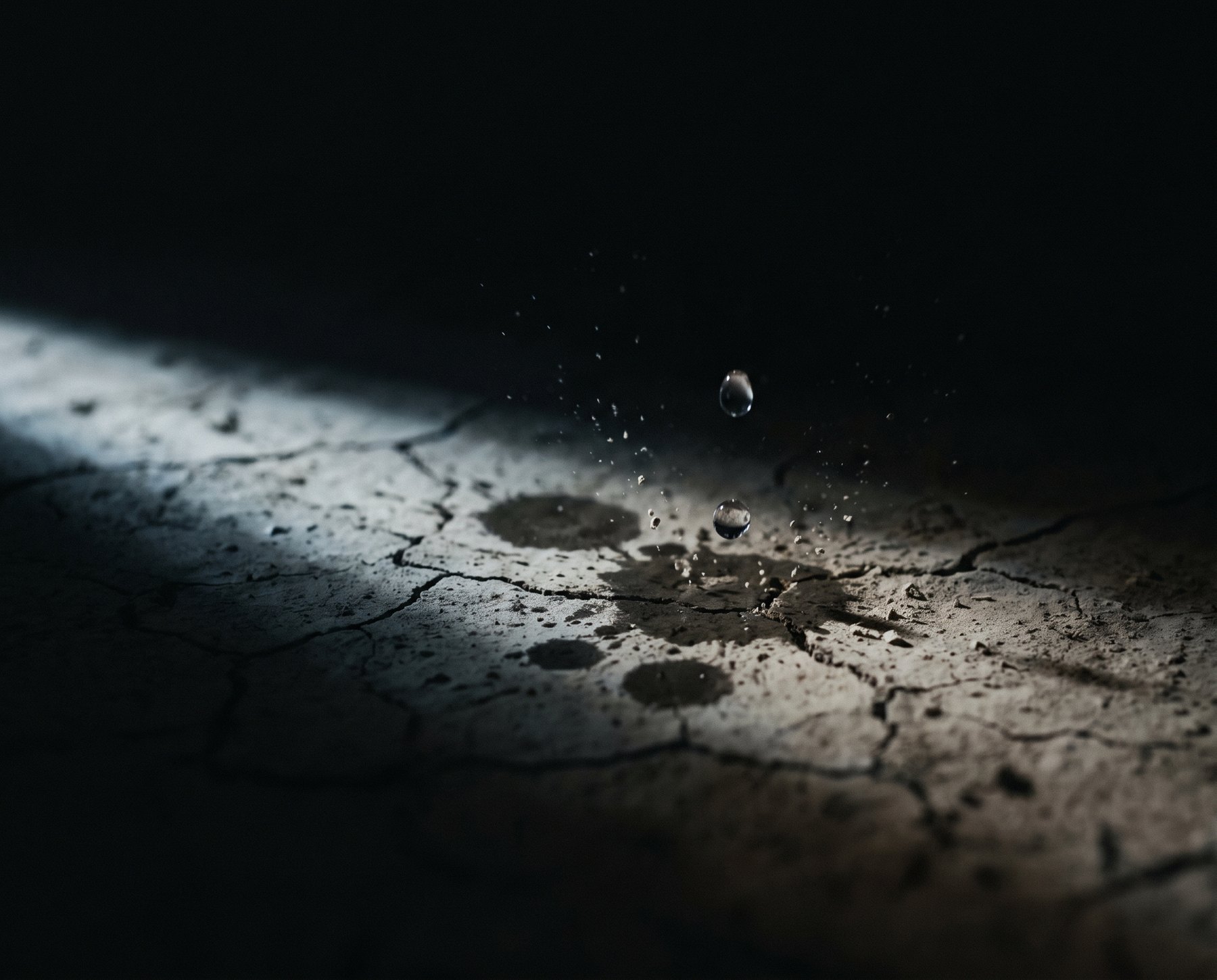
They ran about six hundred experiments on twenty eight surfaces, sixteen of them soils. What they saw: when a drop hits a porous surface it traps tiny bubbles of air. The bubbles rise through the drop and burst, throwing fine particles into the air, like the fizz in a glass of soda.
Light and moderate rain made more of these particles than heavy rain. This fits what people have always known without measuring: the smell is strongest when the first sparse drops hit dry ground. Once the rain pours, the smell fades.
Each raindrop, seen this way, is a small machine that lifts earth into the air.
A rebuilt rain
Makers of scent have long wanted to keep the rain. In Kannauj, in northern India, there is an attar called mitti, meaning earth. Discs of clay are baked, then distilled in copper pots, the vapour passing into sandalwood oil. The result recalls dry earth after the first rain, freshly fired pottery, wet stone.
Western perfume took another road. From the late 1980s a style called ozonic appeared, using molecules such as Calone and Floralozone to suggest air after rain, sea breeze, water. That is rain in a clean, clear sense, with less earth.
Both are reconstructions. Mitti keeps the earth. Ozonic keeps the air. Neither holds a whole dry season inside.
Perhaps because the real smell of rain is not a thing. It is an event: dry ground, then water, then a few minutes. To smell it whole, you still have to stand outside at the moment the first rain begins.
Olfactory Art