
Essays · Photography
Naoya Hatakeyama. Blast.
The rock rises, and has not yet fallen.
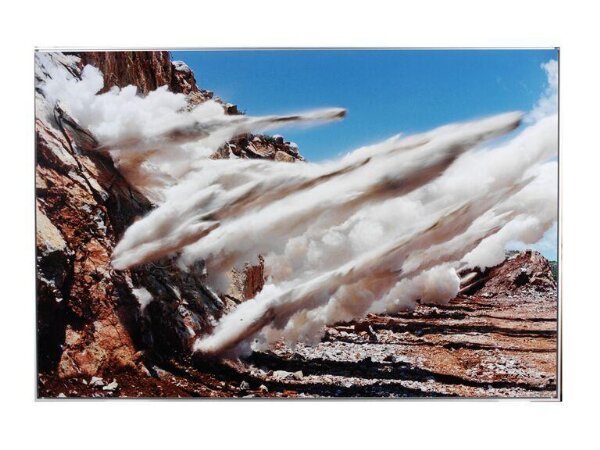
Victoria and Albert Museum · Victoria and Albert Museum
A cliff, a thousandth of a second
Blast #5707, photographed in 1998, shows a limestone face in Japan at the instant of a quarry explosion. Against a blue sky, boulders and stone dust fly outward. Some pieces are still whole; others have already become white cloud. All of it hangs in the air.
According to the Victoria and Albert Museum in London, which holds a print, the rock is thrown about twenty metres from the face, and each blast lifts more than two thousand tons of stone. That figure is nowhere in the picture. The picture holds only a very short moment, so short that the rock looks light.
The print is a C-type colour photograph mounted on aluminium, about fifty-five by eighty-one centimetres. Shown together, eighteen prints from the series can form a grid almost eight metres wide. Before it, the viewer sees one explosion repeated many times, a different shape each time.
Shooting from a distance
Hatakeyama began Blast in 1995. He could not stand behind the camera when the charge went off, because that is where the rock lands. He set a 35mm camera on a tripod near the face, retreated to safety, and fired the shutter by remote control at a thousandth of a second.
He did not choose the camera position alone. He followed the blasting technician, who knew where the rock would fly and how far. Photography here leans on the knowledge of another trade: breaking stone.
This places the photographer in an odd position. He is not looking through the viewfinder when the event happens. He waits for the siren, hears the blast, feels the air hit him, and only later learns what the film has kept. The image belongs more to the camera and the rock than to the eye.
The limestone of a home region
Hatakeyama was born in 1958 in Rikuzentakata, on Japan's northeast coast, a region rich in limestone. Quarries and processing plants were part of the landscape he grew up in. His father worked for a time at a cement factory and often took him fishing at a port where quarried limestone was loaded onto ships.
Before Blast, he had photographed limestone quarries and plants in Lime Works, a slow, still look at the same material. Blast does the opposite: it picks the fastest, most violent instant of the whole cycle.
Limestone blasted from the quarry goes on to become lime, cement, the concrete of cities. Looking at Blast, one sees the first step of a building, while it is still a mountain.
What the eye cannot see
The human eye cannot hold a thousandth of a second. Someone watching the blast sees a flash, a cloud of dust, then hears the rock fall. The shape of the stone in flight, the gaps between fragments, the colour of dust before it settles, exist only on film.
So Blast does not record what people saw. It shows them for the first time. Photography works here as a measuring instrument, like the scientific photographs of the nineteenth century that caught a falling drop or a galloping horse.
Yet Hatakeyama's images hold something else. Each one is a moment when the mountain loses a part of itself. The beauty of floating rock cannot be separated from a cliff being taken apart, day after day, so that cities have material. The V&A describes his concern as two opposing landscapes, quarry and city. Blast stands exactly where the two touch.
Photography