
Essays · Photography
Naoya Hatakeyama. Lime Works.
Before a city stands up, it is dust on a factory roof.
About thirty plants
Lime Works is a colour series Naoya Hatakeyama made in the early 1990s. He travelled to limestone quarries, lime works and cement plants at about thirty sites across Japan, from Hokkaido in the north to Okinawa in the south.
The series first appeared as a book in 1996, published by Synergy in Tokyo. It sold out quickly and has been reprinted several times. The Getty Museum in Los Angeles holds one print from the series, Lime Works #46101.
Many images are wide horizontal frames made at dusk or dawn. The buildings are grey blue. Warm orange light leaks from windows and doorways. Pipes, towers, conveyors and tunnels join up like a small city with no one in it.
A layer of dust on everything
The first thing a viewer notices is white. Limestone dust covers roofs, walls, railings, the ground. It softens the sharp edges of steel. It makes the whole frame look as if it has just snowed.
The dust is not an effect. It is matter ground off while stone is turned into lime and cement, lifted into the air and settled again. The factory records its own work on its own body.
Hatakeyama chose hours of weak light, when the lamps inside the plants were still on. The pictures have a fineness and stillness close to painting. No sound of machines, no moving smoke, no workers. Only surfaces, and the dust on them.
Look long enough and the dust becomes legible. Thick where stone passes often. Thin where wind has carried it off. Roofs whiter than walls. The ground whiter than both. The photograph becomes a map of where the material has touched.
From quarry to city
Japan lacks many minerals, but limestone it has in plenty. Limestone makes cement, and cement makes concrete. Much of the buildings, bridges and expressways of Japanese cities comes out of places like the ones Hatakeyama photographed.
Lime Works looks at the city from the other end. Instead of the finished tower, it shows where the tower's material is being made. The quarry is where the mountain is taken away. The city is where it is rebuilt in another form. The plant sits in between.
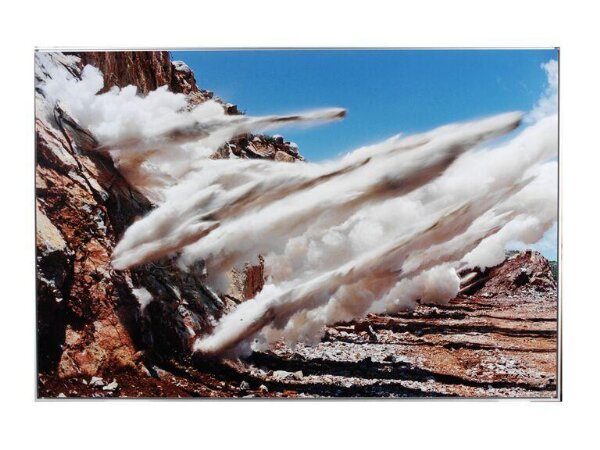
This way of looking runs through his later work. In Blast, begun in 1995, he returned to the quarry to catch the instant stone is blown from the cliff. If Blast is the fastest beat of the cycle, Lime Works is the slowest: material waiting, being ground, cooling.
A home region made of stone
Hatakeyama was born in 1958 in Rikuzentakata, a coastal city in the northeast, in a region rich in limestone. His childhood is tied to docks where stone was loaded onto ships, and to a father who worked for a time in a cement factory.
Lime Works says none of this. There is no biography inside the frame. But the patience of the series, crossing the country only to find lime plants, suggests the material was not foreign to the man holding the camera.
Industrial photography is often seen as cold, like Bernd and Hilla Becher lining up water towers in rows. Lime Works is warmer. Orange lamps, dusk, fine dust make the plants look like places where people live, though no one appears.
Photography