
Essays · Olfactory Art
Peter de Cupere. Olfabet.
Learning to read again, this time with the nose.
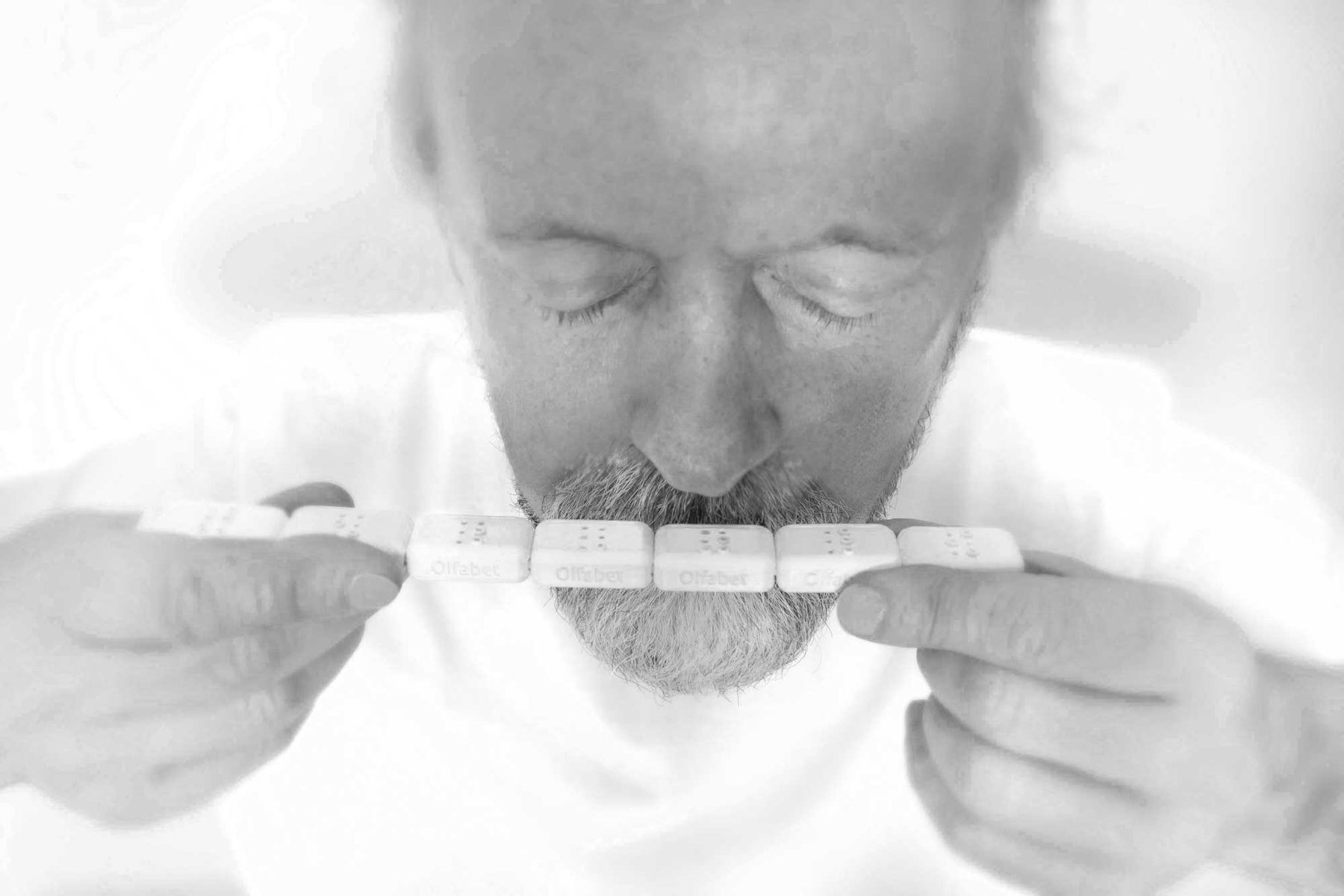
Olfabet © Peter de Cupere · Olfabet (official project site, Peter de Cupere)
An alphabet you cannot see
The name Olfabet joins two words: olfactory, relating to the sense of smell, and alphabet. The idea is in the name. This is an alphabet for the nose.
The principle is simple. Each letter is linked to a smell, specifically a scent molecule. The learner memorises each pairing of letter and smell, the way children learn their letters. Once they know them, several smells can be combined into a word, and several words into a sentence.
At first the reader must separate the smells, identify each letter and spell it out. According to the project, practice brings a change: the reader starts to recognise a combination of smells as a whole word at once, without breaking it down. That is exactly how the eye reads. We do not look at each letter of a familiar word; we see its shape.
Research, not a toy
Olfabet is an artistic research project by Peter de Cupere, the Belgian artist who has worked with smell for decades. It sits within the MANUFrACTURE research group at PXL-MAD School of Arts, linked to Hasselt University in Belgian Limburg.
The project site gives no start date. In 2022 Olfabet was a finalist for the Institute for Art and Olfaction's Sadakichi Award for experimental work with scent. That a writing system was considered alongside sculptures and installations shows how thin the line between art and research is here.
The project describes its aim as translating language into another sense. Writing now has two main doors: the eye, through print, and the hand, through Braille. Olfabet proposes a third. It calls it Olfalanguage.
When a smell must mean one thing
The most interesting thing about Olfabet is that it asks smell to do something smell rarely does. In daily life a smell means different things to different people. Camphor sends one person to a grandmother's wardrobe and another to a clinic. Smell carries private memory, which makes it hard to use as a shared sign.
An alphabet needs the opposite. The letter A has to be A for every reader. Olfabet asks smell to set its private memories aside and become a sign that anyone who learns it reads the same way.
It is an experiment on how people smell. Can the nose learn the precision the eye acquired over thousands of years of writing? Or does smell always keep something that will not reduce to a sign?
The project does not settle the question. It offers a system and invites people to try.
Reading by breathing
Reading with the eyes happens at a distance. The page stays still and we pass over it. Reading with the nose is different. A smell has to enter the body to be recognised. The reader must breathe in. For a moment the sentence is air in their lungs.
A sentence in smell does not last. It drifts, mixes with the surrounding air, weakens. To read it again, it has to be opened again. Writing on paper endures; smell does not. So Olfabet raises a question about the lifespan of language: how does a message readable only while it is still in the air differ from one carved in stone?
Seen against De Cupere's wider practice, Olfabet is a more systematic step. In many earlier works he used smell to add meaning to an image. Here he lets smell stand alone as a language, with no image attached.

Olfactory Art