
Essays · Contemporary Art
Rei Naito, Ryue Nishizawa. Matrix.
Water finds its way. People only sit and watch.
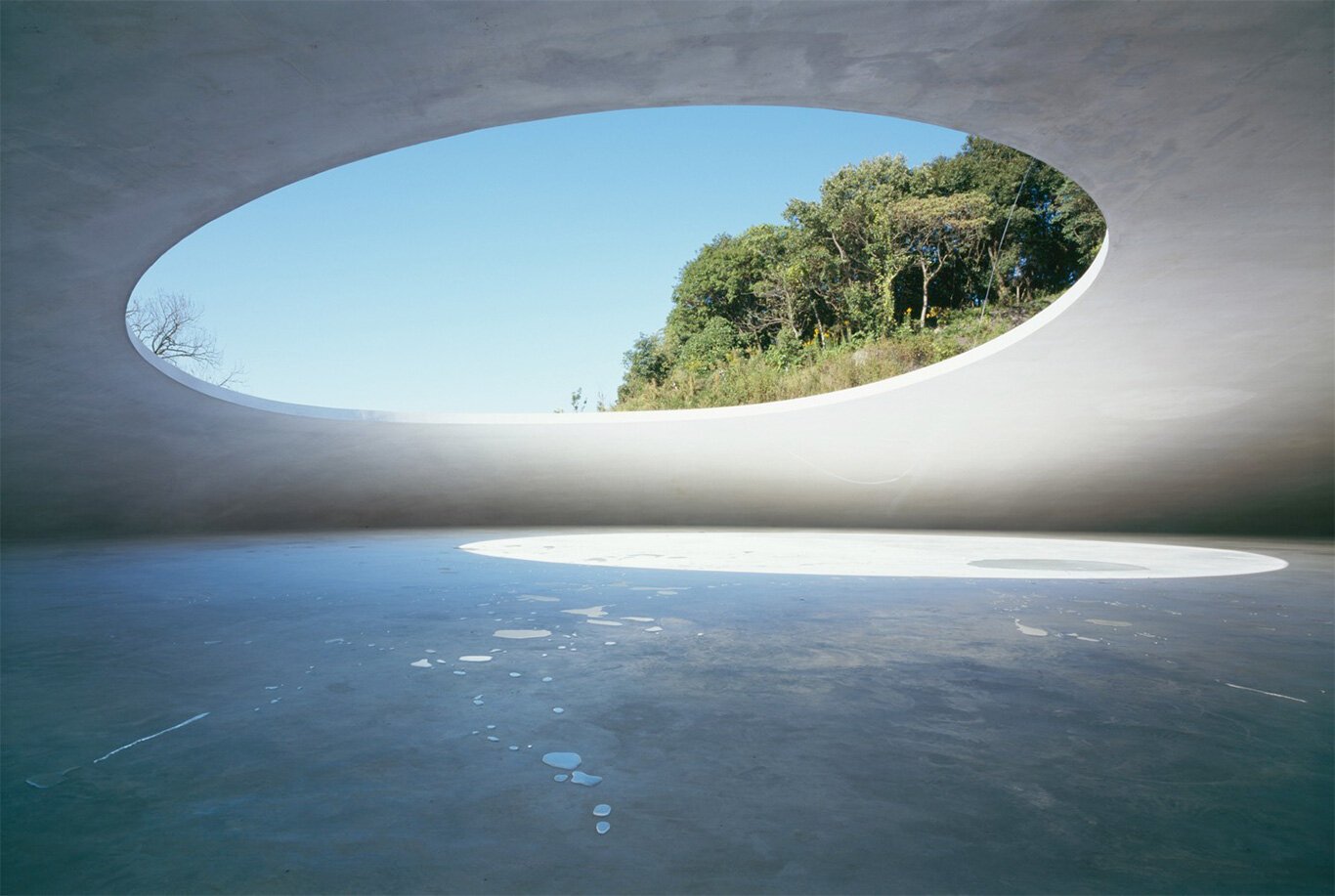
Benesse Art Site Naoshima · Benesse Art Site Naoshima
A drop of concrete
On the island of Teshima, in Japan's Seto Inland Sea, a low, white, curved structure sits on a hillside above the sea. From afar it looks like a drop of water that has just landed and stopped. This is the Teshima Art Museum, opened in 2010.
It is the work of two people. The architect Ryue Nishizawa built the shell. The artist Rei Naito made the work inside, titled Matrix. The museum holds only this one work.
According to Benesse Art Site, the concrete shell is about 40 by 60 metres, 4.3 metres at its highest point, and has no columns at all. The curved roof holds itself up. Inside is one continuous space, no walls, no corners.
Two oval openings are cut in the roof. Through them come the wind, sounds and light of the world outside. There is no glass. A bird can pass over, a leaf can fall in, rain can enter.
Water rising from the floor
Matrix does not hang on a wall. It lies on the floor. From tiny holes in the concrete, water seeps up all day long, a little at a time. A drop grows, then begins to roll along the almost invisible slope of the floor.
Some drops move fast, some slowly. When two meet they merge, larger, heavier, faster. Sometimes they gather into a small pool, spread, then run into another hole and disappear.
Visitors remove their shoes in some areas. No photographs, no video, no sketching. Phones are not used. The rules do one simple thing: they make people look with their own eyes, and wait.
Many sit on the floor, level with the drops. Some lie down. Some sit for hours without a word.
A work that changes with the sky
Because the openings face the sky, Matrix is never the same twice. In strong sun the water glitters and the roof's shadow is sharp on the floor. On grey days the whole space softens, the grey of the concrete almost merging with the water.
Wind shifts the path of the drops. Rain brings water from above to meet water rising from below. Winter, summer, early morning, late afternoon: each is a different work.
For years Rei Naito has made very small, very light works: a thread, a glass bead, a hanging scrap of cloth. They ask to be looked at closely. At Teshima she reversed the scale but kept the spirit: a wide space, and what there is to see is still small drops of water.
Nishizawa makes the architecture nearly vanish. No columns, no windows, no ornament. The shell is only a curve between ground and sky.
Rice fields and water
The museum stands in the corner of a terraced rice field that had been abandoned and was restored with local residents. Walking there, visitors pass the terraces before they see the white shell.
This is not a side detail. Rice lives on water. Farmers are used to watching water flow, pool and soak in. Matrix brings that attention into a quiet room: where does the water come from, where does it go, how long does a drop take to finish its path.
One might compare it to how James Turrell works with light: both use architecture to frame something natural, then let it do its own work. At Teshima, though, what is framed is not the sky. It is the ground, and what it breathes out.
Matrix stays in memory because it makes nothing new. Water, wind and light were already there. The work only gives them a place to be seen.
Contemporary Art