
Essays · Modern Art
Robert Morris. Untitled.
An object with no surface of its own. It wears the room.
Tate · Tate
Four cubes on the floor
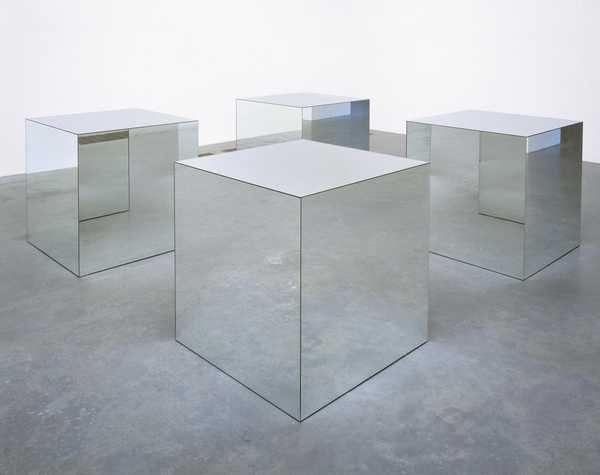
This untitled work consists of four cubes, each about ninety one centimetres a side. Every face is mirrored. They sit directly on the floor, spaced widely enough for people to walk between them. No plinth, no frame, no paint.
As the viewer moves around them, the mirrors reflect floor, walls, ceiling, the other cubes and the viewer, shifting with every step. Tate's label speaks of complex and shifting interactions between gallery and spectator. The solid objects all but dissolve into the space around them.
Robert Morris, 1931 to 2018, was one of the central figures of American minimal sculpture in the mid 1960s. His works of this period are geometric forms pared down as far as they go.
A situation, not an object
Morris tended to arrange his forms into what he called situations, in which one is aware of one's own body at the same time as the piece. The four mirrored cubes show that principle more clearly than anything.
Before a statue we usually look at a separate thing. Here you cannot look at a cube without seeing yourself. You see your feet on the floor, your head tilting, yourself again at another angle in the next cube. The work is not only in the four boxes. It is in the space between them, and in the person passing through.
Morris cared about spacing too. In a 1974 letter to Tate he wrote that originally the space between the boxes equalled the combined volume of all four. Later he dropped that rule and placed them according to the room, always leaving at least five or six feet between them for walking.
Made more than once
The first set of four mirror boxes was made in 1965 for Morris's exhibition at the Green Gallery, New York, in February that year. They were perspex, the mirroring would not adhere, and Morris later destroyed them. Accounts of that first set's size do not agree.
According to Tate's records, the museum's version was first fabricated in London in 1971 for Morris's exhibition at Tate. In 1976, with his permission, it was remade in more durable materials: mirror over lightweight board cubes. Another version in polished stainless steel was made in 1974 for Sonnabend Gallery in New York, because steel does not break.
Tate notes that the cubes were first installed in the museum's garden for the 1971 exhibition. When the show had to be remade with substitute works, they were brought into the galleries. Tate bought the work from the artist through Leo Castelli in 1972.
Why the mirrored cubes stay
Minimal sculpture is often described as cold and dry, all form and industrial material. Morris's mirrored cubes show another side: a minimal object can depend entirely on the viewer and the room. No one sees the same work twice.
Mirror is a strange material for sculpture. It has mass, edges, corners, yet its surface always belongs to something else. Morris used exactly that. The clearer the geometry, the more unstable the image upon it.
Mirror facing mirror, the viewer found inside the object: Louise Bourgeois built that into a closed room, in a far more private way. With Morris nothing is closed. There is only an open room, four cubes, and a person walking among them.
Modern Art