
Essays · Olfactory Art
Sèvres, Jean-Claude Duplessis. Pair of Vases (Pots Pourris à Bobèches).
The nose brings porcelain flowers to life.
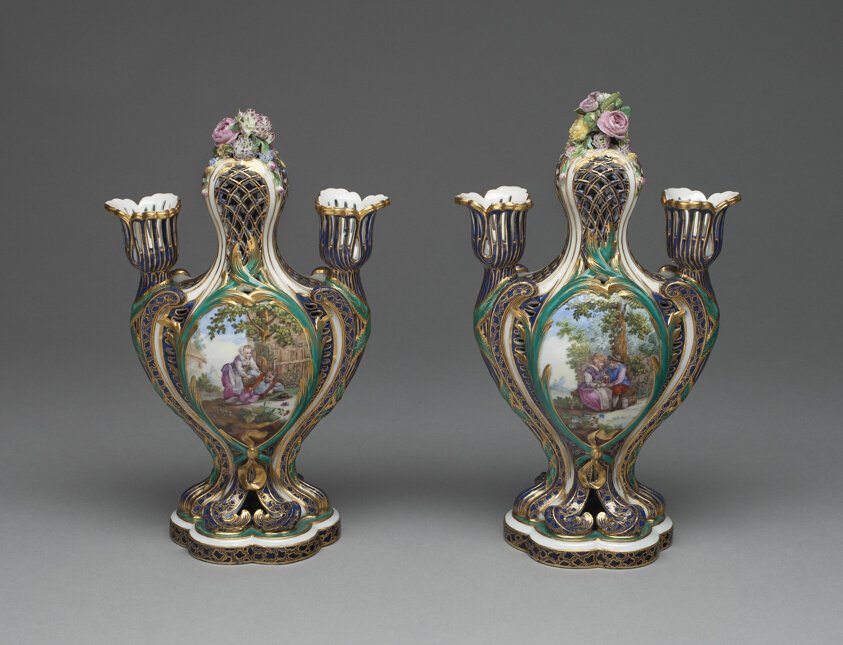
Jean-Claude Duplessis, Pair of Vases (Pots Pourris à Bobèches). The Art Institute of Chicago, Joseph Maier and Arthur Lewis Liebman Memorial: Gift of Kenneth J. Maier, M.D. · Public domain
Candleholder and room freshener
This pair of vases was made at the Sèvres porcelain factory in France around 1759. Soft paste porcelain, polychrome enamels and gilding. The two are close in size: one 24.2 cm high, the other 24.8 cm, both 8.9 cm deep. They belong to the Art Institute of Chicago.
The name says most of it. A pot pourri holds scented dried flowers. A bobèche is the drip pan of a candle socket. Each vase is both a candleholder and a way to scent a room.
According to the Art Institute of Chicago, potpourri or burning pastilles were placed in the foot of each vase. The smell escaped through the intricate piercing along the sides and through a bulb shaped projection between the candleholders. On top of each vase sit porcelain flowers.
And this is the point the museum makes: the rising scent made the porcelain flowers seem alive.
Designer and painter
The shape was designed by Jean Claude Duplessis, a sculptor who lived from about 1695 to 1774 and shaped many of the factory's vase models at Vincennes and then Sèvres over many years. The painting on this pair is attributed to André Vincent Vieillard, who lived from 1717 to 1790 and worked at the factory from 1752 until 1790.
The factory was founded in 1740 at Vincennes and later moved to Sèvres, near Paris. The pair came to Chicago as a gift, in memory of Joseph Maier and Arthur Lewis Liebman, from Kenneth J. Maier. From an eighteenth century French room to an American museum, they have travelled more than two hundred years. The original smell did not come along. In the case today the feet are empty, the candles unlit, and the porcelain flowers are only porcelain again.
The pot pourri à bobèches is a model, not a single work. The Metropolitan Museum of Art in New York holds one of the same type, dated around 1759 to 1760, also linked to Duplessis but painted by other hands. The J. Paul Getty Museum holds a pair with pink and green grounds and scenes after seventeenth century paintings. One shape, a different painted layer on each pair.
What stays constant across versions is the structure: candles above, smell below, porcelain flowers on top, and piercings for the smell to rise.
Light and smell on one object
An eighteenth century room at night needed two things: light and a pleasant smell. Usually these were separate objects. A candle on a stand. A bowl of dried flowers in a corner. The Sèvres pair brings both into one place.
The result is more than convenient. It makes a scene. Candlelight falls on the porcelain flowers and brightens the enamel. At the same moment, smell rises from the foot through the piercings. Someone sitting nearby sees lit flowers and smells flowers. Nothing in the scene is a real flower.
This is design for the senses before there were words for it. Duplessis did not only make a handsome shape. He made a small machine for pleasantly deceiving the viewer. The eye supplies the image, the nose supplies the evidence, and the mind concludes on its own that the flowers are in bloom.
The Pots Pourris à Bobèches are worth remembering because they show scent doing the work of a storyteller. It needs no words. It only has to stand beside an image and let people believe the two belong together. From the same factory and designer, another vase uses painting to guide the nose, see the pot pourri Pompadour.
Olfactory Art