
Essays · Olfactory Art
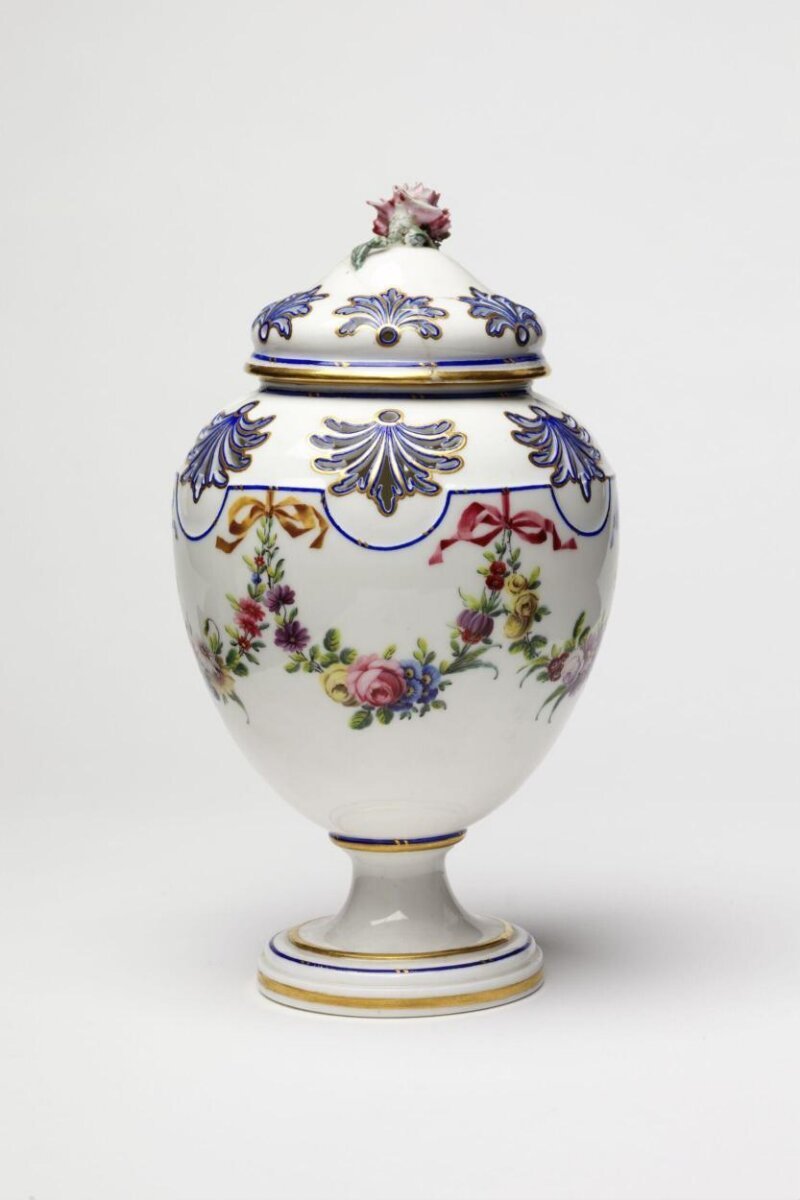
Sèvres, Jean-Claude Duplessis. Pot pourri Pompadour.
The painted garland is a label for a smell.
© Victoria and Albert Museum, London · Victoria and Albert Museum (V&A)
A vase pierced around the neck
The vase is about 8.5 inches high, roughly 21 cm, in two parts: body and cover. It is soft paste porcelain on a white ground, painted in enamels and gilt. It was made at the Sèvres porcelain factory in France in 1765 and is now in the Victoria and Albert Museum, London.
What sets it apart is the neck. Around the shoulder runs a row of pierced holes. The vase is not for flowers or water. It is for potpourri: dried petals, leaves, sometimes added spices, left together so their smell escapes slowly through the openings. The lid has a flower knop.
Around the body hang painted festoons of flowers, tied with ribbon and set among palmettes. According to the V&A, the garlands were a visual clue for those in the room: a smell is spreading, and this is where it comes from.
Two marks in blue enamel sit underneath. One is the interlaced Ls of Sèvres with the date letter M, for 1765. The other is a quaver, the personal mark of the flower painter Antoine Toussaint Cornailles.
One man shaped it, another painted it
The shape was designed by Jean Claude Duplessis, a sculptor who lived from about 1695 to 1774 and served as artistic director of the Vincennes, later Sèvres, factory from about 1745 until his death. He set the form. Others painted on it.
The painter here was Cornailles, who lived from 1735 to 1812 and specialised in flowers. Sèvres divided work by skill: those who shaped, those who painted flowers, those who painted birds, those who gilded. Each had a mark underneath. The quaver was how Cornailles signed.
The model is called the pot pourri Pompadour, after Madame de Pompadour, mistress of Louis XV. According to the V&A, she played a significant role in promoting the factory and its wares. A person's name was given to a shape, and the shape was made again and again.
The V&A vase is not the first version. According to the Wallace Collection catalogue of Sèvres porcelain, the original model appeared in 1752 with ogee framed holes on the shoulder. The V&A piece belongs to a third variant, known from 1764 to 1770, in which those holes became fan shaped, leaf like piercings. The form stayed; the way the smell escaped was redrawn.
Smell as part of the interior
The V&A notes that the vase probably had a pair when first sold, and may have belonged to a garniture, a set of vases for the mantelpiece. Such a set was part of the room, like a mirror or curtains. So was the smell it released: a layer of the interior, invisible but present.
In the eighteenth century, standards of hygiene were very different from today. For those who could afford them, perfume and potpourri mattered enormously. An aristocratic room was arranged not only for the eye. It was arranged for the nose.
This vase does both at once. It holds the source of the smell and paints an image of it. A visitor might never lift the lid. They only needed to smell something pleasant and see the garlands, and the two would connect on their own.
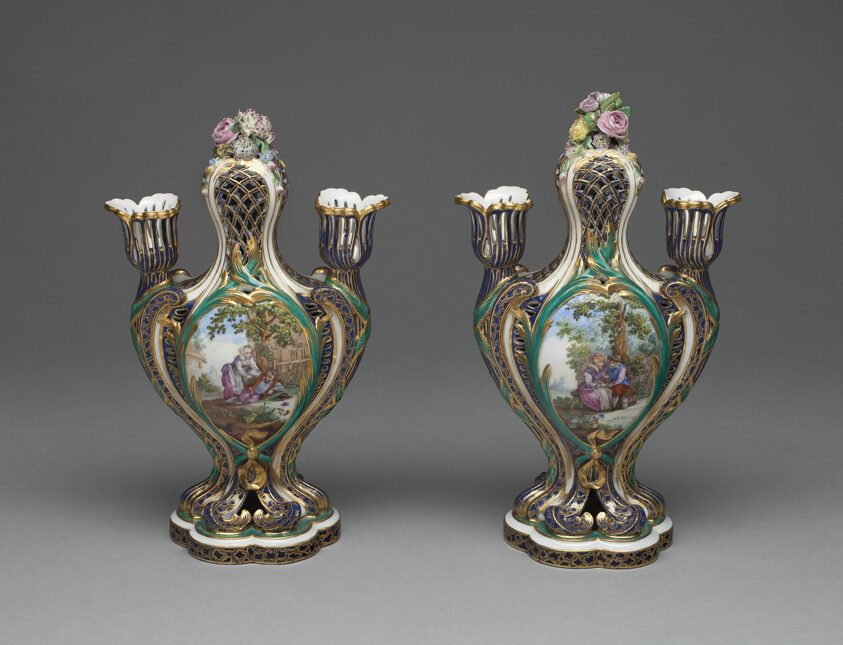
The pot pourri Pompadour is worth remembering because it shows the eighteenth century understood something we rarely say today: a smell needs an introduction. A smell without an image is easily ignored, or credited to the wrong place. Sèvres put the image right on the source. The same designer and factory also made vases that scented a room and held candles, see the Pots Pourris à Bobèches.
Olfactory Art