
Essays · Olfactory Art
Chen Mingyuan. Tripod Incense Burner.
A scent for one desk, not for the whole room.
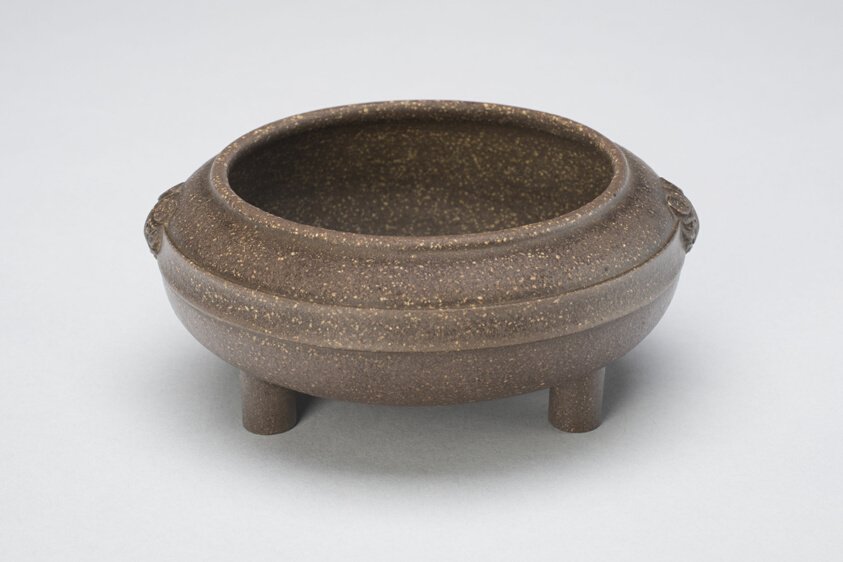
Chen Mingyuan, Tripod Incense Burner. The Art Institute of Chicago, Gift of Mr. Russell Tyson · Public domain
Under five centimetres
The Art Institute of Chicago records it this way: tripod incense burner, China, Qing dynasty, 17th century. The maker is Chen Mingyuan, active about 1650 to 1700. Material: Yixing stoneware. Size: 4.8 cm high, 11 cm in diameter.
Those two numbers say more than they seem to. The width is more than twice the height. This is a low, broad object, steady on three feet, almost flush with the desk. It fits in the palm of a hand.
It came to the museum as a gift from Russell Tyson, who also gave the museum other Chinese ceramics, among them a Song dynasty incense burner in the form of a duck. The record carries no text. No story, no commentary. Only the maker, the material, the size.
For an object like this, the silence of the record is not a gap. It makes the viewer look harder.
Zisha clay and a Yixing potter
Yixing, in Jiangsu province, is known for a clay called zisha, purple sand. Its wares are often left unglazed, so the colour of the object is the colour of fired earth: brown, brick red, deep purple, ochre. Most people know Yixing through its teapots.
Chen Mingyuan is among the most frequently named Yixing potters, active in the later 17th century and into the early 18th, under the Kangxi emperor. He made more than teapots. He was known for small pieces modelled on natural forms, nuts, fruit, branches, and for objects for the scholar's desk. His name was so prized that many later pieces carry his mark without being his.
The Chicago burner belongs to that world of the desk. It is not a temple vessel or a large burner for a hall. It is a private object, for one person, at one familiar seat.
Its three feet recall ancient bronze tripods, ritual vessels of distant dynasties. The potter borrows that solemn form, shrinks it, and turns bronze into clay. A ritual object becomes something to set beside an inkstone.
Scent on the desk
On the desks of Ming and Qing readers, an incense burner was a familiar thing, beside the inkstone, the brushes, the brush pot, a scholar's rock. The incense was not an offering. It kept company with the work. A thin line of smoke beside the page.
A burner this small suits that kind of smoke. It does not travel far. It keeps the scent within arm's reach. The person at the desk can smell it; someone at the door may not.
Penta sees here a way of thinking about scent quite unlike the large burners of crowded places. The scent is not there to announce anything. It is part of the seat, like the light from a window or the tooth of the paper. It marks out a space for work.
Yixing clay adds a further layer. Unglazed and finely porous, it is the reason tea drinkers say a zisha pot holds the taste of tea over time. No record tells us what this burner kept. But the idea sits in the material: an object that can carry traces of its use.
In Japan, at nearly the same time, Nonomura Ninsei made ceramic incense burners with coloured glazes and bright decoration. Side by side, the two directions are clear. One dresses the vessel. The other lets the clay speak.
Chen Mingyuan's burner has no decoration mentioned in its record. Only form, clay, three feet. And an empty space in the middle, waiting to be lit.
Olfactory Art