
Essays · Modern Art
Kazimir Malevich. Dynamic Suprematism.
Màu không cần một vật để đứng trên đó.
Colour does not need an object to stand on.
Tate · Tate
Những hình trôi trên nền trắng
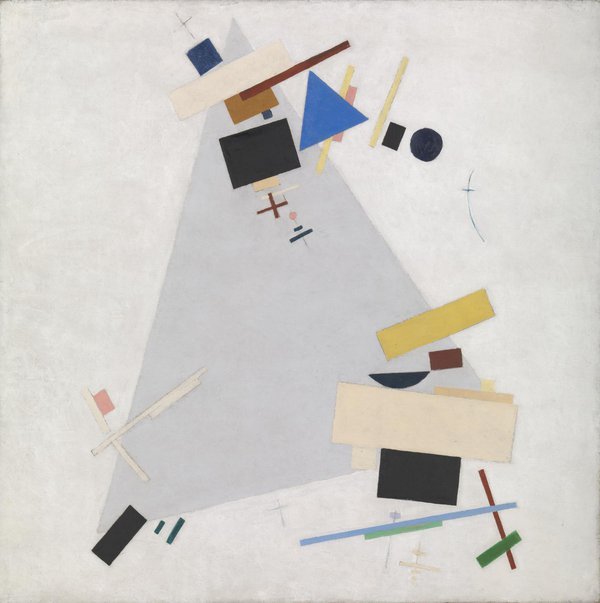
Dynamic Suprematism là một bức sơn dầu gần như vuông, mỗi cạnh khoảng tám mươi phân. Nền màu trắng ngà. Ở giữa là một tam giác lớn màu xanh lam nhạt, hơi nghiêng về phía trái.
Vẽ đè lên tam giác và tụ quanh ba đỉnh của nó là một chuỗi hình học nhiều màu, mỗi hình một góc nghiêng. Nổi bật nhất là một tam giác nhỏ xanh đậm ở phía trên, một hình chữ nhật vàng tươi bên phải tâm tranh, và một hình chữ nhật màu kem lớn hơn ngay bên dưới.
Không có đường chân trời. Không có trên dưới rõ ràng. Các hình không nằm trên mặt đất nào, không bị trọng lực kéo xuống. Tate mô tả chúng như những dạng hình học rõ nét được kích hoạt trong không gian, trên nền trắng. Người xem đứng trước tranh có cảm giác chúng vừa dừng lại một nhịp, và có thể lại tiếp tục bay.
Số 57
Mặt sau tấm toan ghi bằng chữ Latin: Supremus N 57, kèm năm 1916. Tên nghệ sĩ và chữ Moskva viết bằng chữ Kirin. Supremus là cái tên Malevich dùng để đặt cho các tranh Tối thượng của mình, vẽ trong khoảng 1915 đến 1922. Logic của hệ thống đánh số đến nay vẫn chưa rõ.
Có một giả thuyết hấp dẫn. Ở triển lãm 0.10 tại Petrograd, từ ngày 20 tháng 12 năm 1915 đến ngày 19 tháng 1 năm 1916, các tác phẩm số 48 đến 59 của Malevich được xếp chung dưới tên Những khối hội hoạ trong chuyển động. Các số 60 đến 77 thì ngược lại: Những khối hội hoạ hai chiều ở trạng thái nghỉ. Số 57 rơi đúng vào nhóm chuyển động.
Nhưng mặt sau tranh ghi 1916, trong khi triển lãm khai mạc giữa tháng 12 năm 1915. Và bức tranh không xuất hiện trong những tấm ảnh chụp phòng trưng bày còn lại. Vì vậy Tate ghi năm là 1915 hoặc 1916, và để ngỏ câu hỏi nó có từng treo ở 0.10 hay không.
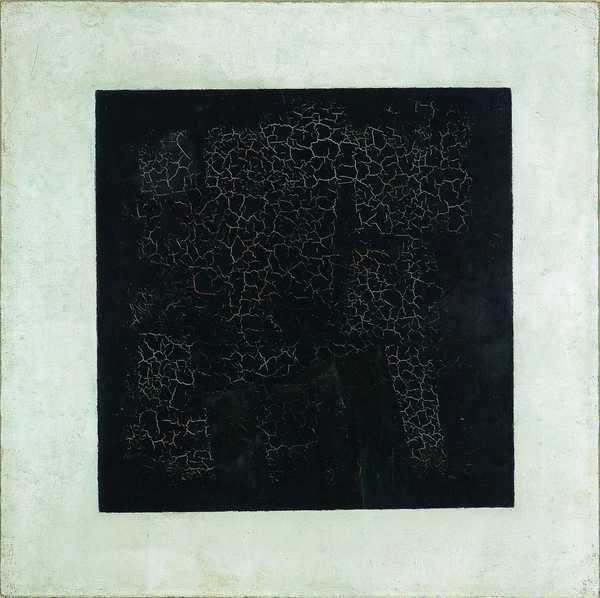
Cũng ở 0.10, Malevich đã treo Black Square ở góc phòng. Nếu hình vuông đen là trạng thái nghỉ tuyệt đối, thì những bức như Supremus 57 là lúc các khối màu bắt đầu rời chỗ.
Vẽ thẳng lên toan
Bức tranh là một lớp sơn đồng đều. Ảnh chụp X quang xác nhận không có lớp nào bên dưới, không có nét vẽ phác. Bố cục dường như đã được tính trọn từ trước, rồi các hình được vẽ thẳng lên vải.
Từng có một bản vẽ chì liên quan, cỡ khoảng ba mươi bốn phân. Năm 1935 nó được cho Museum of Modern Art ở New York mượn dài hạn, rồi đến năm 1938 thì biến mất, đến nay chưa tìm lại. Bản vẽ có ít hình hơn, màu và vị trí hơi khác, nên có thể là bản nghiên cứu trước hoặc một biến thể sau.
Nhà giám tuyển Nicholas Cullinan viết năm 2014 rằng những tác phẩm như thế này mang một dải màu phong phú và tinh tế hơn, đánh dấu bước chuyển từ cái gọi là Tối thượng tĩnh sang những bố cục sống động, phức tạp hơn của Tối thượng động. Tên bức tranh nói đúng điều ấy.
Trong một văn bản năm 1919, Malevich giải thích rằng cần tạo ra những khung mới của màu thuần tuý, dựa trên điều màu tự đòi hỏi. Màu phải thoát khỏi việc tô cho một vật, để tự đứng thành một cấu trúc.
Hành trình của một bức tranh
Bức tranh từng được trưng tại triển lãm Jack of Diamonds ở Moscow tháng 11 năm 1916. Nhà nước Xô viết mua nó, và năm 1929 nó vào State Tretyakov Gallery. Năm 1932 đến 1933 nó xuất hiện trong triển lãm lớn Các nghệ sĩ nước Nga Xô viết qua 15 năm ở Leningrad, với cái tên Bố cục màu động. Dấu của triển lãm ấy vẫn còn trên khung căng.
Nó nằm ở Tretyakov hơn bốn mươi năm. Tháng 12 năm 1975, bức tranh được phép rời Liên Xô và về tay công ty Comvalor Finanz AG. Tate mua nó năm 1978, với sự hỗ trợ của hội Friends of the Tate Gallery.
Malevich học tại Trường Hội hoạ, Điêu khắc và Kiến trúc Moscow từ 1904 đến 1910. Tranh đầu tay của ông là chân dung và phong cảnh. Sau giai đoạn Tối thượng, ông làm những mô hình kiến trúc gọi là architecton, rồi cuối những năm 1920 quay lại vẽ hình tượng, nhất là đời sống nông thôn.
Dynamic Suprematism thuộc về một khoảnh khắc ngắn giữa hai thời kỳ ấy, khi màu được thả ra khỏi mọi vật và được phép chuyển động một mình.
Forms drifting on white
Dynamic Suprematism is an oil painting on a nearly square canvas, about eighty centimetres a side. The ground is off white. At the centre is a large pale blue triangle, tilted slightly to the left.
Painted over the triangle and gathered around its three points is a sequence of geometric forms in many colours, each at its own angle. Most prominent are a small deep blue triangle near the top, a bright yellow rectangle right of centre, and a larger cream rectangle just below it.
There is no horizon. No clear up or down. The forms rest on no ground and are not pulled by gravity. Tate describes them as clear geometric forms activated in space against white. Standing in front of the painting, you sense they have paused for a beat and might move on.
Number 57
The back of the canvas reads in Latin script: Supremus N 57, with the year 1916. The artist's name and the word Moskva are in Cyrillic. Supremus was the title Malevich gave his Suprematist paintings, made between 1915 and 1922. The logic of the numbering is still unclear.
There is an attractive theory. At the 0.10 exhibition in Petrograd, from 20 December 1915 to 19 January 1916, Malevich's works numbered 48 to 59 were grouped under the title Painterly Masses in Movement. Numbers 60 to 77 were the opposite: Painterly Masses in Two Dimensions in a State of Rest. Number 57 falls in the moving group.
But the back of the painting says 1916, while the show opened in mid December 1915. And the painting does not appear in surviving installation photographs. So Tate dates it 1915 or 1916 and leaves open whether it hung at 0.10 at all.
It was at 0.10 that Malevich hung Black Square in the corner. If the black square is absolute rest, works like Supremus 57 are the moment the masses of colour begin to leave their places.
Painted straight onto canvas
The painting is one even layer of paint. X rays confirm there is nothing underneath and no underdrawing. The composition seems to have been fully worked out beforehand, then the forms drawn directly onto the cloth.
A related pencil drawing, about thirty four centimetres across, once existed. In 1935 it went on extended loan to the Museum of Modern Art in New York, and by 1938 it had disappeared. It has not been traced. It had fewer shapes and slightly different colours and placings, so it may have been a study or a later variant.
The curator Nicholas Cullinan wrote in 2014 that works like this brought a richer and subtler range of colour, marking a shift from so called static Suprematism to the livelier, more intricate compositions of dynamic Suprematism. The title says exactly that.
In a 1919 text Malevich explained that new frameworks of pure colour had to be created, based on what colour itself demanded. Colour had to stop serving an object and stand as a structure of its own.
The journey of a painting
The painting was shown at the Jack of Diamonds exhibition in Moscow in November 1916. The Soviet state bought it, and in 1929 it entered the State Tretyakov Gallery. In 1932 to 1933 it appeared in the large exhibition Artists of the RSFSR over 15 Years in Leningrad, under the title Dynamic Colour Composition. That exhibition's stamp is still on the stretcher.
It stayed at the Tretyakov for more than forty years. In December 1975 it was granted permission to leave the Soviet Union and passed to the company Comvalor Finanz AG. Tate bought it in 1978 with help from the Friends of the Tate Gallery.
Malevich studied at the Moscow School of Painting, Sculpture and Architecture from 1904 to 1910. His early works were portraits and landscapes. After Suprematism he made architectural models he called architectons, and in the late 1920s returned to figurative painting, above all rural life.
Dynamic Suprematism belongs to a short moment between those periods, when colour was released from every object and allowed to move on its own.
Modern Art