
Essays · Olfactory Art
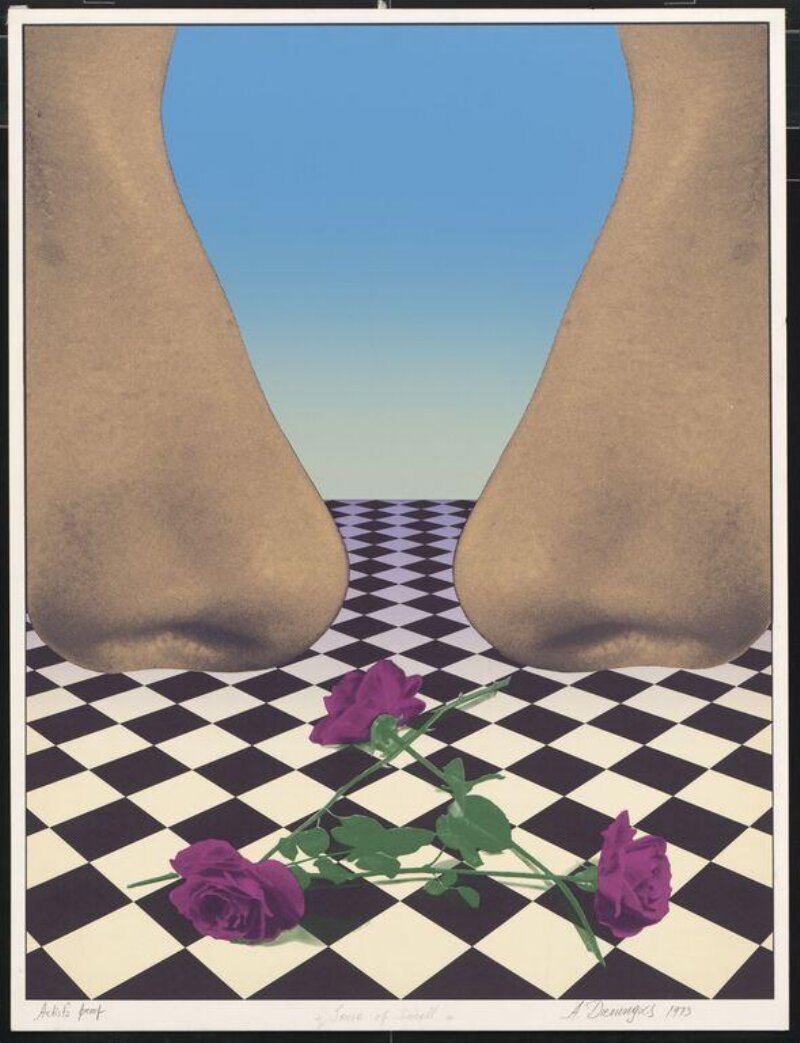
Achilles Droungas. A Sense of Smell.
To rename a picture is to move where the viewer stands.
© Victoria and Albert Museum, London · Victoria and Albert Museum (V&A)
Two nostrils and three roses
Above, two huge skin coloured forms fill most of the sheet. Look again and they are nostrils, seen from below, openings facing down. Between them lies a strip of blue sky, paling towards the horizon.
Below is a black and white chequered floor, receding in strict perspective. On it lie three purple roses with green stems and leaves, crossed as if someone had just dropped them.
No face. No room. Only nose, flowers, floor and sky. Four things are enough to build a scene.
It is a colour screenprint made in 1973, probably in London. The impression in the Victoria and Albert Museum is an artist's proof, signed and dated. In pencil along the lower edge: Artist's proof at left, the title in the middle, A. Droungas 1973 at right.
A Greek printmaker in London
Achilles Droungas was born in 1940 in Piraeus, the port of Athens. He studied printmaking at the Athens School of Fine Arts from 1958 to 1965 under Kostas Grammatopoulos. In 1970 a Greek state scholarship took him to the Slade School of Fine Art in London, where he stayed until 1973, the year of this print.
From the late 1960s to the mid 1970s he showed in many major international print exhibitions, and his prints were published in London, New York and Athens. Tate holds another of his 1973 screenprints, City under Siege.
Later he became better known as a painter. The National Gallery of Greece has held a retrospective of his work. His painting is usually placed between critical realism and hyperrealism, with a familiar device: trompe l'oeil, making the painted thing look like the real one.
A Sense of Smell already carries that mark. The nostrils are printed with photographic detail, pores, shadow, highlight. Yet they hang in the sky, larger than the horizon. Real in each detail, absurd as a whole.
When a title changes the picture
The V&A record notes a small fact: shortly after publication the artist changed the title. It was first Three Purple Roses. It became A Sense of Smell.
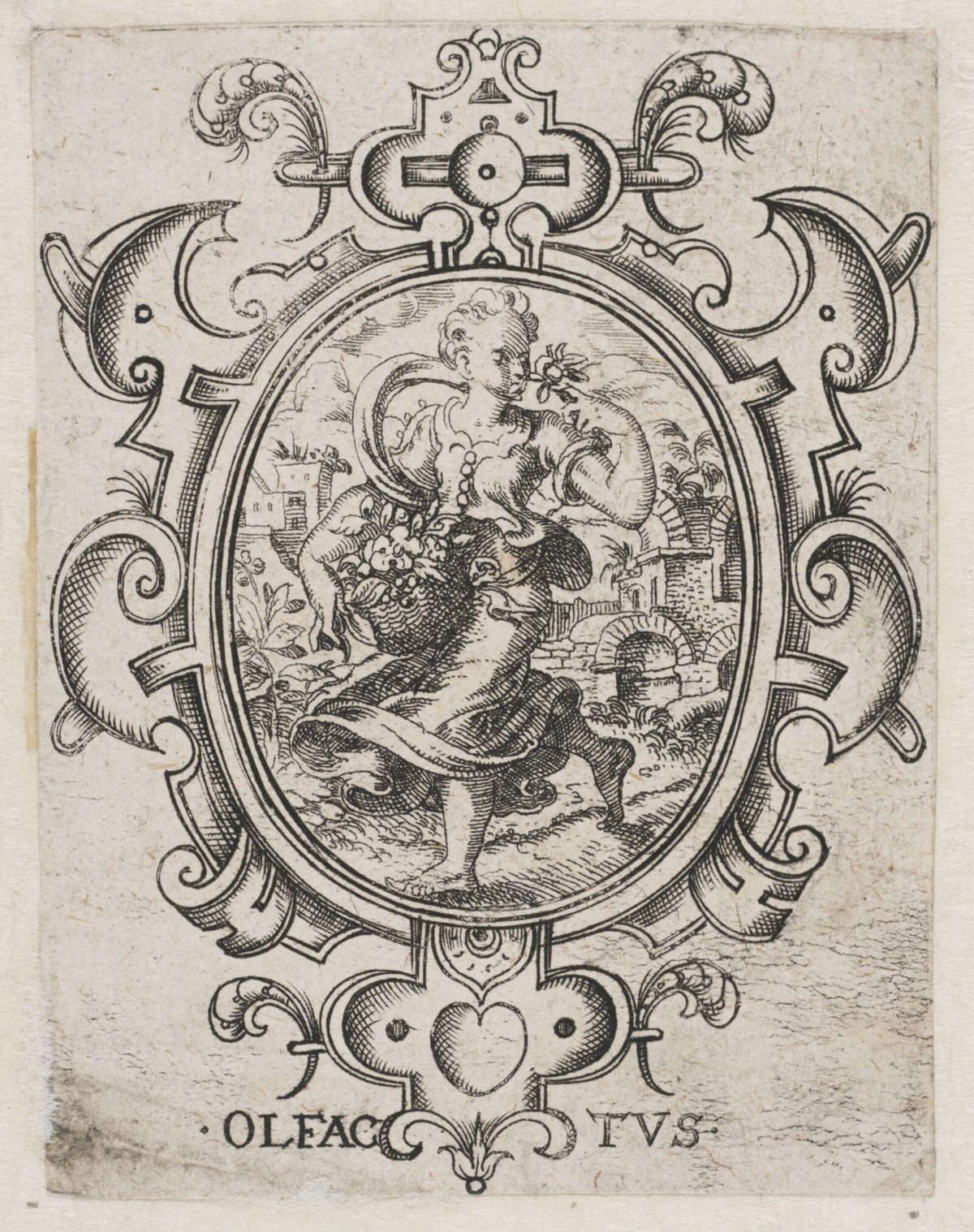
Not a line on the print changed. But the new title pulls the image into a long tradition. Since the sixteenth and seventeenth centuries European artists had depicted the five senses one by one, and smell was usually a figure raising a flower to the nose, as in Abraham Bosse's Paris etching.
Droungas keeps the two oldest elements of that subject, the flower and the nose, and removes the person. No one holds the flower. No garden, no costume, no caption in verse. Only the organ and the thing smelled, on an empty stage.
The chequered floor helps make that stage. It is familiar from surrealist painting, an ideal plane running to infinity where every object turns strange. Placed on it, the roses become specimens. Placed in the sky, the nostrils turn smell into something vast, enveloping, almost like weather.
Smell is the hardest sense to paint. No one sees a scent. Older painters solved it with symbols. Droungas solves it with scale: the nose grows until it cannot be ignored.
Olfactory Art